
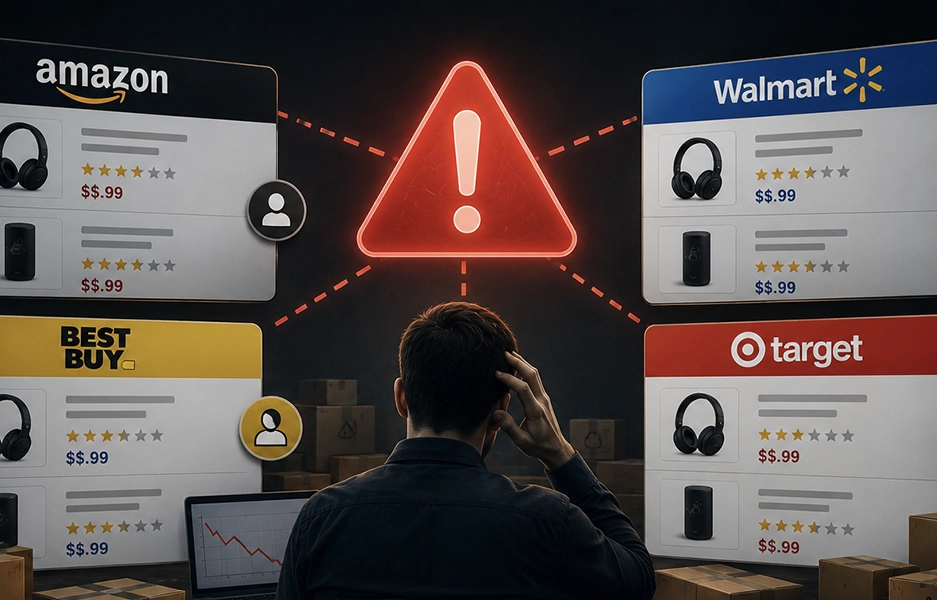
Third-party marketplaces like Amazon, Walmart, eBay, and others offer enormous opportunity.
Table of Contents
- Loss of Pricing Control
- Buy Box Instability and Suppression
- Unauthorized Sellers and Grey Market Expansion
- Damage to Brand Perception
- Cross-Channel Price Conflicts
- Reduced Data Control and Platform Dependency
- Increased Legal and Enforcement Risk
- Margin Compression and Advertising Inefficiency
- Long-Term Brand Dilution
- The Core Issue: Access Without Governance
- Final Thought
They provide built-in traffic. They offer global reach. They remove the need to build infrastructure from scratch. For many brands, they are a primary growth engine.
But with that opportunity comes risk — and not just operational risk. Structural risk.
When brands rely on third-party marketplaces without a governance strategy, they often experience price erosion, Buy Box instability, unauthorized sellers, and long-term brand dilution.
Here are the real risks brands must understand before scaling aggressively on third-party platforms.
1. Loss of Pricing Control
Third-party marketplaces are algorithm-driven.
The lowest competitive offer typically wins the Buy Box (or Featured Offer). That means sellers are incentivized to undercut each other — even by pennies.
If your brand allows multiple sellers on a listing, or if unauthorized sellers appear, pricing can quickly spiral downward.
Common triggers include:
- Automated repricing tools
- Sellers racing to win Buy Box share
- Inventory liquidation
- Grey market diversion
- Cross-marketplace price matching
Once one seller drops below MAP (Minimum Advertised Price), others often follow. Over time, MSRP loses relevance, and customers anchor to a lower perceived value.
Price erosion on marketplaces spreads faster than in traditional retail because algorithms react instantly.
Without structured monitoring and enforcement, brands often lose pricing integrity before they even realize it.
2. Buy Box Instability and Suppression
On platforms like Amazon and Walmart, visibility equals revenue.
Nearly all conversions flow through the Buy Box or Featured Offer. If your brand does not control that placement, you do not control the customer relationship.
Third-party marketplaces introduce Buy Box risk in several ways:
- Competing sellers undercut pricing
- Unauthorized sellers win rotation
- External price mismatches trigger suppression
- Inventory fluctuations impact eligibility
In some cases, the platform removes the Buy Box entirely — displaying “See All Buying Options” instead.
This can happen even when:
- You have inventory in stock
- Your pricing aligns with MAP
- Your seller metrics are strong
Why? Because third-party platforms enforce price parity across reputable retailers. If your product appears cheaper elsewhere, suppression may occur.
Revenue becomes frozen in inventory that customers cannot easily purchase.
Most brands respond by lowering prices — instead of identifying the root cause.
3. Unauthorized Sellers and Grey Market Expansion
Third-party marketplaces make it easy for anyone to list a product.
All it takes is:
- A seller account
- Inventory
- A matching ASIN
That accessibility is part of what makes marketplaces powerful — but it also makes them vulnerable.
Unauthorized sellers frequently acquire inventory through:
- Distributors
- Wholesalers
- Liquidation channels
- Grey market diversion
- Arbitrage
Once they appear on your listing, they can:
- Undercut pricing
- Win the Buy Box
- Divert revenue
- Disrupt authorized partners
And because they’re often selling authentic product, enforcement becomes more complex than simply filing a counterfeit complaint.
The longer unauthorized sellers operate, the more normalized marketplace instability becomes.
4. Damage to Brand Perception
Customers do not understand third-party mechanics.
If they receive:
- Used products sold as new
- Incorrect variations
- Expired goods
- Damaged packaging
- Poor fulfillment
They blame the brand — not the seller.
Negative reviews accumulate under your product listing.
Over time, this affects:
- Conversion rates
- Organic search ranking
- Advertising efficiency
- Long-term brand trust
Even if your brand operates a clean, compliant seller account, the customer experience can be compromised by other sellers sharing your listing.
On third-party marketplaces, your reputation is partially in the hands of strangers.
5. Cross-Channel Price Conflicts
Most major marketplaces monitor external pricing.
If your product is advertised at a lower price on another reputable platform — even if caused by a distributor or grey market seller — the primary marketplace may react.
This can lead to:
- Buy Box suppression
- Price threshold adjustments
- Reduced visibility
The issue may not even originate on the platform where you’re experiencing the problem.
Marketplace algorithms are interconnected with broader pricing ecosystems.
Without cross-platform monitoring, brands often fix symptoms rather than causes.
6. Reduced Data Control and Platform Dependency
When selling through third-party marketplaces, you don’t fully own the customer relationship.
You rely on:
- Platform algorithms
- Platform policies
- Platform enforcement timelines
Marketplace rules can change with little notice.
Account suspensions can happen quickly.
Appeals processes can be slow and opaque.
This creates operational vulnerability.
Brands that depend heavily on marketplace revenue must prepare for the reality that they do not control the infrastructure.
Diversification and governance strategies become essential.
7. Increased Legal and Enforcement Risk
Third-party marketplaces require careful enforcement strategy.
Filing complaints without proof — such as false trademark or counterfeit claims — can expose brands to:
- Legal disputes
- Counterclaims
- Account health damage
Grey market enforcement requires precision:
- Test buys
- Serial or lot number tracing
- Graduated outreach
- Proper documentation
We are not attorneys, and brands should always consult qualified legal counsel before pursuing aggressive enforcement.
On third-party marketplaces, enforcement mistakes can escalate quickly.
8. Margin Compression and Advertising Inefficiency
When multiple sellers compete on the same listing, advertising dollars can benefit competitors.
For example:
- Your PPC ads drive traffic
- An unauthorized seller wins the Buy Box
- They capture the conversion
You effectively subsidize their sales.
Additionally, price competition reduces margin, making advertising less profitable.
The more fragmented your seller landscape, the harder it becomes to maintain predictable profitability.
9. Long-Term Brand Dilution
Perhaps the biggest risk is gradual brand dilution.
Third-party marketplaces reward price competitiveness and fulfillment speed — not brand positioning.
Without careful governance, your brand can shift from premium to commodity.
This happens when:
- Pricing becomes inconsistent
- Sellers compete aggressively
- Packaging and messaging vary
- Customer experiences become unpredictable
Brand equity is built over years — and can erode quietly through uncontrolled marketplace activity.
The Core Issue: Access Without Governance
Third-party marketplaces are not inherently dangerous.
They are powerful.
But power without structure creates instability.
To operate safely, brands must implement:
- MAP monitoring
- Seller monitoring
- Buy Box diagnostics
- Unauthorized seller removal
- Distribution oversight
- Graduated enforcement strategies
Marketplaces reward speed and automation. Brands must respond with intelligence and structure.
Final Thought
Third-party marketplaces can scale your brand faster than any traditional channel.
But scale without control leads to:
- Price erosion
- Buy Box loss
- Channel conflict
- Reputation damage
- Margin compression
The question is not whether to sell on marketplaces.
The question is whether you are prepared to govern them.
If your brand is experiencing pricing instability, Buy Box volatility, or unauthorized seller activity, our team can help you identify where risk is emerging and how to regain control.
You can connect with us here.
Growth on third-party marketplaces isn’t just about selling more.
It’s about protecting what you’ve built while you scale.
Thank you for reading our post, ‘The Risks of Third-Party Marketplaces — What Brands Need to Know.’ We hope you found it helpful.
Take control of your marketplace presence with fast, effective brand protection strategies.
Every day, unauthorized sellers and MAP violations can erode your pricing, reputation, and revenue. Don’t wait for problems to escalate, start enforcing your policies and reclaim your market authority with our proven tools and expert support.


 Brand Alignment