

Distributors are often essential to scaling a brand. They expand geographic reach, support retail placement, and accelerate revenue growth. On paper, the model makes sense: you move product in volume, they move it into the market.
Table of Contents
- Loss of Control Once Inventory Leaves Your Hands
- Unauthorized Sellers on Amazon and Walmart
- MAP Violations and Price Erosion
- Buy Box Instability and Suppression
- Parallel Imports and International Diversion
- Liquidation and Secondary Market Leakage
- Channel Conflict and Retailer Frustration
- Internal Incentive Misalignment
- Legal and Enforcement Risk
- The Core Risk: Wholesale Without Governance
- Final Thought
But what often gets overlooked is this: wholesalers can also become the primary source of pricing erosion, unauthorized marketplace sellers, and Buy Box instability.
Without tight oversight and structured agreements, selling through wholesalers can quietly undermine your brand’s long-term value.
Here are the key risks brands should understand before relying heavily on wholesale channels.
1. Loss of Control Once Inventory Leaves Your Hands
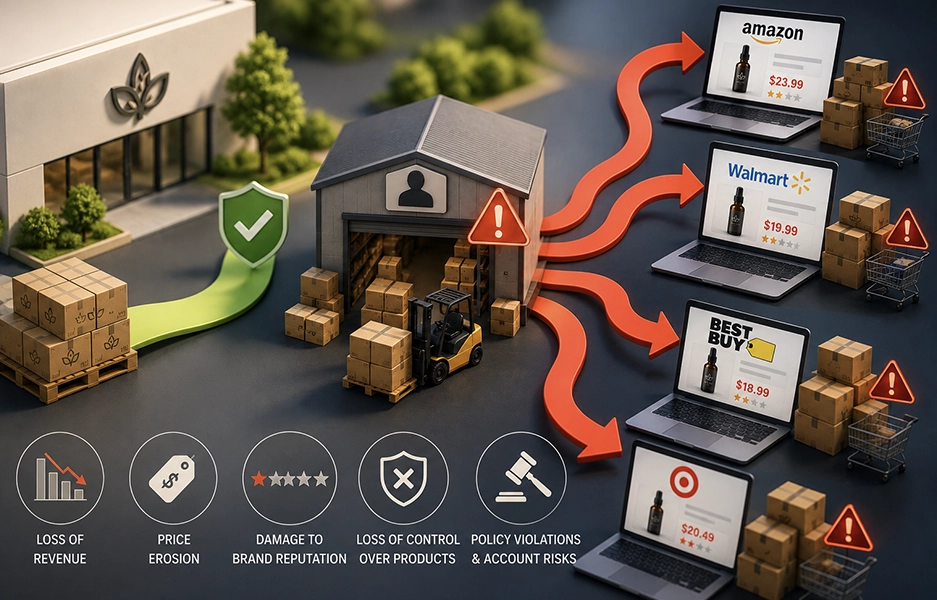
When you sell direct-to-consumer, you control the pricing, presentation, and customer experience. When you sell through wholesalers, control shifts the moment the inventory ships.
Wholesalers may resell to smaller retailers, sell to sub-distributors, divert inventory to online resellers, export product to other territories, or liquidate excess stock. The issue isn’t always bad intent. It’s structural.
Wholesalers are designed to move product. Once they’ve purchased inventory, their incentive is margin and velocity — not necessarily brand governance. If your agreements don’t strictly define resale permissions and marketplace restrictions, your product can quickly surface in places you never intended.
2. Unauthorized Sellers on Amazon and Walmart
One of the most common downstream effects of wholesale distribution is unauthorized marketplace sellers. Here’s how it typically happens: a wholesaler sells inventory to a smaller reseller, who lists the product on Amazon and prices below MAP to win the Buy Box. Other sellers react and drop pricing. Now your listing has multiple sellers, pricing instability, and declining Buy Box control.
In more complex scenarios, large wholesale distributors operate with multiple LLCs or affiliated accounts — appearing as separate sellers while remaining part of the same supply chain. If you can’t easily trace the source of diversion, enforcement becomes reactive and fragmented.
Marketplace instability often begins upstream — in wholesale channels.
3. MAP Violations and Price Erosion
Wholesalers frequently sell in bulk at aggressive pricing. If downstream buyers ignore your Minimum Advertised Price (MAP) policy, price erosion can spread quickly.
Common triggers include automated repricing tools, overstock clearance, end-of-quarter discounting, and competing wholesale accounts undercutting each other. Once one seller drops below MAP, others follow — creating a cascading effect where MAP loses credibility, MSRP becomes meaningless, and customers anchor to a lower perceived value.
Without structured MAP monitoring and graduated enforcement, wholesale-driven violations can permanently reset your pricing floor.
4. Buy Box Instability and Suppression
On Amazon, pricing and seller behavior directly affect Buy Box eligibility. If wholesale-supplied sellers undercut pricing, your authorized seller may lose the Buy Box, your brand-owned account may become ineligible, or Amazon may suppress the Buy Box entirely.
Buy Box suppression is particularly damaging. Even if you have inventory in stock, customers may only see “See All Buying Options” instead of “Add to Cart.” Revenue becomes frozen in inventory that customers cannot easily purchase.
Many brands mistakenly lower prices in response — without addressing the root cause: uncontrolled wholesale distribution.
5. Parallel Imports and International Diversion
Large wholesalers sometimes take advantage of regional pricing differences. If your product is priced lower in one country due to currency, duties, or regional strategy, wholesalers may export it into higher-priced markets.
These parallel imports often surface on Amazon or other marketplaces, creating territory disputes, distributor conflict, price confusion, and increased enforcement complexity. Your domestic retail partners may question why international sellers are offering lower prices.
Without clear territorial clauses and penalties in distribution agreements, stopping parallel imports becomes extremely difficult.
6. Liquidation and Secondary Market Leakage
Wholesalers often handle aging inventory. If stock doesn’t move, it may be sold to liquidation buyers, auctioned in bulk lots, sold as A-stock or B-stock, or released into secondary markets. Once inventory enters liquidation channels, it often finds its way to Amazon through arbitrage sellers who price aggressively below MAP because their acquisition cost was heavily discounted.
Consequences include used products sold as new, increased negative reviews, Buy Box displacement, and ongoing enforcement headaches. By the time the brand detects the issue, inventory may already be widely dispersed. Prevention at the wholesale level is far more effective than chasing violations later.
7. Channel Conflict and Retailer Frustration
If wholesalers allow inventory to surface online at lower prices, your brick-and-mortar partners will notice quickly. Retailers may reduce purchase orders, demand price matching, issue chargebacks, or lose trust in your pricing stability.
Why would a retail partner promote your product if consumers can buy it cheaper online? Wholesale instability often creates cross-channel tension that damages long-term growth.
8. Internal Incentive Misalignment
Wholesale orders are often large and attractive from a revenue standpoint. But volume alone doesn’t equal healthy distribution.
Red flags to watch for include unusually large purchase orders, orders focused only on top Amazon-selling SKUs, requests to ship to third-party logistics warehouses, and sudden spikes in volume without corresponding retail expansion.
Sales teams are often incentivized on revenue — not channel compliance. Without executive oversight and structured vetting, short-term wholesale wins can lead to long-term marketplace disruption.
9. Legal and Enforcement Risk
Enforcement must be strategic and careful. Aggressive accusations without proof — such as false trademark or counterfeit claims — can expose brands to legal risk.
Best practices include:
- Graduated enforcement strategies (friendly outreach → formal notice → escalation)
- Test buys to confirm product sourcing
- Serial or lot number tracking where possible
- Consulting qualified legal counsel before pursuing legal action
We are not attorneys, and brands should always consult legal counsel when drafting distribution agreements or enforcing violations. Poorly executed enforcement can create additional liability.
The Core Risk: Wholesale Without Governance
Wholesalers are not inherently problematic. Unstructured wholesale distribution is.
Without clear online resale restrictions, defined territories, MAP policies, ongoing marketplace monitoring, seller intelligence, and graduated enforcement systems — even reputable wholesalers can unintentionally destabilize your marketplace presence.
In today’s environment, wholesale strategy must include marketplace governance. Because once inventory spreads into open distribution, control becomes exponentially harder to regain.
Final Thought
Wholesale can scale your revenue. But scale without visibility and enforcement can erode margins, destabilize the Buy Box, and dilute your brand.
If your brand is experiencing unexpected marketplace sellers, frequent MAP violations, declining Buy Box ownership, channel complaints, or price instability — the root cause may not be the marketplace. It may be your wholesale structure.
If you’d like to better understand how wholesale distribution is affecting your pricing and Buy Box performance, our team can walk you through it. Connect with us at our contact page.
Wholesale should expand your brand — not weaken your control.
Thank you for reading our post, ‘The Risks of Selling Through Wholesalers — What Brands Often Overlook.’ We hope you found it helpful.
Take control of your marketplace presence with fast, effective brand protection strategies.
Every day, unauthorized sellers and MAP violations can erode your pricing, reputation, and revenue. Don’t wait for problems to escalate, start enforcing your policies and reclaim your market authority with our proven tools and expert support.


 Luis Amor