
One of the most frequent—and frustrating—questions brand owners ask is:
“Why does Amazon let hijackers steal my listing?”
Whether it’s unauthorized sellers, counterfeiters, or “listing hijackers” offering your branded product (or cheap imitations) on your ASIN, it can feel like Amazon is failing to protect your business. But the real answer is more complex, rooted in marketplace policies and legal realities.
Here’s what every brand needs to know.
What Is an Amazon Listing Hijacker?
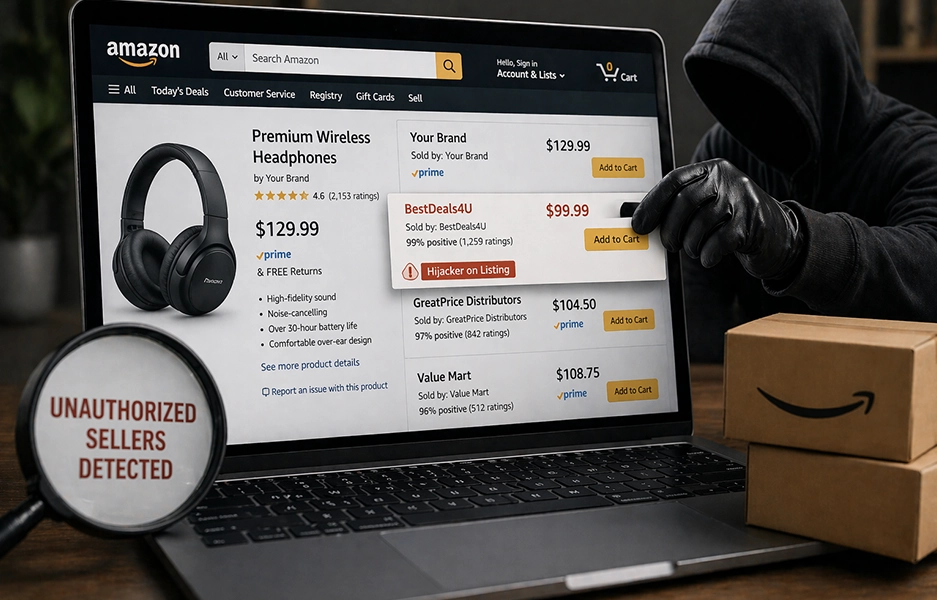
A “listing hijacker” is any seller who lists themselves on your branded product’s ASIN—often without authorization.
Hijackers might:
- Sell diverted or gray market goods
- Offer counterfeit, used, or non-genuine items as new
- Undercut your price, winning the Buy Box
- Use your brand name, images, and reviews to mislead shoppers
This creates confusion for customers, damages your brand, and diverts your sales. If you want the broader playbook, see how to deal with an Amazon hijacker.
Why Does Amazon Allow This to Happen?
1. The Open Marketplace Model
Amazon’s marketplace is designed as an “open” platform.
If someone legally acquires your product—regardless of source—Amazon generally allows them to resell it, thanks to the First Sale Doctrine. Amazon does not require resellers to prove they’re authorized unless you’re in a special program (like Brand Gating or Brand Registry), or unless there’s clear evidence of counterfeiting or infringement.
2. Scale and Automation
With millions of ASINs and global sellers, Amazon relies heavily on automated systems—not manual review. Listings are matched by product identifiers (UPC, EAN, ASIN). Any seller with the “same” product can add their offer to your listing by default, unless restrictions are in place.
3. Proof Burden Is on the Brand
Amazon generally does not take action against a seller just because they’re not “authorized.” Brands must prove a policy violation—such as selling counterfeits, violating trademarks, or infringing copyrights—to have a hijacker removed. Otherwise, Amazon assumes all sellers are offering legitimate, real products. This is closely related to why Amazon often does not remove unauthorized sellers automatically.
4. Counterfeit and Infringement Require Evidence
When you report a hijacker for counterfeit or IP infringement, Amazon may require:
- A test buy to verify the product is not genuine
- Clear documentation of trademark/copyright ownership
- Proof that the listing violates Amazon’s policies
If a hijacker sells authentic goods (even if acquired through the gray market), Amazon may not remove them unless you have a clear distribution agreement violation and can demonstrate harm. In many cases, the real issue is that hijackers are selling authentic product, which makes enforcement harder.
The Role of Brand Gating: What It Is and Its Levels
Brand gating is Amazon’s system for restricting which sellers can list certain branded products. However, brand gating is not universal, and the level of protection varies widely by brand and product.
Here are the main levels of brand gating on Amazon:
1. Open Listing (No Brand Gating):
Anyone with an Amazon seller account can add their offer to your listing. This is the default for most brands.
2. Account Health-Based Gating:
Amazon may require that sellers meet a minimum account health score or performance standard before being allowed to list certain brands.
3. Invoice-Based Gating:
For some brands, sellers must submit recent invoices proving legitimate purchase of inventory—often requiring invoices from authorized distributors. This provides a moderate barrier, but determined hijackers can sometimes find workarounds.
4. Full Brand Approval (Highest Level):
Only sellers that the brand has explicitly approved can list the product. This highest level of gating is rare and typically reserved for major global brands or those who have worked closely with Amazon’s brand protection teams. In this scenario, hijackers can’t list your product without your written approval.
For most brands, achieving the highest level of gating requires close cooperation with Amazon, strong evidence of repeated abuse, and participation in advanced brand protection programs. For the majority, some form of open or moderate gating is the norm, leaving the door open for hijackers and unauthorized sellers. Tools like Amazon Brand Registry can help, but they are not a complete shield.
Why Is This a Problem for Brands?
- Loss of Buy Box: Hijackers usually compete by offering a lower price, stealing the Buy Box and sales.
- Customer Confusion: Shoppers can’t distinguish between you and hijackers—bad experiences reflect on your brand.
- Brand Reputation Damage: Counterfeit or low-quality products erode customer trust and lead to poor reviews.
- Channel Conflict: Authorized partners lose out, and pricing policy enforcement collapses.
- Revenue Loss: Sales are diverted, and your official channels suffer.
It also matters whether the issue is actual counterfeit or something else. In many situations, the seller is an Amazon hijacker, not necessarily a counterfeiter.
What Can Brands Do About Listing Hijackers?
1. Enroll in Amazon Brand Registry
Brand Registry provides tools for reporting IP infringement, easier counterfeit reporting, and sometimes proactive protections.
2. Monitor Your Listings
Use monitoring software to detect unauthorized sellers the moment they appear—across Amazon and other platforms.
3. Take Action Fast
- Cease & Desist Letters: Notify hijackers of your rights and request immediate removal through cease and desist messaging.
- Test Buys: Purchase the hijacker’s product to gather proof (for counterfeit or quality violations) using Amazon test buys.
- Report to Amazon: Use Brand Registry’s reporting tools or Seller Support. Provide evidence for faster resolution.
4. Close Distribution Gaps
Audit your partners and limit access to your products. Use serialization and track-and-trace systems where possible.
5. Leverage Brand Gating or Legal Enforcement
For higher-value brands, “brand gating” (limiting who can sell) or legal actions may be possible, but usually require Amazon’s involvement and strong evidence. In some cases, this also overlaps with choosing the right type of Amazon complaint when reporting abuse.
Final Thoughts
Amazon’s marketplace model prioritizes open competition and consumer choice—but that comes at a cost for brands. Without robust monitoring, enforcement, and channel controls, hijackers can (and do) profit at your expense.
The key is a proactive, evidence-based strategy:
Monitor your listings, secure your distribution, and take action at the first sign of hijacking. Many brands also reinforce this with Amazon MAP enforcement.
Want to see how Brand Alignment helps brands remove hijackers and protect Amazon listings?
Connect with our team here. We’ll guide you through the process step by step.
Take control of your marketplace presence with fast, effective brand protection strategies.
Every day, unauthorized sellers and MAP violations can erode your pricing, reputation, and revenue. Don’t wait for problems to escalate, start enforcing your policies and reclaim your market authority with our proven tools and expert support.


 Brand Alignment