
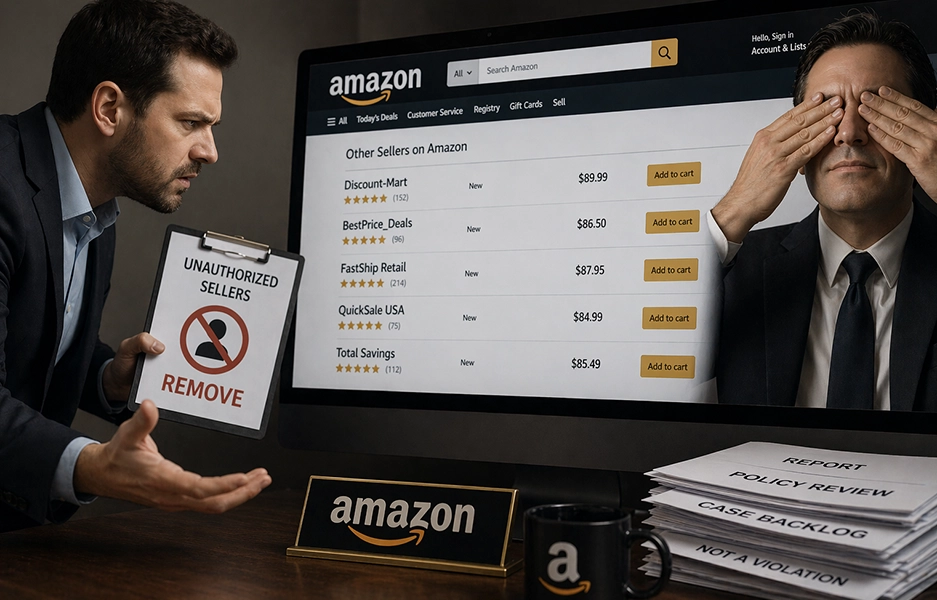
For many brands, unauthorized sellers on Amazon create confusion, erode pricing, and damage reputation. It’s natural to ask: “Why won’t Amazon just remove them?” The answer is tied to how Amazon’s marketplace works, and what brands need to do to protect themselves.
Why Amazon Doesn’t Automatically Remove Unauthorized Sellers
1. Amazon’s Marketplace Philosophy: Open Platform
Amazon operates as an open marketplace. That means anyone who acquires your product, through distribution, retail, or even liquidation, can list and sell it on Amazon, unless they’re breaking specific Amazon rules.
Amazon believes in maximizing consumer choice and price competition, which benefits shoppers but makes unauthorized seller enforcement more difficult for brands. This is one reason many brands have to think carefully about whether they should sell on Amazon at all.
2. The First Sale Doctrine (U.S. Law)
U.S. law gives individuals and businesses the right to resell genuine, lawfully purchased products, even without the brand’s approval. Unless a seller is offering counterfeit goods or violating intellectual property, Amazon typically will not intervene. This legal standard makes it difficult to get Amazon to remove sellers just because they’re “unauthorized.”
3. Amazon Doesn’t Enforce Your Distribution Agreements
Your agreements with distributors and retailers do not apply to Amazon. Amazon enforces only its own policies and U.S. law, not the private contracts you have with your partners. If your distributor violates your agreement by selling on Amazon, Amazon won’t remove them based on your contract alone. That is why strong selective distribution matters before products leak into the marketplace.
4. Burden of Proof Is on the Brand
Amazon expects brands to provide evidence of serious violations, such as counterfeit, trademark infringement, or copyright abuse, not just lack of authorization. Brands must demonstrate to Amazon that a seller is breaking Amazon policy, not just their internal rules.
5. Brand Gating and Registry Are Limited
Only some brands or listings are “gated,” meaning Amazon restricts who can sell. Most brands do not have this protection, and must rely on Brand Registry or manual enforcement, which requires brands to actively monitor and report violations. Even with Brand Registry, you’ll need to provide proof for each case. Learn more about how Amazon Brand Registry works or visit Amazon Brand Registry.
What Can Brands Do Instead?
1. Enroll in Amazon Brand Registry
Gives you access to powerful tools for reporting intellectual property violations and, in some cases, for controlling your listings.
2. Monitor Your Listings Proactively
Use MAP monitoring and unauthorized seller detection tools to know who is selling, at what price, and when.
3. Enforce with Data
Send cease & desist letters (https://www.brandalignment.com/cease-and-desist-messaging/), use test buys (https://www.brandalignment.com/amazon-test-buys/), and gather evidence of counterfeit or infringement when reporting to Amazon. Stronger Amazon brand protection strategies usually depend on this kind of evidence-based enforcement.
4. Audit Your Supply Chain
Identify and close distribution leaks, and work with trusted partners who agree to your terms, and who understand the risks of unauthorized resale. In many cases, this requires deeper grey market supply chain investigation.
5. Explore Brand Gating
For high-risk or high-value products, work with Amazon to seek higher levels of brand gating, though this is usually reserved for large brands with proven need.
The Bottom Line
Amazon’s system isn’t designed to police unauthorized sellers for you. Their priority is customer choice, and their rules are built around product authenticity and intellectual property, not your authorized seller network.
The brands who win on Amazon are the ones who proactively monitor, enforce, and control their channels through programs like Amazon MAP enforcement and efforts to remove unauthorized sellers on Amazon.
Need a strategy to remove unauthorized sellers and regain control?
Connect with Brand Alignment’s experts here. We’ll walk you through the next steps to protect your brand, your pricing, and your reputation.
Take control of your marketplace presence with fast, effective brand protection strategies.
Every day, unauthorized sellers and MAP violations can erode your pricing, reputation, and revenue. Don’t wait for problems to escalate, start enforcing your policies and reclaim your market authority with our proven tools and expert support.


 Brand Alignment