

A price cascade is a self-reinforcing downward pricing spiral — learn what causes them, how they spread across eCommerce channels, and what brand owners can do to stop them.
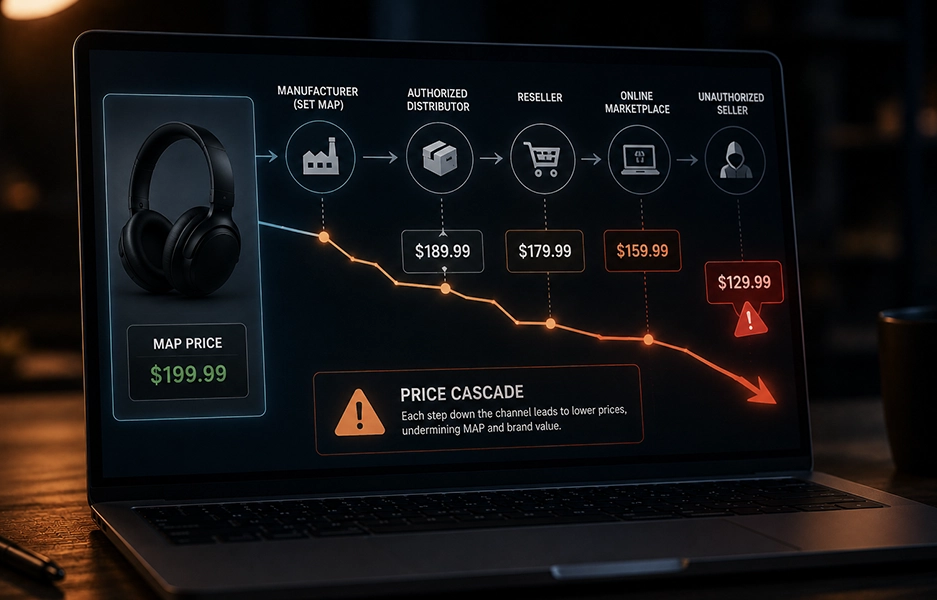
A price cascade is a rapid, chain-reaction decline in product pricing triggered when one seller reduces price and forces competitors to follow. In eCommerce, it often starts with a single “first mover” undercutting the market, leading to a downward spiral that erodes margins, disrupts brand equity, and destabilizes channel pricing structures. Once pricing drops at one point in the distribution network, it cascades across other sellers, marketplaces, and sometimes even regions.
What is a Price Cascade?
A price cascade is a sequential pricing reaction where a single price reduction triggers a chain of competitive responses across multiple sellers or channels. The sequence typically unfolds as follows:
- A seller reduces price below market equilibrium
- Competitors match or undercut to retain sales
- Automated repricing tools accelerate the reaction
- Prices continue falling until stabilization or intervention
Simple definition: A price cascade is a self-reinforcing downward pricing spiral across multiple sellers or channels. Understanding why price wars happen on Amazon provides essential context for any brand experiencing these dynamics on the platform.
Key characteristics
- Triggered by a “first mover” undercutting the market
- Amplified by algorithmic repricing systems
- Common in competitive marketplaces like Amazon
- Often linked to unauthorized or grey market sellers
Why Price Cascades Happen
Price cascades occur due to structural incentives in modern digital commerce. Multiple forces can act simultaneously, making cascades difficult to predict and even harder to stop once they start.
1. First-mover undercutting
A single seller reduces price to gain Buy Box visibility or liquidation advantage. This is often the ignition point of a cascade, and it sets off every subsequent reaction in the chain.
2. Automated repricing systems
Most eCommerce sellers use dynamic pricing tools that automatically match or beat competitor prices within minutes. What might take a human hours to notice and respond to happens in seconds through automation — turning a single price move into a market-wide event.
3. Overstock or liquidation pressure
Sellers with excess inventory prioritize cash flow over margin protection. A distributor sitting on 500 units will often break MAP rather than hold inventory through a slow season, and that decision starts the cascade.
4. Grey market and unauthorized sellers
Grey market sellers and unauthorized resellers frequently ignore MAP (Minimum Advertised Price) rules and aggressively undercut authorized distribution channels. Unlike authorized partners, they have no long-term relationship to protect and no supply access to lose. Learn more about how grey market sellers exploit automated repricing to accelerate price cascades.
5. Marketplace algorithms
Platforms like Amazon reward lower-priced offers with higher visibility. When the algorithm surfaces the cheapest listing, it creates a direct incentive for sellers to cut price — and minimum advertised price (MAP) policies are the primary tool brands have to resist that structural pressure.
Why Price Cascades Matter for Brands
For brand owners and ecommerce directors, price cascades are not just pricing events — they are brand integrity risks with measurable downstream consequences.
Business impact
- Margin erosion across all channels
- Loss of Buy Box control
- Breakdown of MAP compliance
- Channel conflict between authorized sellers
- Long-term brand devaluation
The core challenge is that once a cascade begins, it becomes difficult to reverse without coordinated enforcement or pricing control mechanisms. MAP enforcement tools exist specifically to catch and stop violations before they spiral. Without them, a single rogue listing can drag your entire channel down within hours.
Understanding how to deal with MAP violations before they escalate is one of the most effective ways to prevent a cascade from spreading across your distribution network.
Price Cascade in E-Commerce and Retail
In eCommerce, price cascades are most visible on marketplaces like Amazon and Walmart. The combination of algorithmic repricing, Buy Box competition, and a large pool of third-party sellers creates ideal conditions for rapid price deterioration.
Typical cascade sequence on Amazon
- An unauthorized seller lists below MAP
- Authorized sellers respond defensively to protect sales volume
- Algorithmic repricers engage across multiple seller accounts
- Buy Box rotates rapidly or becomes suppressed
- Brand loses pricing control across the listing
Example: A product with a MAP of $100 drops to $92 due to a grey market seller. Within hours: 5–10 sellers match $92. One seller drops to $89. The cascade accelerates to the $80–$85 range. Brand perception shifts to “discount product.”
Understanding how the Amazon Buy Box works explains why price is such a powerful lever in these dynamics — the Buy Box algorithm heavily weights price, making lower-priced offers almost self-reinforcing. When cascades are severe enough to suppress the Buy Box entirely, see why Amazon suppresses the Buy Box and what that signals for your brand.
The most effective early intervention is removing unauthorized sellers before they can trigger the first price move. Eliminate the ignition point and the cascade has nowhere to start.
Price Cascade in Supply Chain and Economics
In supply chain economics, price cascades reflect inefficiencies in inventory distribution and channel control. The retail marketplace is often just where the symptoms become visible — the root cause is usually upstream.
Root causes
- Excess downstream inventory creating liquidation pressure
- Lack of coordinated pricing policies across distribution tiers
- Parallel imports and arbitrage channels bypassing authorized networks
- Weak distributor enforcement and oversight
Economic effects
- Price instability across regions and channels
- Reduced predictability for manufacturers and authorized distributors
- Incentives for opportunistic reselling at the expense of channel health
- Pressure on authorized distributor relationships and margins
A price cascade is often a symptom of broken supply chain governance, not just competitive pricing. Brands that address this at the distribution level — through tighter agreements, serial number tracking, and distributor audits — are better positioned to prevent cascades than those who rely solely on marketplace enforcement. This is why rethinking distribution control is a foundational piece of cascade prevention strategy.
Price Cascade in Financial Markets
While the term is most common in retail and eCommerce contexts, structurally similar dynamics appear in financial markets under different names but with the same underlying mechanics.
Comparable mechanism
- A large sell order triggers an initial price decline
- Stop-loss orders activate automatically at preset thresholds
- Algorithmic trading amplifies sell pressure across related assets
- Liquidity thins as buyers pull back, accelerating the drop
The result is a cascading liquidation effect structurally similar to retail repricing spirals. In both cases, automation converts a single actor’s decision into a market-wide event, and the damage moves faster than human intervention can respond.
| eCommerce Price Cascade | Financial Market Cascade |
|---|---|
| First seller drops price | Large sell order executes |
| Repricers follow automatically | Algorithmic trading reacts |
| Buy Box shifts to cheapest offer | Liquidity shifts, spreads widen |
| Price floor collapses | Asset price drops rapidly |
Key Takeaways
- A price cascade is a chain reaction of price reductions across sellers or channels, triggered by a single first-mover event.
- Automation and algorithmic repricing tools dramatically accelerate the speed and depth of cascades.
- Grey market and unauthorized sellers are among the most common ignition points.
- Cascades directly impact margin, Buy Box control, and long-term brand equity.
- Supply chain misalignment — not just marketplace competition — is often the root cause.
- MAP enforcement and continuous MAP price monitoring are the primary tools for catching cascade triggers before they spread.
- The same self-reinforcing mechanics that drive retail price cascades appear in financial market liquidation events.
FAQ
What triggers a price cascade?
Usually a first seller lowering price below market equilibrium, often due to liquidation pressure, overstock, or unauthorized selling. Once the first move happens, automated repricing tools carry the reaction forward without human involvement.
Is a price cascade always bad?
For consumers, a price cascade can mean lower prices in the short term. For brands and their authorized distribution networks, it almost always signals margin loss, brand dilution, and channel instability.
How do brands stop price cascades?
By enforcing MAP policies consistently, controlling authorized distribution, removing unauthorized sellers before they can trigger the first price move, and using Amazon MAP enforcement tools to catch violations in real time.
Are price cascades common on Amazon?
Yes. They are especially common due to the combination of algorithmic repricing, Buy Box competition, and the large volume of third-party sellers operating on the platform at any given time.
What is the difference between a price drop and a price cascade?
A price drop is isolated — one seller reduces price and it stays there. A cascade is systemic and reactive: the initial drop triggers a chain of competitive responses across multiple sellers, often accelerated by automation.
Conclusion
A price cascade is one of the most critical yet underestimated pricing dynamics in modern eCommerce. It begins with a single deviation but quickly evolves into a systemic breakdown of pricing control across channels.
For brand owners, understanding and preventing cascades is essential to maintaining profitability, channel stability, brand perception, and Buy Box performance. Organizations that actively monitor pricing behavior, enforce MAP policies, and control unauthorized sellers are significantly better positioned to prevent cascading price erosion before it spreads.
In today’s marketplace, pricing is not static — it is reactive. And without control mechanisms in place, one small price move can cascade into a full-scale margin collapse.
Thank you for reading our post, ‘What Is Price Cascade: Meaning, Causes and Market Impact.’ We hope it gave you a clearer picture of how pricing spirals start and how brands can get ahead of them. At Brand Alignment, we help brands monitor pricing across hundreds of marketplaces, identify the unauthorized sellers that trigger cascades, and enforce MAP policies before a single price drop becomes a full channel breakdown. If you’d like to learn how we can support your pricing integrity strategy, we’d love to connect.
Take control of your marketplace presence with fast, effective brand protection strategies.
Every day, unauthorized sellers and MAP violations can erode your pricing, reputation, and revenue. Don’t wait for problems to escalate, start enforcing your policies and reclaim your market authority with our proven tools and expert support.


 Luis Amor