

Amazon brand gating blocks unauthorized sellers before they can list your products — here’s how to qualify, apply, and make it work for your brand in 2025.
Amazon brand gating is a Brand Registry program that restricts which third-party sellers can list your products. When active, any unauthorized seller attempting to list your ASINs is automatically blocked unless they provide documentation, written authorization from your brand, and in some cases a non-refundable fee. It is one of the most direct tools available to brand owners for stopping counterfeit products and unauthorized resellers before they cause damage.
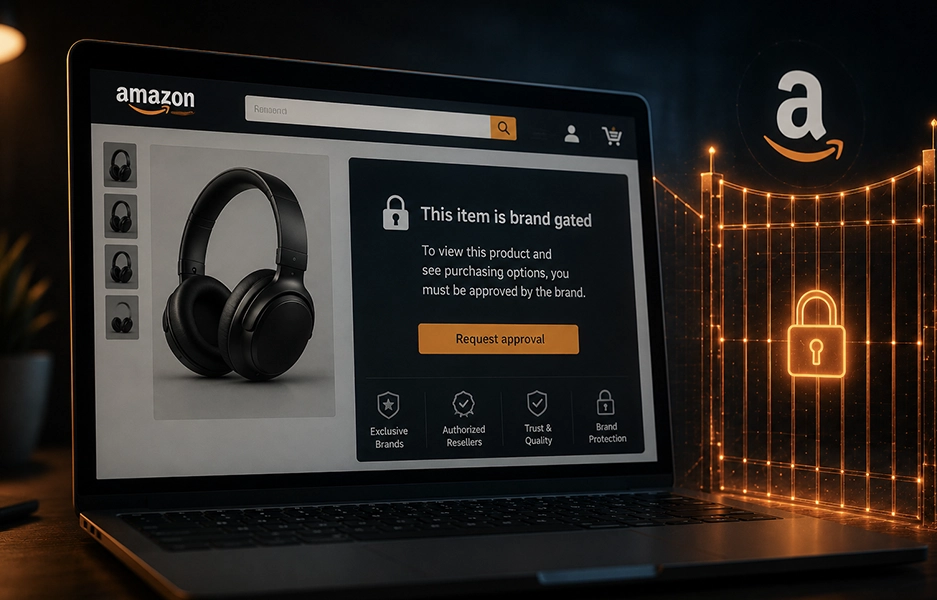
What is Amazon brand gating?
Amazon brand gating is a protection mechanism within the Amazon Brand Registry that creates an approval barrier at the ASIN level. When your brand is gated, Amazon’s system automatically intercepts any attempt by a third-party seller to list your products and requires them to prove they are authorized to do so.
The program operates on a per-ASIN basis, meaning you can gate specific products rather than your entire catalog. It works through Amazon’s Seller Central verification layer, which checks incoming listing attempts against a database of gated ASINs and triggers a documentation request before the listing can go live.
Brand gating is distinct from Amazon Brand Registry itself. Brand Registry gives brand owners access to protection tools; gating is one specific layer of protection that requires a separate request and qualification process. For a detailed comparison, see Amazon Brand Registry vs. Amazon Transparency.
Why brands use Amazon brand gating
Counterfeit prevention
Amazon seized over 15 million counterfeit products in 2024, more than double the prior year’s figure. Unauthorized sellers listing fake versions of your products under your ASINs is the most direct brand integrity threat on the platform. Counterfeit protection through brand gating addresses this by blocking the listing attempt before it ever goes live, rather than forcing you to react after the fact.
Pricing control
Unauthorized resellers often undercut brand pricing, which erodes margins across your entire authorized channel. When listings are gated, third-party sellers cannot compete on your ASINs without your explicit permission, giving you much greater control over MAP compliance. Learn more about Amazon MAP enforcement strategies that work alongside brand gating.
Listing integrity
Hijacked listings can alter product images, titles, and descriptions, causing customer confusion and negative reviews that attach to your brand. Gating prevents unauthorized sellers from attaching to your listings in the first place.
Reduced enforcement burden
Without brand gating, protecting your listings requires constant monitoring, cease-and-desist letters, and manual reporting to Amazon. Brand gating automates much of this, shifting the burden of proof to potential sellers rather than to your brand protection team.
How the gating process works
Brand gating operates at the ASIN level through Amazon’s Seller Central verification system. Here is the sequence when a third-party seller attempts to list a gated product:
- Seller searches for the product. A seller searches your product in Seller Central under “Add a Product” and finds the ASIN.
- Gated status is detected. Amazon’s system immediately recognizes the ASIN as gated and blocks the listing attempt.
- Documentation request is triggered. The seller is prompted to submit invoices, authorization letters, and other required documents.
- Fee payment required. The seller must pay a non-refundable $1,500 fee, which goes directly to your brand.
- Review and decision. Amazon reviews the submission. Only sellers you have explicitly authorized will pass. Others are permanently blocked for that ASIN.
Important: The $1,500 fee is non-refundable even if the seller’s application is rejected. This financial barrier alone significantly reduces opportunistic counterfeit attempts.
How to apply for Amazon brand gating
- Own a registered trademark. An active, registered trademark in the relevant country is a hard prerequisite. A pending trademark application is not sufficient on its own, though Amazon’s IP Accelerator program can provide interim access to Brand Registry while your application is being processed. Understanding trademark infringement enforcement options will also strengthen your application.
- Enroll in Amazon Brand Registry. Brand Registry enrollment is required before you can request brand gating. Review the pros and cons of Amazon Brand Registry if you have not enrolled yet. The program is free, but trademark registration fees (typically $350 to $800 in the US) apply.
- Compile your ASINs. Identify the specific ASINs you want gated. You do not need to gate your entire catalog; targeting high-risk or high-value products is a common and practical approach.
- Document your brand protection efforts. Amazon expects evidence that you are actively managing brand integrity. This includes cease-and-desist letters sent to unauthorized sellers, records of complaints filed, and documentation of counterfeit incidents. The stronger this evidence, the more likely your application will be approved.
- Submit through your Amazon representative or Brand Registry portal. Contact Amazon’s Brand Registry support or your dedicated account representative to file your application. Typical approval timelines range from 3 to 5 weeks, with complex cases taking longer.
- Manage authorized sellers. Once gated, you approve trusted sellers and monitor for any unauthorized listing attempts. Amazon’s system blocks unapproved sellers automatically, but ongoing management is still recommended.
Note: Brand gating is not automatic with Brand Registry enrollment. You need to actively request it, demonstrate a history of brand protection efforts, and in many cases file IP complaints before Amazon will approve the application.
What sellers face when a brand is gated
For resellers and unauthorized third-party sellers, encountering a gated brand requires meeting strict criteria before listing is permitted. To gain approval, a seller must typically:
- Hold a Professional Seller account (Individual accounts are generally ineligible)
- Maintain a strong account health and performance history
- Provide three purchase invoices from the manufacturer or an authorized distributor, dated within the last 90 days
- Provide written authorization from your brand (a Letter of Authorization)
- Pay the non-refundable $1,500 fee to the brand
Sellers who cannot meet these requirements are blocked from listing. For more on the different types of sellers that gating stops, see 9 types of unauthorized sellers on Amazon.
Types of gating on Amazon: brand gating vs. category gating vs. ASIN restrictions
These three restriction types are frequently confused, and understanding the difference matters for both brand owners and sellers.
| Type | Who controls it | Scope | Typical requirements |
|---|---|---|---|
| Brand gating | Brand owner (via Brand Registry) | Specific ASINs under a brand | Authorization letter, invoices, $1,500 fee |
| Category gating | Amazon | Entire category (e.g., Fine Jewelry, Watches) | Safety certifications, invoices, category-specific docs |
| ASIN-level restriction | Amazon | Individual product | Varies; often invoices only |
Not all gated situations require the same response. If a seller sees no application button at all in Seller Central, it typically means Amazon has fully restricted the brand or ASIN and is not accepting new sellers.
Pros and cons of Amazon brand gating
Pros for brand owners
- Blocks counterfeit listings before they go live
- Reduces enforcement workload — making it easier to remove unauthorized sellers on Amazon
- Protects pricing integrity across channels
- Non-refundable fee deters opportunistic sellers
- Strengthens legal standing for IP enforcement actions
- Supports premium brand positioning on Amazon
- Makes authorized distributors more confident in your Amazon strategy
Cons and limitations
- Requires significant groundwork to qualify (trademark, Brand Registry, IP complaint history)
- Approval is not guaranteed — see the limits of Amazon Brand Registry
- Does not prevent all unauthorized activity; sellers with forged documents can still attempt to apply
- Ongoing management is still necessary
- Not available to brands without registered trademarks
- Application and approval can take 3 to 5 weeks or more
Key takeaways
- Amazon brand gating is a Brand Registry program that blocks unauthorized sellers from listing your products at the ASIN level.
- It requires an active registered trademark and Brand Registry enrollment as prerequisites.
- Unauthorized sellers must pay a non-refundable $1,500 fee to your brand plus provide invoices and written authorization.
- Brand gating is not automatic; you must apply, demonstrate brand protection efforts, and receive Amazon’s approval.
- It differs from category gating (controlled by Amazon) and ASIN-level restrictions (also Amazon-controlled).
- Amazon’s gating system became more automated in 2025, with algorithmic review of seller account history and documentation.
- The number of brands enrolled in Brand Registry grew from 500,000 to over 700,000 in a single year, signaling that gated brands will become more common.
FAQ
Is Amazon brand gating free for brand owners?
Yes, there is no fee for the brand owner to apply for or maintain brand gating. The $1,500 non-refundable fee is paid by unauthorized third-party sellers who attempt to list your gated products, and that fee goes to your brand.
Do I need Amazon Brand Registry before applying for brand gating?
Yes. Brand Registry enrollment is a hard requirement for brand gating. Brand Registry itself requires an active registered trademark in the country where you want protection.
How long does it take to get brand gating approved?
Typical timelines range from 3 to 5 weeks from submission to decision. More complex cases or brands with limited prior IP enforcement history may take longer.
Does brand gating stop all unauthorized sellers?
It substantially reduces unauthorized listing attempts but does not eliminate them entirely. Sellers with fraudulent documentation can still submit applications. However, the documentation requirements and the $1,500 fee eliminate the vast majority of opportunistic counterfeiters.
What is the difference between brand gating and category gating?
Brand gating is requested by the brand owner and applies to specific ASINs under their brand. Category gating is applied by Amazon across entire product categories and is not controlled by individual brand owners.
Can small brands apply for brand gating?
Yes. Brand gating is not exclusive to large corporations. Any brand enrolled in Brand Registry with an active trademark can apply, provided they can demonstrate brand protection efforts and meet Amazon’s eligibility criteria.
What documents does a seller need to list a gated brand?
Sellers typically need three purchase invoices from an authorized manufacturer or distributor dated within the last 90 days, a Letter of Authorization from the brand, and payment of the $1,500 non-refundable application fee.
Thank you for reading our post, ‘Amazon Brand Gating: What It Is, How It Works, and Why Your Brand Needs It.’ We hope you found it helpful. At Brand Alignment, we specialize in helping brands protect their presence on Amazon and other marketplaces — from unauthorized seller removal to MAP enforcement and beyond. If you have questions or want to learn how we can support your brand protection strategy, we’d love to hear from you.
Take control of your marketplace presence with fast, effective brand protection strategies.
Every day, unauthorized sellers and MAP violations can erode your pricing, reputation, and revenue. Don’t wait for problems to escalate, start enforcing your policies and reclaim your market authority with our proven tools and expert support.


 Brand Alignment