

MAP enforcement on Shopify is one of the most critical brand protection strategies for e-commerce companies managing multi-channel distribution.
When brands sell through authorized retailers and third-party Shopify stores, maintaining Minimum Advertised Price (MAP) compliance becomes essential to prevent pricing erosion, channel conflict, and unauthorized discounting.
Without structured enforcement, Shopify stores can unintentionally violate MAP policies through coupons, automatic discounts, and promotional campaigns that push pricing below approved thresholds.
Table of Contents
- What is MAP enforcement on Shopify?
- Why MAP compliance matters for Shopify brands
- How MAP violations happen on Shopify
- The risk of MAP violations
- MAP enforcement impact model
- How MAP enforcement works on Shopify
- Authorized vs unauthorized sellers
- Why Shopify makes MAP enforcement complex
- Internet-wide MAP enforcement
- Brand Alignment approach to MAP enforcement
- Best practices for MAP enforcement on Shopify
- FAQ
What is MAP enforcement on Shopify?
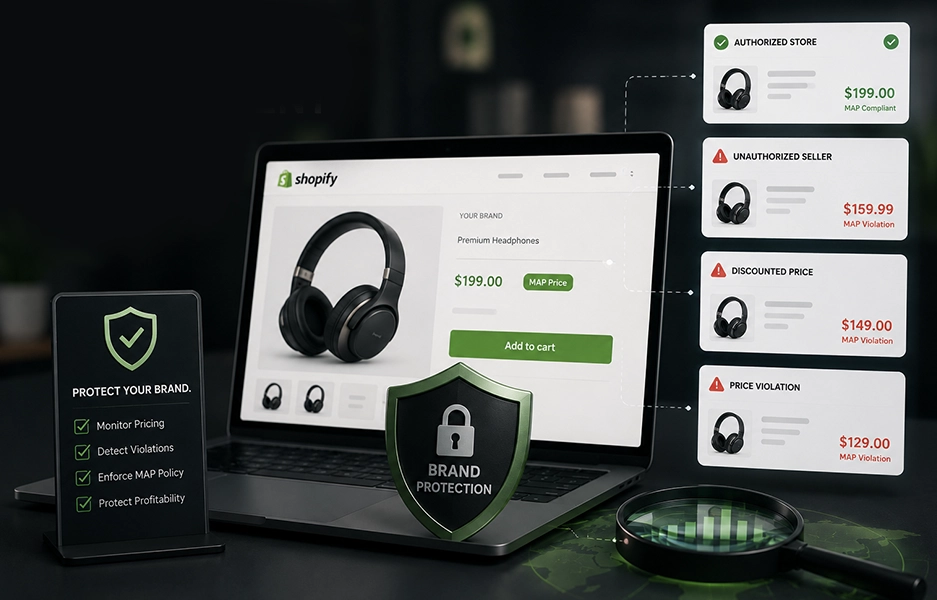
MAP enforcement on Shopify is the process of ensuring that all advertised and effective prices for products respect the Minimum Advertised Price set by the brand. It includes:- Monitoring advertised pricing across Shopify stores
- Detecting coupon and discount violations
- Identifying unauthorized sellers
- Enforcing pricing policies across SKUs
- Preventing undercutting of brand value
Why MAP compliance matters for Shopify brands
MAP compliance protects:- Brand equity
- Channel relationships
- Retail pricing consistency
- Wholesale agreements
- Long-term product positioning
How MAP violations happen on Shopify
Most MAP violations are not intentional. They occur due to system-level discount conflicts. Common causes:- Sitewide discount campaigns
- Automatic coupon codes applied at checkout
- Email marketing promotions
- Bundle pricing logic
- Loyalty program discounts stacking
- Affiliate-driven discount links
The risk of MAP violations
When MAP enforcement fails, brands face:- Price erosion across channels
- Loss of Buy Box competitiveness on Amazon
- Breakdown of authorized reseller networks
- Increased gray market activity
- Reduced perceived product value
MAP enforcement impact model
| Area | Without MAP Enforcement | With MAP Enforcement |
|---|---|---|
| Pricing consistency | Fragmented | Controlled |
| Seller behavior | Unregulated | Structured |
| Brand value | Weakening | Protected |
| Channel trust | Conflicted | Stable |
| Revenue predictability | Low | High |
How MAP enforcement works on Shopify
Effective MAP enforcement requires structured monitoring + real-time decisioning. Core process:- Define MAP pricing per SKU
- Monitor Shopify store pricing behavior
- Detect discount stacking or violations
- Compare against MAP thresholds
- Trigger enforcement or alerts
- Log violations for audit purposes
| Step | Process |
|---|---|
| 1 | SKU Mapping |
| 2 | Discount Tracking |
| 3 | MAP Threshold Comparison |
| 4 | Violation Detection |
| 5 | Enforcement Action |
| 6 | Compliance Log |
Authorized vs unauthorized sellers
MAP enforcement is directly tied to seller control.| Seller Type | Behavior | MAP Risk |
|---|---|---|
| Authorized Retailer | Follows brand pricing rules | Low |
| Unauthorized Seller | Uses aggressive discounting | High |
| Gray Market Seller | Ignores MAP agreements | Critical |
Why Shopify makes MAP enforcement complex
Shopify introduces unique enforcement challenges:- Flexible discount systems
- App-based pricing automation
- Affiliate and influencer-driven traffic
- Lack of centralized seller control
- Multi-layer coupon stacking
Internet-wide MAP enforcement
MAP enforcement on Shopify cannot be isolated. Brands must monitor:- Shopify stores
- Amazon
- Walmart
- eBay
- Social commerce channels (TikTok, Instagram Shops)
Brand Alignment approach to MAP enforcement
Brand Alignment provides a unified system that combines:- MAP price monitoring across all channels
- Unauthorized seller detection
- Gray market supply chain investigation
- Seller classification (authorized vs unauthorized)
- Enforcement workflows (cease & desist actions)
- Buy Box and channel protection strategy
| MAP Compliance Level | Outcome |
|---|---|
| 100% compliance | Stable brand pricing |
| 80% compliance | Minor leakage |
| 50% compliance | Active discount conflicts |
| 20% compliance | Severe channel disruption |
| 0% compliance | Loss of pricing control |
Best practices for MAP enforcement on Shopify
A strong MAP enforcement strategy should include:- SKU-level MAP definition
- Continuous price monitoring
- Discount and coupon tracking
- Seller identification and classification
- Automated violation alerts
- Enforcement escalation process
- Regular channel audits
FAQ
What is MAP enforcement on Shopify? It is the process of ensuring all Shopify store prices comply with a brand’s Minimum Advertised Price policy. Why do MAP violations happen on Shopify? Because discount systems, coupons, and promotions can reduce prices below MAP without recognizing brand policy thresholds. Can Shopify automatically enforce MAP? Not natively. MAP enforcement requires external monitoring or enforcement systems. Why is seller monitoring important for MAP? Because it identifies which retailers or sellers are responsible for violations, not just the price drops.MAP enforcement on Shopify requires more than a pricing policy. It requires a continuous enforcement system capable of identifying violations, tracing their source, and eliminating unauthorized sellers from your channel ecosystem.
Without systematic MAP enforcement, brands lose pricing control, erode brand value, and fuel gray market activity that undermines authorized resellers across every channel.
Brand Alignment delivers structured MAP enforcement across Shopify and all major marketplaces. Contact us to build a MAP enforcement strategy that protects your pricing integrity and your brand.
Take control of your marketplace presence with fast, effective brand protection strategies.
Every day, unauthorized sellers and MAP violations can erode your pricing, reputation, and revenue. Don’t wait for problems to escalate, start enforcing your policies and reclaim your market authority with our proven tools and expert support.


 Brand Alignment