

Using MAP pricing is one of the most common strategies brands use to protect pricing consistency, maintain channel stability, and prevent uncontrolled discounting across retailers and marketplaces.
Minimum Advertised Price (MAP) policies are widely used in brand protection and channel management because they help preserve margin integrity, support authorized reseller relationships, and stabilize marketplace performance across platforms like Amazon and Google Shopping.
But MAP is not a perfect solution.
When implemented correctly, MAP strengthens pricing discipline and reinforces brand control. However, when it is poorly structured or not actively enforced, it can lead to confusion among resellers, inconsistent execution, and a false sense of pricing protection.
To understand the foundation behind MAP pricing before evaluating its pros and cons, read here: What is MAP Pricing .
What Is MAP Pricing?
MAP (Minimum Advertised Price) is the lowest price a retailer is allowed to publicly advertise a product for.
Important distinction:
- MAP regulates advertised price — not necessarily the final selling price.
- It applies to public listings (websites, marketplaces, ads, email campaigns, etc.).
MAP is different from:
- MSRP (Manufacturer’s Suggested Retail Price)
- SRP (Suggested Retail Price)
- UPP (Unilateral Pricing Policy)
A MAP policy sets pricing boundaries to protect brand perception and channel fairness. If you need a deeper breakdown, see what MAP pricing is and how a minimum advertised price works.
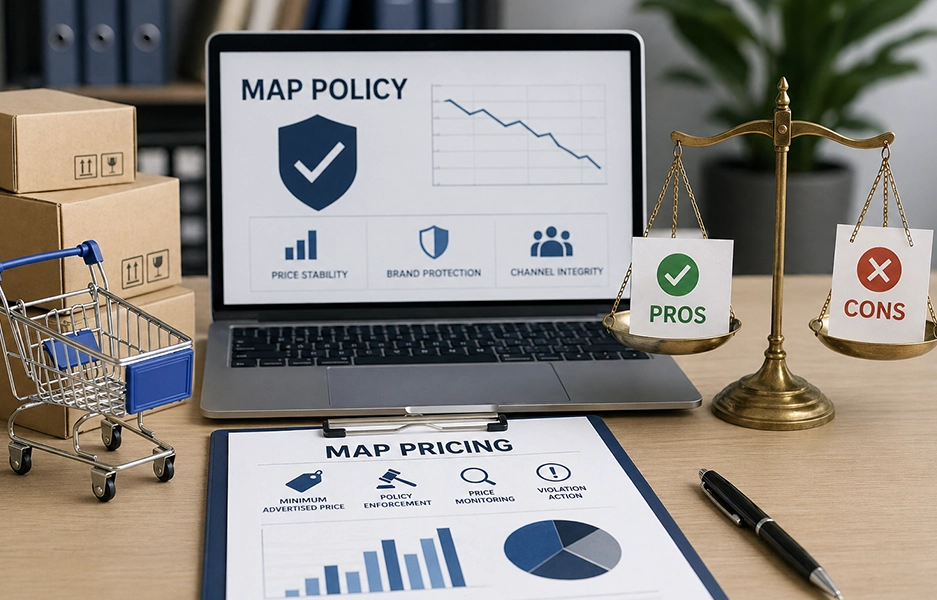
The Pros of Using MAP Pricing
1. Protects Brand Value
Price signals quality.
If your product has an MSRP of $199 but regularly appears advertised at $129, customers begin to question its value.
MAP pricing helps:
- Maintain premium positioning
- Prevent price erosion
- Reinforce perceived product quality
For brands investing in marketing, product development, and brand equity, MAP protects that investment.
2. Stabilizes Retail Relationships
Retailers want predictability.
If one seller discounts aggressively while others follow policy, compliant partners become frustrated.
Without MAP:
- Authorized retailers lose margin
- Trust deteriorates
- Purchase orders shrink
With MAP:
- Sellers compete on service, availability, and customer experience — not price alone
- Retailers feel protected
- Channel conflict decreases
This stability is especially important in wholesale and distribution-heavy models.
3. Prevents Price Cascading
One of the most damaging marketplace behaviors is price cascading.
This occurs when:
- One seller drops below MAP
- Other sellers match the price
- Automated repricing software accelerates the decline
- A race to the bottom begins
Without MAP enforcement, pricing can collapse in hours.
MAP creates a baseline that discourages this cycle before it spreads.
4. Protects Buy Box Stability (On Marketplaces)
On platforms like Amazon, price is a dominant Buy Box factor.
If sellers aggressively undercut one another:
- Buy Box ownership becomes unstable
- Margins shrink
- Unauthorized sellers gain visibility
A strong MAP policy supports Buy Box consistency — especially when paired with strategies to win the Buy Box on Amazon.
5. Encourages Long-Term Planning
Retailers are more likely to:
- Invest in marketing
- Build in-store displays
- Support promotions
- Place larger orders
When they know pricing discipline will be maintained.
MAP creates a predictable pricing ecosystem that supports long-term growth rather than short-term discounting.
The Cons of Using MAP Pricing
While MAP offers strong advantages, it is not without limitations.
1. MAP Does Not Enforce Itself
A policy on paper is not protection.
Without active monitoring and enforcement:
- Sellers ignore the policy
- Violations multiply
- Price erosion becomes normalized
Many brands assume that announcing MAP is enough.
It isn’t.
MAP requires:
- Marketplace monitoring
- Evidence collection
- Seller notification
- Escalation processes
- Consistent follow-through
Without enforcement infrastructure, MAP loses credibility quickly. Learn more about what MAP enforcement is and how it works in practice.
2. Grey Market Sellers Ignore MAP
MAP policies typically apply to authorized sellers.
Unauthorized sellers, grey market resellers, and liquidators are not contractually bound.
If inventory leaks into unauthorized channels:
- MAP violations increase
- Buy Box instability follows
- Retail relationships suffer
In these cases, MAP alone cannot solve the problem. Distribution control becomes equally important, often requiring removal of unauthorized sellers and deeper intervention.
3. Legal Sensitivity
MAP policies must be structured carefully.
Brands must avoid:
- Price fixing language
- Direct coordination between retailers
- Overly aggressive communication
MAP policies are typically unilateral — meaning retailers choose whether to comply, and brands choose whether to continue supplying them.
Improperly structured policies can create legal exposure. See whether MAP pricing is legal for more detail.
4. Administrative Complexity
Effective MAP management requires:
- SKU-level tracking
- Screenshot documentation
- Time-stamped evidence
- Violation history tracking
- Escalation systems
As your SKU count grows, complexity increases.
Enterprise brands may monitor thousands of listings across multiple marketplaces and countries.
Without structured systems, manual enforcement becomes overwhelming, which is why many brands rely on MAP monitoring software.
5. Potential Retailer Pushback
Some retailers dislike MAP.
They may argue:
- It limits promotional flexibility
- It reduces competitive advantage
- It complicates clearance inventory
If communication is unclear, retailers may see MAP as restrictive rather than protective.
Education and consistent enforcement are essential to maintaining retailer alignment.
6. Does Not Prevent External Price Matching
On marketplaces like Amazon, price suppression can occur if external retailers advertise lower pricing — even if Amazon sellers follow MAP.
For example:
- A retailer advertises below MAP
- Amazon detects the lower price
- The Buy Box is suppressed
- Revenue stalls
In this case, cross-channel monitoring is necessary. MAP must extend beyond a single platform to be effective. This is a common reason MAP doesn’t work on Amazon without a broader strategy.
When MAP Pricing Makes Sense
MAP is most effective for brands that:
- Operate through wholesale or distribution networks
- Sell on high-transparency marketplaces
- Have premium positioning
- Need Buy Box stability
- Want predictable retail partnerships
It is particularly valuable in categories where:
- Price competition is aggressive
- Repricing software is common
- Grey market activity is prevalent
When MAP Alone Is Not Enough
MAP cannot solve:
- Supply chain leaks
- Parallel imports
- Liquidation diversion
- Counterfeit issues
- Unauthorized seller networks
In those cases, MAP must be paired with:
- Distribution discipline
- Seller monitoring
- Enforcement infrastructure
- Inventory tracing capabilities
This often includes structured approaches to dealing with MAP violations and violators.
Best Practices for Using MAP Effectively
If you choose to implement MAP pricing, consider these foundational principles:
- Draft it carefully with legal oversight.
- Monitor continuously — not occasionally.
- Apply enforcement consistently across all sellers.
- Educate retailers on the purpose of MAP.
- Track violation patterns to identify root causes.
- Align internal teams (sales, compliance, leadership) to avoid mixed messaging.
Consistency builds credibility.
Inconsistent enforcement weakens policy authority.
Final Verdict
MAP pricing is one of the most powerful tools a brand can use to protect margin, stabilize channels, and maintain marketplace control.
But it is not a passive solution.
MAP works when:
- It is structured properly
- It is monitored actively
- It is enforced consistently
- Distribution is controlled strategically
Without those elements, MAP becomes symbolic rather than effective.
The real advantage of MAP isn’t just higher prices.
It’s control.
And in today’s marketplace — where price transparency is instant and competition is relentless — control is what separates stable brands from those caught in endless price wars.
Take control of your marketplace presence with fast, effective brand protection strategies.
Every day, unauthorized sellers and MAP violations can erode your pricing, reputation, and revenue. Don’t wait for problems to escalate, start enforcing your policies and reclaim your market authority with our proven tools and expert support.


 Brand Alignment