

Fulfillment by Amazon (FBA) is one of the main reasons Amazon became the dominant force in eCommerce. For brands and sellers, FBA offers convenience, scale, and access to Prime customers. But it also introduces cost complexity, inventory risk, and brand-control challenges.
If you’re considering FBA — or evaluating whether it’s still the right model for your business — here’s a practical breakdown of the pros and cons.
What Is Amazon FBA?
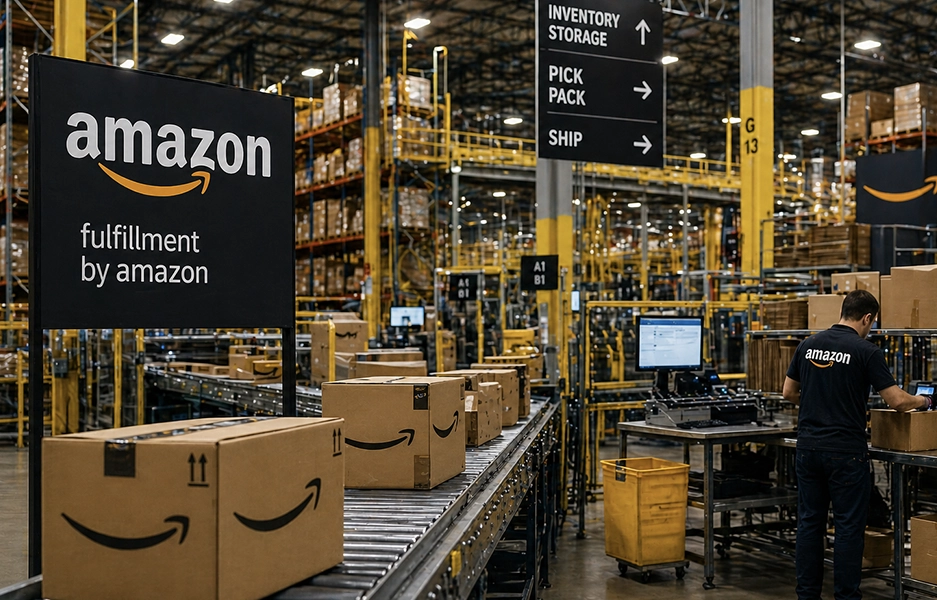
Fulfillment by Amazon (FBA) allows sellers to send inventory to Amazon’s warehouses. Amazon then handles:
- Storage
- Picking and packing
- Shipping
- Returns
- Customer service
When a customer places an order, Amazon fulfills it on your behalf.
Products fulfilled via FBA are typically eligible for Prime shipping, which significantly impacts conversion rates. You can learn more about how FBA works directly from Amazon here.
The Pros of Using Amazon FBA
1. Prime Eligibility Boosts Conversions
Prime is one of Amazon’s most powerful selling tools.
Customers trust:
- Fast delivery
- Easy returns
- Consistent service
Prime-eligible listings often convert significantly better than Fulfilled by Merchant (FBM) listings. See the key differences between FBA and FBM to understand this impact.
In competitive categories, not using FBA can put you at a visibility disadvantage.
2. Increased Buy Box Competitiveness
FBA improves your eligibility for the Buy Box.
Amazon favors offers that:
- Ship quickly
- Maintain strong delivery metrics
- Offer reliable customer service
Because Amazon controls the fulfillment process under FBA, performance risk is lower — making your offer more competitive in Buy Box rotation.
For many sellers, FBA is the fastest path to Buy Box visibility. This is directly tied to how Amazon decides the Featured Offer.
3. Operational Simplicity
FBA removes much of the daily fulfillment burden.
You don’t need to manage:
- Individual order packing
- Shipping labels
- Customer return processing
- Carrier negotiations
For growing brands, this frees up time to focus on marketing, product development, and expansion.
4. Scalability
FBA scales with demand.
If you suddenly experience a spike in sales, Amazon’s infrastructure can handle volume surges far more efficiently than most in-house fulfillment setups.
This makes FBA particularly attractive for:
- Seasonal products
- Viral product launches
- High-velocity SKUs
5. Multi-Channel Fulfillment (MCF)
Amazon also allows sellers to use FBA inventory to fulfill orders from other channels through Multi-Channel Fulfillment.
This means you can:
- Store inventory once
- Ship orders for your Shopify store
- Ship marketplace orders
- Centralize logistics
For some brands, this simplifies inventory management.
The Cons of Using Amazon FBA
While FBA offers convenience and scale, it comes at a cost — both financially and strategically.
1. Storage Fees & Long-Term Costs
FBA fees include:
- Fulfillment fees (per unit)
- Monthly storage fees
- Long-term storage penalties
- Removal and disposal fees
If inventory planning is inaccurate, slow-moving stock can become expensive quickly.
Brands must forecast carefully to avoid excessive storage charges — especially during Q4, when storage fees increase.
2. Loss of Inventory Control
Once inventory enters Amazon’s fulfillment centers, visibility decreases.
Issues can include:
- Inventory misplacement
- Receiving discrepancies
- Damaged units
- Delayed inbound processing
While Amazon offers reimbursement systems, reconciling discrepancies requires monitoring.
You’re trusting Amazon’s warehouse network — not managing your own.
3. Higher Fee Structure Compared to FBM
FBA convenience comes at a premium.
When you factor:
- Referral fees
- FBA fulfillment fees
- Storage fees
- Advertising costs
Margins can shrink quickly — especially for lower-priced products.
For bulky or heavy items, FBA fees may significantly impact profitability.
Some brands find hybrid models (FBA + FBM) more efficient depending on SKU characteristics.
4. Increased Exposure to Unauthorized Sellers
FBA can make listings more attractive to unauthorized sellers.
Why?
Because:
- FBA boosts Buy Box eligibility
- Fast shipping increases conversions
- High-performing listings attract arbitrage sellers
If distribution leaks exist, unauthorized sellers may:
- Send diverted inventory to FBA
- Undercut pricing
- Win Buy Box share
Once inventory is inside FBA, sellers can rotate in and out of the Buy Box rapidly.
Without monitoring and enforcement, Buy Box stability can deteriorate quickly. Many brands address this through Buy Box recovery strategies and removing unauthorized sellers on Amazon.
5. Amazon Controls the Customer Relationship
Under FBA:
- Amazon manages customer service
- Amazon handles returns
- Amazon controls buyer communication
You have limited direct access to customer data.
This restricts your ability to:
- Build direct relationships
- Collect marketing insights
- Increase customer lifetime value outside Amazon
For brands focused on long-term DTC growth, this is a trade-off.
6. Returns & Condition Issues
Amazon’s customer-first return policy can create challenges.
Returned units may:
- Be marked as sellable
- Be reshipped to new customers
- Result in condition complaints
If damaged units are mistakenly reintroduced into inventory, negative reviews can follow.
Monitoring returns and reviewing customer feedback becomes essential — especially considering buyer trust in third-party sellers.
When Amazon FBA Makes Sense
FBA is ideal for:
- High-velocity SKUs
- Products under standard size tiers
- Brands focused on Prime competitiveness
- Sellers without in-house fulfillment infrastructure
- Businesses prioritizing scale over direct customer ownership
For many brands, FBA is not optional — it’s necessary to remain competitive, especially when trying to protect brand equity on Amazon.
When FBA May Not Be Ideal
FBA may be less suitable for:
- Oversized or heavy items
- Low-margin products
- Slow-moving inventory
- Highly customized or fragile products
- Brands prioritizing direct customer data
In some cases, FBM or third-party logistics providers (3PLs) offer better cost control.
Hybrid Strategy: The Modern Approach
Many sophisticated brands use a hybrid fulfillment strategy:
- FBA for fast-moving SKUs
- FBM or 3PL for oversized items
- Controlled inventory allocation
- Strict monitoring for unauthorized sellers
This approach balances:
- Prime visibility
- Margin protection
- Inventory control
Final Verdict
Amazon FBA is one of the most powerful fulfillment systems in global eCommerce.
Pros:
- Prime eligibility
- Buy Box competitiveness
- Operational simplicity
- Scalability
Cons:
- Fee complexity
- Storage risk
- Reduced inventory control
- Increased exposure to marketplace competition
FBA isn’t just a logistics decision.
It’s a strategic decision about control, margin, and marketplace positioning.
The brands that succeed with FBA don’t simply send inventory to Amazon and hope for the best.
They pair fulfillment efficiency with:
- Careful margin analysis
- Distribution discipline
- Buy Box monitoring
- Unauthorized seller enforcement
Because while FBA solves shipping — it doesn’t solve marketplace control.
And in today’s environment, control is what protects long-term profitability.
Take control of your marketplace presence with fast, effective brand protection strategies.
Every day, unauthorized sellers and MAP violations can erode your pricing, reputation, and revenue. Don’t wait for problems to escalate, start enforcing your policies and reclaim your market authority with our proven tools and expert support.


 Brand Alignment