

A-Stock, B-Stock, C-Stock — these inventory grades shape pricing, channel control, and brand reputation. Here’s why they matter more than most brands realize, and how mismanaged stock grades fuel unauthorized selling.
Table of Contents
- What Are Inventory Grades?
- A-Stock: The Gold Standard for Brand Value
- B-Stock: The "Open Box" and Refurbished Category
- C-Stock: Salvage, Heavily Used, and Parts
- Why Inventory Grades Matter for Brand Protection
- How B-Stock and C-Stock Enter the Marketplace
- Best Practices for Managing Inventory Grades
- Stock Grading and Brand Protection: The Bottom Line
In today’s retail landscape, not all inventory is created equal. Inventory grading — the classification of products as A-Stock, B-Stock, or C-Stock based on condition, packaging, and resale eligibility — has become a critical factor in pricing strategy, customer trust, and channel control. For brands managing MAP compliance and marketplace integrity, understanding these stock categories and controlling how they flow through your distribution network can mean the difference between market leadership and sustained margin erosion.
What Are Inventory Grades?
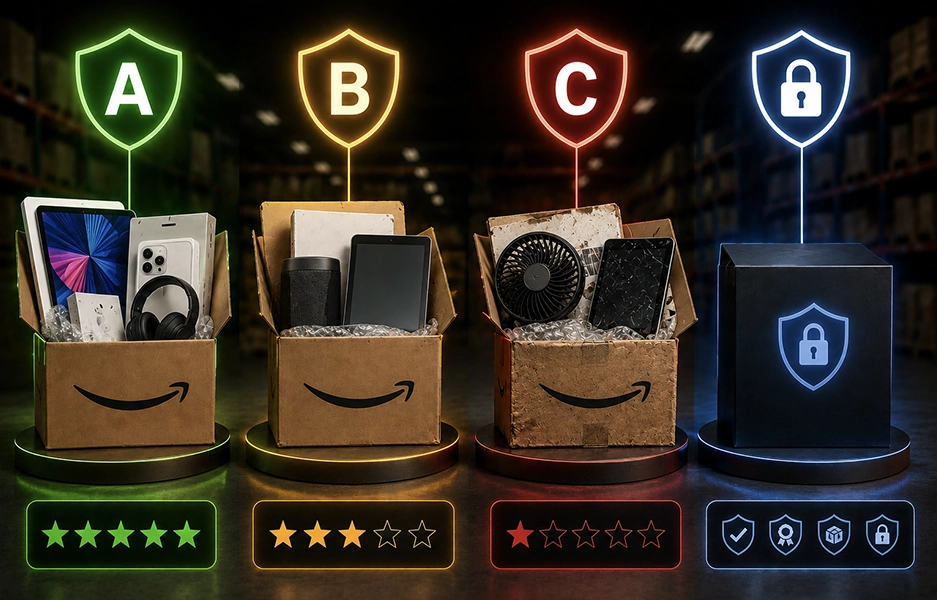
Inventory grades are standardized classifications used by brands, retailers, distributors, and resellers to describe the condition, packaging integrity, and resale eligibility of products. Clear grading standards are essential for setting accurate prices, meeting consumer expectations, preventing MAP violations, and protecting brand reputation across all channels.
While grading terminology varies somewhat by industry and platform, the three most universal grades are:
- A-Stock: New, factory-sealed inventory — the standard condition for primary retail.
- B-Stock: Not quite new — includes open-box, refurbished, or cosmetically imperfect items that cannot be sold as new.
- C-Stock: Used, heavily refurbished, or salvage product with significant defects or missing components.
Below these grades, some industries recognize D-Stock (salvage only) or simply “parts/repair.” The critical principle is that each grade should carry honest, accurate labeling — and that lower-grade inventory should never be misrepresented as a higher grade. This misrepresentation is one of the most common ways that pallet resellers and liquidation buyers create brand protection problems for manufacturers and authorized sellers.
A-Stock: The Gold Standard for Brand Value
A-Stock is new, unopened product in its original, factory-sealed packaging. This is the inventory condition that defines your brand’s price point, customer expectations, and authorized channel standard. Every retail and ecommerce sale through your authorized network should involve A-Stock.
Characteristics of A-Stock inventory:
- Factory sealed, unused, and undamaged — exactly as the manufacturer shipped it.
- Includes all original accessories, documentation, and manufacturer’s warranty.
- Sold through authorized channels at MSRP or MAP-compliant pricing.
- Eligible for full warranty coverage and manufacturer support.
Why A-Stock matters for brand protection: it sets the benchmark for reputation and price. When A-Stock leaks into unauthorized channels — through distributor diversion, retail arbitrage, or supply chain breaches — it disrupts MAP pricing, undercuts authorized retail partners, and creates grey market competition that authorized sellers can’t match without violating their own agreements. Product diversion of A-Stock is one of the most damaging supply chain integrity failures a brand can experience.
B-Stock: The “Open Box” and Refurbished Category
B-Stock encompasses products that cannot be sold as new but retain significant usable value. It’s a broad category that covers a range of conditions and origins:
- Customer returns: Even unused returns that were opened lose their A-Stock status once the seal is broken.
- Open-box items: Products returned with opened packaging, whether used or not.
- Display models: Floor or display units from retail environments.
- Manufacturer refurbishments: Items that were returned, inspected, repaired to working order, and repackaged — typically sold as “certified refurbished.”
- Items with minor cosmetic damage: Products with dents, scratches, or surface wear that don’t affect functionality.
- Excess or discontinued inventory with outdated packaging: Technically new but no longer meeting current packaging standards.
B-Stock is a legitimate and valuable category — brands can recover significant value from well-managed B-Stock programs. The key requirements are honest labeling (“open box,” “refurbished,” “used — like new”) and controlled distribution channels. How liquidation affects brands is most visible through poorly managed B-Stock that enters uncontrolled channels.
Brand protection risks of unmanaged B-Stock:
- B-Stock sold as new triggers negative reviews, warranty disputes, and customer complaints that damage your brand’s product ratings on Amazon and other platforms.
- Deep B-Stock discounts create MAP violations and channel conflict with authorized retailers holding full-price A-Stock inventory.
- Unmanaged B-Stock is a primary entry point for unauthorized sellers created through liquidation — resellers who purchase B-Stock at steep discounts and relist it as new.
C-Stock: Salvage, Heavily Used, and Parts
C-Stock applies to items with significant use, damage, or missing components that place them well below refurbishable condition. This is the lowest viable commercial grade before products are classified as waste or recycling:
- Heavily used or returned products with clear wear and functional issues.
- Items missing essential parts, manuals, or accessories that can’t be easily replaced.
- Products with substantial cosmetic damage — cracked housings, broken components, non-cosmetic scratches.
- Goods suitable only for parts harvesting, salvage resale, or disposal.
C-Stock is typically priced at the lowest levels, often sold with little or no warranty, and should be cleared exclusively through liquidation auctions, salvage wholesalers, or secondary parts markets. The cardinal rule: C-Stock should never be represented as A-Stock or B-Stock. When C-Stock enters consumer-facing channels labeled as better-condition product — especially on Amazon — the resulting customer experience is severe. Negative reviews from C-Stock purchases remain on your brand’s product listing regardless of which seller caused them.
Why Inventory Grades Matter for Brand Protection
Inventory grading isn’t just operational housekeeping — it’s a foundational element of brand protection strategy. Here’s how each grade connects to specific brand risks:
Price integrity: Lower-grade stock sells at discounts. When B- or C-Stock enters your primary retail channels — either through distribution leakage or unauthorized seller activity — it creates downward pricing pressure that triggers MAP violations and undermines the value of your brand’s pricing architecture. Continuous MAP monitoring is the first line of defense against grade-based price erosion.
Channel conflict: Authorized retailers who invested in stocking full-price A-Stock experience direct harm when B-Stock at 40-60% discounts appears on the same marketplace from unauthorized sellers. This creates friction that damages authorized partner relationships and can lead partners to reduce ordering or exit the category.
Brand trust and customer experience: Consumer confusion over product condition — especially when B- or C-Stock is listed as new — results in product reviews that reflect the degraded condition, not your brand’s actual quality standard. These reviews accumulate on your product listings and affect future A-Stock sales.
Buy Box displacement: Unauthorized sellers with B-Stock priced significantly below your authorized listing can win the Amazon Buy Box, meaning your advertising drives revenue to their listing instead of yours. Buy Box recovery in these situations requires both removing unauthorized sellers and ensuring your authorized pricing remains competitive.
How B-Stock and C-Stock Enter the Marketplace
Understanding the pathways through which lower-grade inventory reaches marketplaces like Amazon is essential for building effective controls:
- Brand-controlled refurb programs: Some brands sell inspected, reconditioned goods directly as “certified refurbished” or “open box” through their own Amazon Storefront or outlet channels. When controlled, this is the safest approach.
- Retailer liquidation: Retailers sell B- and C-Stock in bulk to liquidators, who resell to smaller operators or list directly on Amazon and eBay. This liquidation pipeline is the most common source of unauthorized B-Stock on Amazon.
- Return processing pipeline: Amazon’s own return processing creates a significant volume of B-Stock that flows back into the market through Amazon return pallets — making the return pipeline a direct channel through which your B-Stock can reach unauthorized resellers.
- Outlet and factory stores: B-Stock sold through outlet channels is often purchased by arbitrage resellers who then list it on Amazon, sometimes inaccurately representing condition.
- Direct marketplace listings: B- and C-Stock may be listed on eBay, Amazon (as “renewed,” “used — like new,” etc.), or specialty refurb channels by anyone who purchased it through the secondary market.
Each pathway creates a potential source of grey market supply chain leakage that can be traced, monitored, and addressed with the right tools.
Best Practices for Managing Inventory Grades
Brands that manage inventory grades effectively protect their pricing, reputation, and channel relationships while still recovering value from non-A-Stock inventory:
- Label accurately and consistently. Always describe product condition honestly — “A-Stock,” “open box,” “certified refurbished,” “used — very good,” etc. Provide clear descriptions of warranty status, missing accessories, and packaging condition at every stage of the distribution chain.
- Restrict B- and C-Stock to controlled channels. Avoid mixing lower-grade stock into mainstream ecommerce listings. Designate specific authorized channels for B-Stock (certified refurb programs, outlet stores, controlled secondary market partners) and maintain strict separation from A-Stock inventory.
- Vet liquidation partners carefully. Work only with liquidators who contractually agree not to list B- or C-Stock on Amazon as new, and who will accurately represent condition in any resale listing. Audit compliance periodically using test buys.
- Monitor marketplaces continuously. Use MAP monitoring and seller investigation to detect when lower-grade inventory is appearing in unauthorized listings, especially those misrepresenting condition as new.
- Enforce against misrepresented condition listings. Listings where B- or C-Stock is listed as new violate Amazon’s condition policies and can be reported for removal. Removing unauthorized sellers listing misrepresented inventory is one of the most actionable brand protection steps available.
- Educate distribution partners. Train your retail and distribution partners on inventory grading standards and the brand protection implications of improper grading or liquidation practices.
Stock Grading and Brand Protection: The Bottom Line
Inventory grading is a pillar of brand protection and revenue integrity. The three grades play fundamentally different roles in your brand’s commercial ecosystem:
- A-Stock preserves value, upholds MAP, and represents your brand’s quality promise to customers.
- B-Stock helps brands recover value from returns and imperfect inventory — but only when controlled, honestly labeled, and distributed through managed channels.
- C-Stock should be tightly managed and kept entirely out of primary and secondary consumer channels, directed only to salvage or parts markets where its condition is accurately represented.
When managed poorly, B- and C-Stock erode brand trust, trigger MAP violations, fuel unauthorized Amazon sales, and generate negative reviews that permanently impact your product listings. When managed well — with clear grading standards, controlled distribution, continuous marketplace monitoring, and proactive MAP enforcement — inventory grading becomes a competitive advantage that protects your pricing architecture while recovering maximum value from every unit you produce.
Thank you for reading! Inventory grading is foundational to brand protection — and mismanaged B-Stock and C-Stock are among the most common sources of unauthorized Amazon sellers and MAP violations. If your brand needs help identifying stock grade leaks or managing unauthorized sellers, Brand Alignment’s experts are ready to help.
Take control of your marketplace presence with fast, effective brand protection strategies.
Every day, unauthorized sellers and MAP violations can erode your pricing, reputation, and revenue. Don’t wait for problems to escalate, start enforcing your policies and reclaim your market authority with our proven tools and expert support.


 Luis Amor