

For many brands, Amazon presents a strategic decision:
Should we sell directly — or allow authorized resellers to sell our products on the platform?
At first glance, authorizing resellers seems like a simple way to increase reach and generate larger purchase orders without managing every aspect of marketplace operations. But the long-term implications are far more complex.
Authorized resellers can accelerate growth — or quietly erode margin and control.
Here’s a balanced look at the pros and cons, with a focus on what brands often overlook.
What Is an Authorized Reseller?
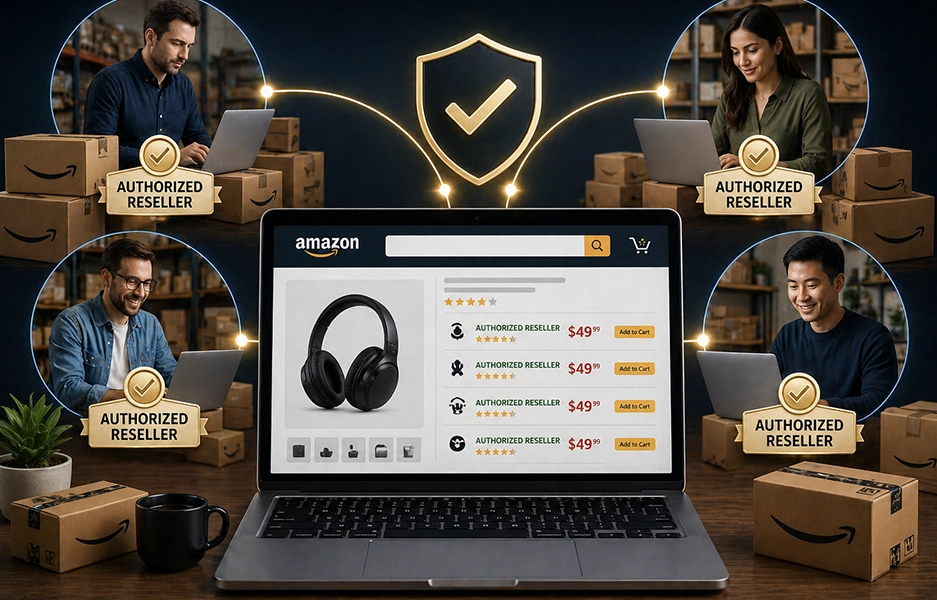
An authorized reseller is a seller approved by the brand to purchase and resell products, typically under a distribution or reseller agreement.
On Amazon, authorized resellers may:
- Purchase directly from the brand
- Purchase from an approved distributor
- Sell via FBA or FBM
- Compete for the Buy Box
Unlike unauthorized sellers, authorized resellers operate within your formal channel structure. But authorization alone does not guarantee alignment with your long-term Amazon strategy. Understanding how these roles differ across the supply chain is critical — see Distributor vs. Wholesaler vs. Retailer.
The Pros of Allowing Authorized Resellers on Amazon
1. Larger Purchase Orders Up Front
One of the most attractive aspects of authorized resellers is the immediate revenue impact.
They often place:
- Large opening purchase orders
- Recurring bulk replenishment orders
- Forecasted commitments
From a cash-flow perspective, this is appealing. You generate strong front-end revenue without handling each individual sale.
However, it’s important to look beyond the initial PO — because what looks strong up front can create downstream cannibalization if not structured carefully.
2. Operational Leverage
If your brand does not want to manage:
- Fulfillment logistics
- Advertising campaigns
- Day-to-day Seller Central operations
- Customer service
Authorized resellers can carry that burden.
In theory, they:
- Invest in PPC
- Optimize listings
- Maintain inventory levels
- Compete effectively for the Buy Box
This reduces internal workload and staffing requirements, especially compared to managing everything in-house as described in Selling on Amazon: Pros and Cons.
3. Increased Inventory Coverage
Multiple authorized sellers can:
- Reduce stockout risk
- Maintain constant inventory availability
- Keep listings active during account disruptions
Redundancy can protect revenue continuity — especially if one account encounters operational issues.
4. Marketplace Expertise
Some resellers bring genuine Amazon expertise.
They may have:
- Strong account health metrics
- Advanced advertising knowledge
- Sophisticated inventory forecasting
- Established logistics systems
If you lack internal marketplace experience, partnering with a high-performing reseller can accelerate your Amazon presence.
The Critical Question: Do They Add Value?
Authorized sellers should bring additional value — not simply piggyback off your marketing and brand equity.
If your brand is already:
- Driving traffic through off-Amazon advertising
- Investing heavily in PPC
- Ranking organically
- Maintaining strong Buy Box ownership
Then what exactly is the reseller contributing?
If their strategy is simply:
- Matching your price
- Winning partial Buy Box share
- Benefiting from your marketing investment
Then they are not expanding your business — they are dividing it.
Authorized sellers should add:
- Incremental advertising spend
- New customer acquisition
- Additional geographic reach
- Operational scale you cannot handle
- Strategic channel partnerships
If they are not expanding the pie, they are splitting it. This aligns with building value-driven Amazon seller strategies.
The Cons of Allowing Authorized Resellers on Amazon
1. Buy Box Fragmentation
When multiple authorized sellers list the same ASIN, they compete for the Buy Box.
Even if all sellers follow MAP, Amazon rotates Buy Box ownership based on:
- Price
- Fulfillment speed
- Seller metrics
- Inventory levels
This results in:
- Shared Buy Box percentages
- Fragmented revenue
- Reduced pricing leverage
If Buy Box ownership is strategically important to your brand, allowing multiple sellers weakens control. To understand how this works, see Buy Box rotation.
2. Backend Cannibalization
Authorized sellers often look strong on the front end because of large POs.
But on the backend, they may:
- Cannibalize your own direct sales
- Take Buy Box share you previously owned
- Reduce your long-term margin
- Limit future pricing flexibility
You may sell more inventory initially — but lose long-term profitability and control.
Front-end revenue can mask backend erosion.
3. MAP Violations Still Happen
Authorization does not equal compliance.
Even authorized sellers may:
- Drop below MAP to capture 100% Buy Box
- Use automated repricers
- Violate during weekends or holidays
- Trigger price cascading
Without structured Amazon MAP monitoring and Amazon MAP enforcement, internal competition can spiral quickly.
4. Margin Compression
When multiple authorized sellers compete, the natural pressure is toward lower pricing.
Even without explicit violations, competitive dynamics lead to:
- Tighter margins
- Higher advertising spend
- Reduced overall profitability
More sellers typically equals thinner margins.
5. Harder Diversion Control
When inventory is sold to multiple authorized resellers, tracing product becomes more complex.
If unauthorized sellers appear:
- Did inventory leak from a distributor?
- Was it resold downstream?
- Was excess inventory diverted?
The more accounts authorized, the more potential entry points for grey market activity.
In many cases, brands need to remove unauthorized sellers on Amazon and investigate supply chain leaks.
6. Channel Conflict
Authorized Amazon resellers can create tension with:
- Brick-and-mortar retailers
- International distributors
- Your own DTC channel
Retail partners may question:
“Why are Amazon sellers undercutting us?”
If pricing discipline isn’t airtight, allowing resellers on Amazon can weaken broader channel relationships. This is especially relevant when applying MAP pricing strategies.
Strategic Models to Consider
Not all reseller strategies are equal.
Open Authorization
Many sellers allowed.
Pros:
- Broad coverage
Cons:
- Pricing instability
- Buy Box chaos
Limited Authorized Network
2–3 carefully selected partners.
Pros:
- Better control
- Clear accountability
Cons:
- Less redundancy
Exclusive Model
One authorized seller (or brand-only model).
Pros:
- Maximum Buy Box control
Cons:
- High dependency
The fewer sellers you allow, the easier control becomes.
When Authorized Resellers Make Sense
They make sense when:
- They bring incremental value
- They expand into new markets
- They invest meaningfully in growth
- You maintain strict MAP enforcement
- Distribution agreements are clearly defined
In these cases, resellers act as partners — not competitors.
When It Becomes Risky
It becomes risky when:
- Resellers simply split existing demand
- They rely on your marketing
- Buy Box ownership is strategically critical
- MAP enforcement is inconsistent
- Distribution visibility is weak
Without structure, authorization evolves into internal competition.
Final Verdict
Allowing authorized resellers on Amazon is not inherently good or bad.
It is a strategic control decision.
Pros:
- Larger initial purchase orders
- Operational leverage
- Redundant inventory coverage
Cons:
- Buy Box fragmentation
- Backend sales cannibalization
- Margin compression
- Increased pricing instability
The real question isn’t:
“Should we authorize resellers?”
It’s:
“Are they expanding our business — or dividing it?”
Authorization without added value leads to dilution.
Authorization with structure and accountability leads to scalable growth.
The brands that win on Amazon don’t simply add sellers.
They design their reseller strategy intentionally — with long-term control in mind.
Take control of your marketplace presence with fast, effective brand protection strategies.
Every day, unauthorized sellers and MAP violations can erode your pricing, reputation, and revenue. Don’t wait for problems to escalate, start enforcing your policies and reclaim your market authority with our proven tools and expert support.


 Brand Alignment