

Seen the videos of people unboxing Amazon pallets? Here’s how resellers actually source them — where to buy, what to expect, the real risks, and what brands need to know about this market.
Table of Contents
- What Are Amazon Pallets?
- Where to Buy Amazon Pallets
- Research Before You Buy: What to Evaluate
- The Bidding and Buying Process
- Receiving and Processing Your Amazon Pallet
- Listing Pallet Inventory on Amazon and Other Marketplaces
- Key Risks and Considerations for Pallet Buyers
- What This Means for Brands: The Brand Protection Angle
Amazon return pallets have become a mainstream entry point for aspiring resellers — fueled by viral social media content showing dramatic unboxing reveals and apparent big finds. But the reality of buying and reselling Amazon pallets is more nuanced than the highlights reel suggests. This guide walks through the complete process step by step: what Amazon pallets actually are, where to buy them, how to evaluate and process them, and the risks that both resellers and brands need to understand.
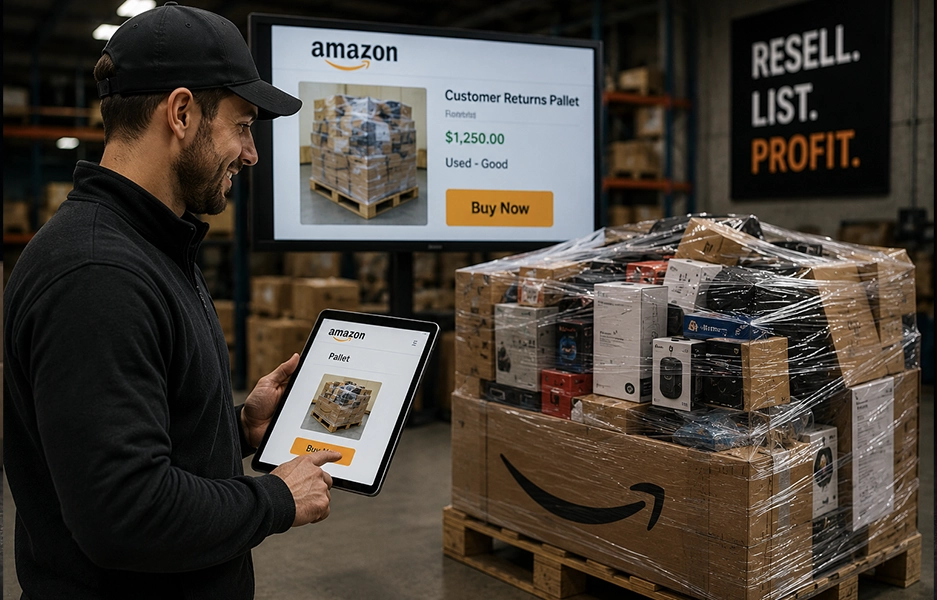
What Are Amazon Pallets?
Amazon pallets are bulk lots of products that originated in Amazon’s supply chain and were removed from active retail inventory for various reasons. Amazon return pallets are real — they’re not an internet myth — but understanding what they actually contain is essential before spending money on one.
The most common sources of Amazon pallet inventory include:
- Customer returns: Products returned by buyers for any reason — changed mind, wrong item, defective, or simply unwanted. These are the largest volume source.
- Overstock: Excess inventory that Amazon or third-party sellers couldn’t move through normal channels.
- Discontinued items: Products being phased out to make room for newer inventory.
- Shelf pulls: Items removed from Amazon’s fulfillment centers for various operational reasons.
Contents can range from brand new and factory sealed to open-box, customer-damaged, incomplete, or non-working. Pallets can be mixed general merchandise or themed by category (electronics, apparel, home goods). Some are “manifested” — meaning you receive a full itemized list of contents. Others are sold blind. How this liquidation process works end-to-end shapes what resellers actually receive and what brands experience in the secondary market.
Where to Buy Amazon Pallets
Amazon does not sell pallets directly to individual consumers. Instead, it works with several established liquidation platforms to move excess and returned inventory at scale. Here are the primary channels resellers use:
- B-Stock (Amazon’s official liquidation marketplace): Amazon’s own B2B liquidation platform. Approved buyers bid on Amazon return and overstock pallets organized by warehouse location, region, and product category. This is the most direct source of Amazon-originated inventory.
- Liquidation.com: One of the largest online auction sites for returned and overstock goods, including Amazon inventory. Buyers can browse, bid, or buy fixed-price lots across a wide range of categories.
- 888lots.com: Specializes in curated lots designed for Amazon resellers, typically with manifests and profit calculators estimating margins after Amazon fees — a feature that actively encourages relisting on Amazon.
- Direct Liquidation, Via Trading, and regional platforms: These sites also offer Amazon-adjacent returns and overstock, though their lots may be less specifically tailored to e-commerce sellers.
- Physical bin stores: Retail locations that purchase truckloads of Amazon returns and sell items individually to the public at very low prices ($1–$10 per item). Popular with Amazon FBA arbitrage buyers.
Most platforms require account registration. Some require business documentation; others are open to the public. Understanding how pallets end up back on Amazon through these channels is important context for both resellers and the brands whose products appear in them.
Research Before You Buy: What to Evaluate
The biggest mistake new pallet buyers make is bidding before doing adequate research. Several factors determine whether a lot is worth purchasing:
- Manifested vs. unmanifested: Manifested pallets provide a detailed itemized list, making it possible to estimate resale value before bidding. Unmanifested pallets are sold blind — typically cheaper, but with significantly higher risk of receiving low-value or unsellable goods.
- Condition codes: Every platform uses a grading system — new, like-new, shelf pull, salvage, etc. Read the platform’s definitions carefully, as grading standards vary significantly between liquidators.
- Total landed cost: Pallets are large and heavy. Freight costs can add $100 to $500 or more to your total investment. Calculate shipping, storage, and processing costs before bidding — not after winning.
- Product category: Electronics and branded goods typically command higher resale prices but also come with stricter Amazon listing requirements, more competition, and higher risk of condition disputes.
- Platform tools: Sites like 888lots provide profit calculators showing estimated Amazon margins. Use these as a starting point, but verify the math independently against current Amazon pricing for the specific products in the lot.
Understanding what’s legal when reselling on Amazon is also essential research for new pallet buyers — the First Sale Doctrine permits resale of authentic goods, but condition accuracy is a strict requirement.
The Bidding and Buying Process
Most liquidation platforms use one of two purchasing formats:
- Auction format: Listings run for several days with a countdown timer. The highest bidder at close wins. Competition for desirable lots can drive prices significantly above opening bids — always set a maximum bid based on your cost analysis, not on competitive momentum.
- Buy Now (fixed price): Some lots are available at fixed prices. This format is more convenient but often priced at a premium. Still useful when specific inventory is needed immediately.
Some platforms have minimum order quantities — particularly for truckload lots or high-value electronics categories. Most require payment in full before release. Winning a bid is a commitment to purchase, so accurate pre-bid research is critical. For buyers near major Amazon fulfillment centers, local pickup can significantly reduce freight costs.
Receiving and Processing Your Amazon Pallet
Winning the bid is just the beginning. What happens when the pallet arrives determines whether the purchase becomes profitable:
- Inspect upon arrival: Photograph the pallet before unpacking. Document any visible damage to shipping packaging. Open and inspect each item, noting condition discrepancies from the manifest (if provided). Photos create documentation for potential disputes.
- Sort by condition: Categorize inventory into sellable as new, open-box/used, parts only, repairable, and disposal/donation. This sorting step determines how each item can be listed and on which platform.
- Clean, test, and repackage where needed: Items in sellable condition may need cleaning or minor cosmetic work. Electronics should be tested before listing. Repackaging should accurately represent the item’s actual condition.
- Review Amazon condition guidelines carefully: Amazon has specific definitions for New, Used — Like New, Used — Very Good, Used — Good, and Used — Acceptable. Do not list an item as “New” unless it is factory sealed in original packaging — this is one of the most important rules for pallet resellers. Test buys by brand protection firms specifically target listings misrepresenting condition.
Listing Pallet Inventory on Amazon and Other Marketplaces
Once processed, pallet inventory can be listed through multiple sales channels — each with different requirements, fees, and risks:
- Amazon FBA: Fulfillment by Amazon gives resellers access to Prime shipping and Amazon’s customer service. For pallet resellers, FBA vs. FBM is an important choice — FBA provides convenience but requires strict condition compliance and involves commingling risks in Amazon warehouses.
- Amazon FBM: Merchant-fulfilled listings give resellers more control over shipping and packaging but require more operational work. Useful for items that don’t justify FBA fees.
- eBay, Mercari, Facebook Marketplace: Good alternatives for items that don’t fit Amazon’s condition requirements or where Amazon margins are thin.
- Physical bin stores: Some higher-volume pallet buyers run their own bin store locations, selling individual items directly to bargain shoppers.
The most important rule across all platforms: never list used, open-box, or incomplete items as new. This violates platform policies, triggers negative reviews, and — in Amazon’s case — can result in account suspension. It also creates brand protection issues for the brands whose products are misrepresented.
Key Risks and Considerations for Pallet Buyers
The viral appeal of Amazon pallet flipping can obscure the genuine risks involved. Before investing, resellers should be realistic about the following:
- Profit is not guaranteed: Many pallets contain significant quantities of low-value, damaged, or unsellable goods. The “treasure hunt” items showcased in social media videos represent a fraction of typical pallet contents.
- Competition is intense and growing: As pallet flipping has grown in mainstream visibility, competition for desirable lots has increased, compressing margins. Profitability requires expertise and efficiency that new resellers take time to develop.
- Amazon account risk: Condition misrepresentation — particularly selling used items as new — is a significant account health risk. Negative reviews, policy violations, and account suspension can eliminate the profitability of an entire pallet purchase.
- Brand restrictions and gating: Some brands use Amazon Brand Registry to gate their products, requiring approval before third-party sellers can list. Customer awareness of authorized vs. unauthorized sellers is also growing.
- Brand monitoring and enforcement: Brands increasingly use MAP monitoring and supply chain investigation to identify pallet-sourced unauthorized sellers. How unauthorized sellers source inventory — including through pallet purchases — is well-understood by brand protection specialists.
What This Means for Brands: The Brand Protection Angle
From a brand perspective, the pallet reseller ecosystem represents one of the most significant sources of unauthorized Amazon sellers. Every liquidation event that moves branded inventory into the open market creates potential resellers who weren’t part of your authorized distribution channel — and who have no obligation to honor your MAP policy, customer service standards, or product condition requirements.
- Pallet-sourced resellers frequently list returned or used goods as new, generating negative reviews on your brand’s product listing.
- Deep-discount liquidation pricing creates downward pressure on authorized channel pricing that can be difficult to recover from.
- The volume and variety of pallet resellers makes ongoing unauthorized seller removal a continuous effort rather than a one-time fix.
The most effective brand protection strategies address both the supply side (controlling how liquidated inventory enters the market) and the demand side (continuous marketplace monitoring and seller enforcement). Understanding the pallet reseller ecosystem — including how buyers source, process, and list inventory — is essential background for any brand building a serious Amazon brand protection program.
Thank you for reading! Whether you’re exploring Amazon pallet buying as a reselling opportunity or a brand monitoring who is sourcing your inventory through the liquidation market, understanding how this ecosystem works is essential. If your brand is dealing with pallet-sourced unauthorized sellers on Amazon, Brand Alignment can help.
Take control of your marketplace presence with fast, effective brand protection strategies.
Every day, unauthorized sellers and MAP violations can erode your pricing, reputation, and revenue. Don’t wait for problems to escalate, start enforcing your policies and reclaim your market authority with our proven tools and expert support.


 Luis Amor