

Not sure if that Amazon email is real or a scam? You’re not alone — fake Amazon emails are among the most common phishing attacks online. Here’s how to tell them apart before you click anything.
Table of Contents
- What Is Liquidation, and Why Does It Matter for Brands?
- How Liquidation Creates Unauthorized Sellers
- The Amazon Return Pipeline Is a Major Driver
- The Biggest Risk: Used Items Listed as New
- Bin Stores and the Long Tail of Unauthorized Sellers
- How Liquidation Marketplaces Accelerate the Problem
- Why Liquidation-Based Unauthorized Sellers Are Hard to Remove
- How Brands Can Reduce Liquidation-Driven Unauthorized Sellers
Brands often assume unauthorized sellers appear on Amazon because of counterfeiters or rogue distributors. While those are real threats, one of the most overlooked sources of unauthorized sellers is liquidation inventory. Once your products enter the secondary market through liquidation, they can reach resellers who relist them on Amazon — often with no awareness of your brand policies, distribution agreements, or MAP pricing. This guide explains how it happens and what brands can do about it.
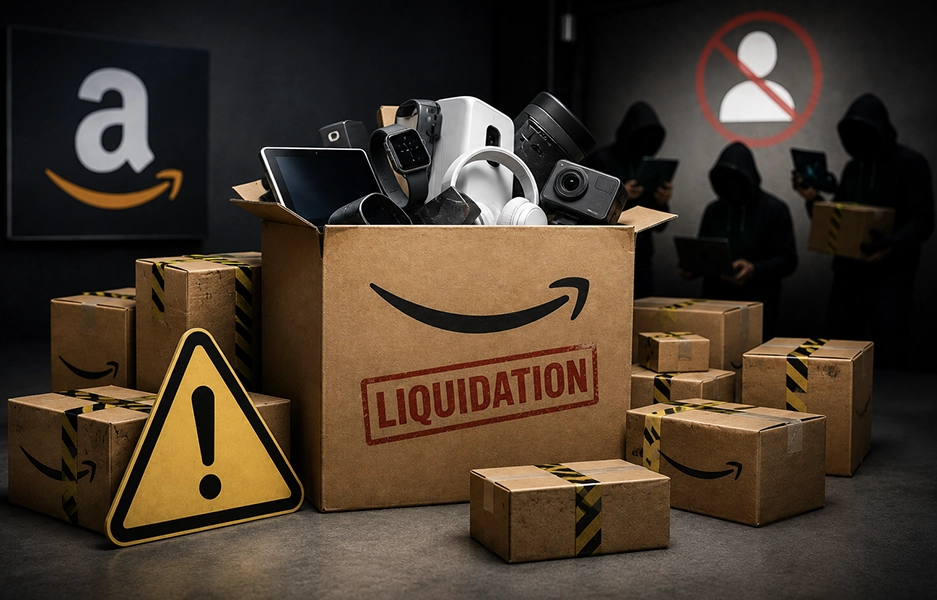
What Is Liquidation, and Why Does It Matter for Brands?
Liquidation is the process of selling off excess, returned, discontinued, or unsold merchandise at a discount — typically in bulk, through pallets, truckloads, or lots. It’s a standard practice in retail and ecommerce: when it costs more to inspect, repackage, and relist individual items than the items are worth, liquidating in bulk is the logical choice.
But from a brand protection standpoint, the moment your products enter the liquidation market, you lose direct control over where they end up. Understanding how liquidation works is the first step to recognizing why it so frequently creates unauthorized sellers — and what that means for your Amazon presence.
Liquidated inventory is sold through platforms like B-Stock (Amazon’s own official liquidation marketplace), Liquidation.com, 888lots.com, and numerous regional warehouses. Once a buyer purchases a lot, that inventory can be relisted on Amazon, eBay, Walmart Marketplace, or any other channel — with no requirement to contact the brand, honor distribution agreements, or comply with MAP pricing policies.
How Liquidation Creates Unauthorized Sellers
The mechanism is straightforward: liquidation puts authentic product into the hands of buyers who are not part of your authorized distribution channel. Those buyers — Amazon FBA resellers, eBay flippers, bin store operators, warehouse resellers, or small local liquidation buyers — often don’t know or care about your distribution policies. They’re chasing margin.
Many of these sellers are not acting in bad faith — they simply purchased authentic inventory through a legal channel and are reselling it. But the outcome is the same as any other unauthorized seller scenario: your products appear on Amazon under sellers you don’t recognize, at prices you didn’t approve, under conditions you can’t verify.
The cycle compounds over time. Each liquidation event introduces new inventory into the secondary market. Each lot sold generates new potential unauthorized sellers. Without active monitoring and intervention, liquidation doesn’t create a one-time problem — it creates a persistent grey market pipeline.
The Amazon Return Pipeline Is a Major Driver
One of the largest contributors to liquidation-based unauthorized selling is the Amazon return pipeline. Amazon return pallets are a well-established secondary market — bulk lots of customer-returned merchandise sold through Amazon’s own B-Stock platform and other liquidation channels.
Returned products can include opened packaging, used items, missing parts, damaged accessories, and incomplete bundles. Instead of inspecting each item individually, retailers and marketplaces sell these in bulk to liquidators. Those liquidators then sell to resellers, who list items on Amazon — creating a direct pipeline from your brand’s returns back to the marketplace.
The risk isn’t just about volume. It’s about condition. Products that end up back on Amazon through the return liquidation pipeline may have been customer-used, partially disassembled, or incompletely repackaged — creating a product experience that bears no resemblance to what your brand intended to deliver.
The Biggest Risk: Used Items Listed as New
The most damaging outcome of liquidation-fed unauthorized selling occurs when returned or open-box goods are listed as “new” on Amazon. This creates a cascade of brand protection problems:
- Customers who believe they’re purchasing a factory-new product receive something used, incomplete, or damaged.
- Negative reviews accumulate on your product listing — not the unauthorized seller’s account, but your brand’s product page.
- Customers blame the brand for the experience, damaging the trust that authorized sellers and your marketing have worked to build.
- “Used-as-new” offers are frequently priced significantly lower than legitimate new listings, directly competing against your authorized inventory.
This is one of the fastest ways liquidation can simultaneously destroy price integrity (your MAP policy becomes meaningless when an unauthorized seller is undercutting by 40%) and product integrity (customers lose trust in quality when returns circulate as new). Product diversion through liquidation is a serious brand protection threat that requires active management.
Bin Stores and the Long Tail of Unauthorized Sellers
Beyond major liquidation platforms, a second wave of unauthorized seller creation comes from physical “bin stores” — retail locations across the US that purchase truckloads of Amazon returns and sell items directly to the public at extremely low prices, typically $1 to $10 per item.
These stores attract a specific type of buyer: people who scan products in-store, check Amazon resale prices on their phone, and immediately list items as FBA sellers. Even small-volume buyers can become unauthorized Amazon sellers overnight, sourcing from a bin store in the morning and listing by afternoon.
This long tail of small-volume resellers is particularly difficult to address because:
- Each individual seller may be listing only a handful of your products.
- They’re constantly being replaced as new lots enter bin stores.
- They operate below the visibility threshold of casual marketplace monitoring.
Only continuous Amazon MAP monitoring and seller investigation can identify and track this level of marketplace activity.
How Liquidation Marketplaces Accelerate the Problem
Some liquidation platforms are explicitly designed to serve Amazon resellers, providing product-level data including estimated Amazon fees, average sale prices, and potential profit margins. This effectively industrializes the unauthorized seller pipeline — making it easier, faster, and more financially calculated for buyers to source liquidated inventory and relist it on Amazon.
When a liquidation platform publishes that a lot contains branded goods with a potential 60% margin on Amazon, it’s actively recruiting the next wave of unauthorized sellers for your brand’s listings. The more attractive your brand’s products are on Amazon, the more targeted your brand becomes as a liquidation resale opportunity.
This is why grey market supply chain investigation matters — identifying not just who is selling, but which liquidation channels are feeding new sellers into your marketplace listings is essential to addressing the source rather than just the symptoms.
Why Liquidation-Based Unauthorized Sellers Are Hard to Remove
Amazon’s marketplace policies create a fundamental challenge for brands trying to remove liquidation-sourced unauthorized sellers. Under the First Sale Doctrine, resellers who have legally purchased authentic goods generally have the right to resell them — and Amazon’s platform reflects this legal reality.
Unless a seller is selling counterfeit goods, violating trademark usage, selling materially different products, or misrepresenting condition, Amazon may not remove them simply because the brand objects to their presence. This means:
- Standard IP-based takedown requests may not apply to authentic liquidated inventory.
- Policy violation complaints (e.g., used-as-new) are more effective but require documentation.
- Removal of one seller often creates space for the next liquidation buyer to fill.
This is why liquidation-based unauthorized selling is a cycle, not a one-time problem. Without addressing the supply source, removing sellers provides only temporary relief. Unauthorized seller removal programs are most effective when combined with supply chain controls that reduce the flow of new inventory into liquidation channels.
How Brands Can Reduce Liquidation-Driven Unauthorized Sellers
Addressing liquidation-based unauthorized sellers requires working on both sides of the problem: reducing the supply of liquidated inventory entering uncontrolled channels, and actively managing what’s already in the marketplace.
- Control how excess and returned inventory is disposed. Where possible, use vetted liquidation partners who contractually agree not to resell on Amazon or other online marketplaces. Destruction or charity donation is preferable to open liquidation for high-risk categories.
- Track inventory through lot codes or serial numbers. Serialized inventory allows you to trace leakage sources and identify which distribution partners or return channels are feeding the secondary market.
- Monitor marketplaces continuously. You need real-time visibility into who is selling, where pricing is dropping, and when new sellers appear. Amazon MAP monitoring combined with seller tracking provides this layer of visibility.
- Enforce MAP and seller compliance aggressively and early. The faster enforcement begins after a new unauthorized seller appears, the less momentum they gain. MAP enforcement that responds quickly prevents pricing from collapsing before it can be corrected.
- Act decisively against “used sold as new” listings. This condition misrepresentation is one of the strongest grounds for test buy-supported removal requests, because it directly violates Amazon’s condition guidelines regardless of the First Sale Doctrine argument.
Liquidation will always be part of ecommerce — but with the right controls in place, brands can significantly reduce how much of their liquidated inventory finds its way back to Amazon through unauthorized sellers.
Thank you for reading! Liquidation is one of the most overlooked sources of unauthorized Amazon sellers — and one of the most persistent. If your brand is experiencing unauthorized sellers and wants to identify whether liquidation is feeding the pipeline, Brand Alignment’s supply chain audit can help.
Take control of your marketplace presence with fast, effective brand protection strategies.
Every day, unauthorized sellers and MAP violations can erode your pricing, reputation, and revenue. Don’t wait for problems to escalate, start enforcing your policies and reclaim your market authority with our proven tools and expert support.


 Luis Amor