

In today’s retail landscape, the line between consumer and distributor has blurred. The rise of online marketplaces has enabled a new class of actors, resellers, who operate with speed, data, and profit optimization. What was once a straightforward retail environment has evolved into a hybrid system where physical stores increasingly serve as sourcing hubs for digital commerce.
At its core, this shift raises a fundamental question: Is what’s economically efficient always ethically acceptable?
Table of Contents
- The Economic Case for Resellers
- The Ethical Tension: Who Gets Access?
- From Consumption to Extraction
- Are Resellers Causing the Problem, or Revealing It?
- Is Socially Destabilizing Behavior Acceptable if It’s Rational?
- The Retailer’s Responsibility
- The Role of Limits and Controls
- Are Resellers Rational or Irrational?
- The Bigger Picture: Two Systems Colliding
- Final Thought
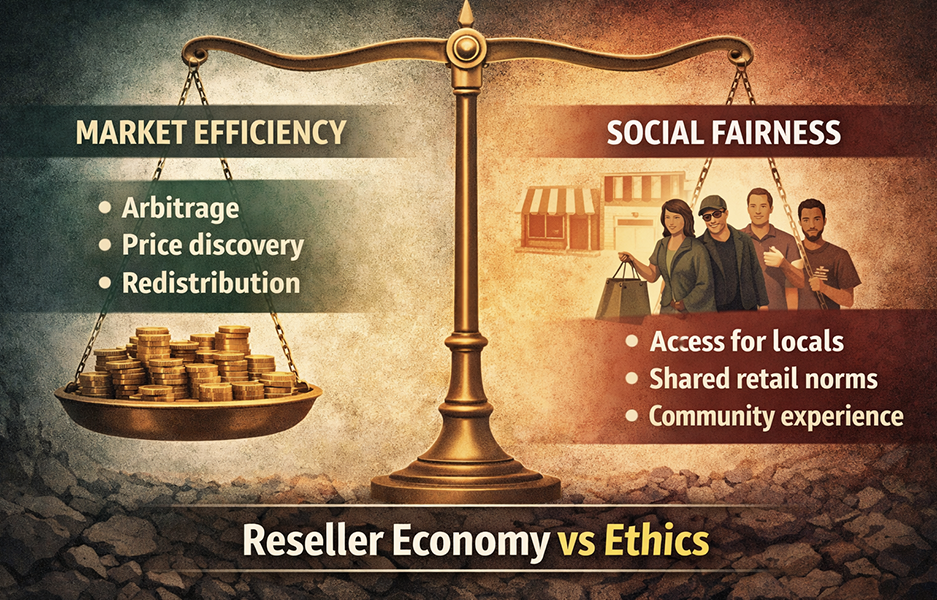
The Economic Case for Resellers
From a purely economic standpoint, resellers are rational actors.
They identify inefficiencies, price gaps between retail and online markets, and exploit them. This is classic arbitrage:
- Buy low (in-store, clearance, regional pricing)
- Sell high (online, where demand is higher)
- Capture the spread
In theory, this improves market efficiency:
- Products move to where demand is highest
- Price discovery becomes more accurate
- Inventory is redistributed across geographies
This is not new. It’s foundational to how markets function.
In fact, much of the online marketplace ecosystem, especially platforms like Amazon, is built around this dynamic. The Buy Box, where nearly 89% of sales occur, rewards sellers who optimize price, fulfillment, and availability.
From this lens, resellers are simply playing the system as designed. For brands that later face downstream pricing and channel instability, these same dynamics often become part of broader Amazon brand protection strategies.
@vivi444_ my husband will record your ugly mug while narrating just how greedy you are. i love you baby thank you for at least trying to get me a bag🩷 do better coach, why allow this? @Coach #coach #coachpurse #arizona #coachdrop #pinkcoach ♬ original sound - vivi444_
The Ethical Tension: Who Gets Access?
The issue becomes more complex when these digital incentives spill into physical environments. Consider a limited product drop in a retail store:- Local customers arrive early, intending to purchase for personal use
- Resellers arrive earlier, often in groups, with the intent to buy in bulk
- Inventory is cleared rapidly
- Regular shoppers leave empty-handed
- Competing asymmetrically (profit vs personal use)
- Prioritizing remote, invisible buyers over present, local ones
- Converting a shared retail space into a supply acquisition channel
From Consumption to Extraction
Traditional retail environments are designed for consumption. Reseller-driven environments shift toward extraction. This changes behavior inside the store:- Normal shopper: “I want one.”
- Reseller: “I want all available units.”
- From fairness to speed and aggression
- From browsing to hoarding
- From community to competition
Are Resellers Causing the Problem, or Revealing It?
There’s an important nuance here. Resellers don’t create inefficiencies, they expose them. They exist because:- Retail pricing is lower than true market demand
- Scarcity is artificially created through limited releases
- Brands benefit from hype but don’t control downstream distribution
- A symptom of mispricing and poor distribution control
- An amplifier of the resulting disruption
Is Socially Destabilizing Behavior Acceptable if It’s Rational?
This is the central ethical question. From a market perspective:- Resellers are efficient
- They allocate goods to the highest willingness-to-pay buyer
- They optimize supply chains
- They disrupt local access
- They create tension in shared environments
- They extract value without contributing to the retail experience
The Retailer’s Responsibility
This is where accountability shifts. Resellers operate within the rules, but retailers design the environment. So: Does a retailer have a moral responsibility to limit this behavior? Legally, not necessarily. Strategically and ethically, arguably yes. Without intervention, retailers:- Turn stores into reseller supply hubs
- Externalize the social cost (frustration, chaos)
- Risk long-term brand damage
The Role of Limits and Controls
Retailers have tools to rebalance this system:- Purchase limits (1–2 units per customer)
- Staggered releases
- Loyalty-based access
- Online queue systems
- Who gets access
- How fairly inventory is distributed
- Whether the retail experience remains consumer-focused
Are Resellers Rational or Irrational?
Economically, resellers are entirely rational. They:- Maximize profit
- Minimize risk
- Scale through systems and coordination
The Bigger Picture: Two Systems Colliding
What we’re witnessing is more than a reseller problem, it’s a system collision.- Physical retail is designed for individuals and communities
- Digital marketplaces are optimized for scale, speed, and arbitrage
Final Thought
The cleanest way to frame this: Resellers convert consumer environments into extraction environments, using physical access to serve digital markets. This is economically rational, but socially corrosive when left unchecked. For brands and retailers, the takeaway is clear: Control isn’t only about pricing or distribution. It’s about defining the rules of access, and protecting the integrity of both your marketplace and your customer experience. In many cases, brands that stabilize pricing and seller behavior also recover performance through a structured Buy Box Recovery Program. If you’re seeing similar dynamics affecting your products, whether through unauthorized sellers, price erosion, or Buy Box loss, there are structured ways to regain control. Would you like to explore how Brand Alignment helps brands manage and prevent these issues? Contact us.Take control of your marketplace presence with fast, effective brand protection strategies.
Every day, unauthorized sellers and MAP violations can erode your pricing, reputation, and revenue. Don’t wait for problems to escalate, start enforcing your policies and reclaim your market authority with our proven tools and expert support.




 Brand Alignment