

A supply chain is the full system moving products from production to customers — and for ecommerce brands, controlling it is the difference between pricing stability and marketplace chaos.
A supply chain is the complete system of organizations, people, activities, data, and resources involved in moving a product from raw materials to the end customer. It includes sourcing, manufacturing, logistics, warehousing, distribution, and retail execution. For ecommerce directors and brand owners, the supply chain is not just an operations function — it directly impacts pricing stability, product availability, brand integrity, and marketplace performance.
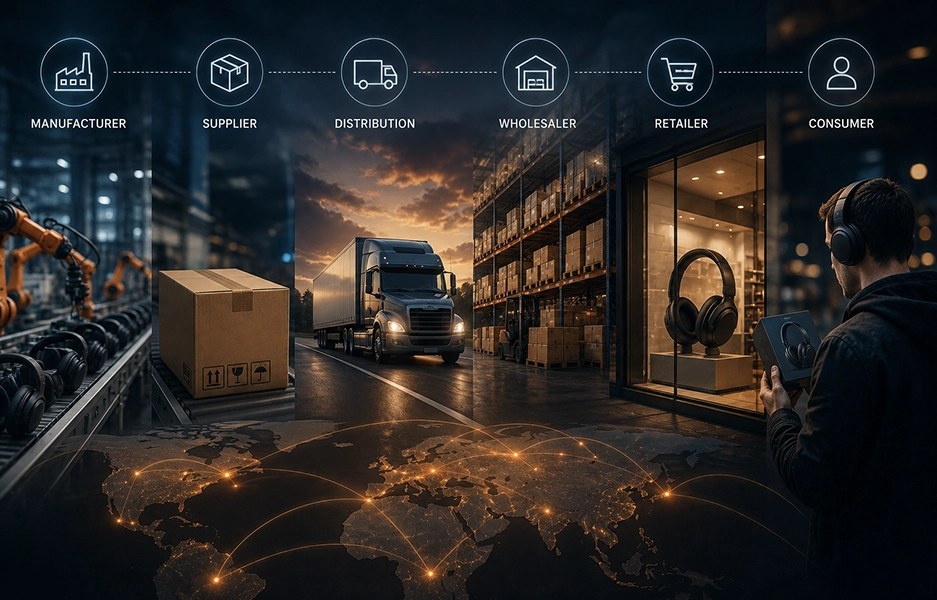
What is Supply Chain?
A supply chain is the end-to-end network that moves a product from production to consumption. It coordinates the flow of:
- Materials — raw inputs from suppliers
- Information — demand signals, forecasting, and inventory data
- Goods — finished products moving through distribution
- Money — payments and pricing structures across tiers
Example: For a consumer electronics brand: Raw materials → Component manufacturers → Assembly factories → Freight shipping → Warehouses → Amazon FBA → Customer delivery. Each step is a link in the supply chain — and a disruption in any link impacts the entire system.
Understanding what causes product diversion within supply chains is essential for brands that want to maintain pricing integrity and channel control.
Why Supply Chain Strategy Matters
A strong supply chain strategy ensures products are delivered efficiently, profitably, and consistently across channels. For ecommerce leaders, the supply chain is a direct driver of competitive performance — not just an operational concern.
Why it matters for ecommerce leaders
- Prevents stockouts and lost Buy Box eligibility
- Stabilizes pricing across marketplaces
- Reduces dependency on reactive firefighting
- Improves customer experience and delivery speed
- Protects brand reputation and channel trust
Key insight: Companies with optimized supply chains can reduce logistics costs by 10–20% while improving service levels (McKinsey industry benchmark). The brands that treat supply chain as a strategic function — rather than a cost center — consistently outperform on marketplace availability and pricing stability.
The decision between using distributors vs. direct-to-consumer models is one of the most consequential supply chain choices a brand makes, directly affecting how much pricing and channel control they retain.
The Five Key Stages of a Supply Chain
1. Sourcing and Raw Materials
This is the acquisition of raw inputs from suppliers. Key activities include supplier selection, contract negotiation, and quality standards enforcement. Sourcing decisions made here ripple through every downstream stage — a supplier reliability issue at this stage can cause stockouts months later.
2. Manufacturing and Production
Transformation of raw materials into finished goods through assembly lines, quality control, and production scheduling. Production lead times and capacity constraints set the ceiling for everything that follows.
3. Warehousing and Inventory Management
Storage and organization of goods before distribution, including inventory forecasting, stock allocation, and demand planning. This is often where grey market products originate — excess inventory that leaks into unauthorized channels rather than being managed through proper disposition.
4. Distribution and Logistics
Movement of goods to retailers or fulfillment centers via shipping (air, sea, ground), 3PL providers, and cross-border logistics. Parallel imports most commonly enter markets at this stage, when goods are redirected from their intended distribution region to another.
5. Retail and Customer Delivery
The final stage where the product reaches the end customer through Amazon FBA or Walmart fulfillment, direct-to-consumer shipping, or last-mile delivery. This is the stage most visible to the brand — and the one most affected by the supply chain decisions made in every prior stage.
Supply Chain vs Supply Chain Management
| Concept | Definition | Focus |
|---|---|---|
| Supply Chain | The physical and informational network of organizations, people, and resources that move a product from raw materials to the end customer | Movement of goods |
| Supply Chain Management | The strategic coordination and optimization of that system — decisions about how to source, produce, distribute, and deliver efficiently | Optimization & control |
The key distinction: the supply chain is the system itself; supply chain management is how you control and improve it. A controlled distribution model is one of the most effective supply chain management strategies for brands that need to maintain pricing power and prevent unauthorized channel activity.
Why Control of Supply Chain Is Critical
Control of the supply chain determines whether a brand maintains pricing power, product availability, and channel integrity. Without it, brands become reactive — responding to marketplace problems that originate upstream in their own distribution network.
Key benefits of supply chain control
- Prevents unauthorized distribution leaks before they reach marketplaces
- Reduces grey market activity by closing the inventory gaps that enable it
- Maintains MAP (Minimum Advertised Price) stability across channels
- Protects Buy Box performance on Amazon and other marketplaces
- Ensures consistent product authenticity throughout the distribution network
Example in ecommerce: When inventory leaks into unauthorized channels, pricing becomes inconsistent, leading to downward pressure and price cascades across marketplaces. Brands that invest in grey market supply chain investigation can identify where leaks originate and seal them at the source, rather than constantly chasing violations at the marketplace level.
The strategic case for supply chain control is also a brand protection case. See why brands must rethink distribution control as a core competency, not just an operational task.
Problems Caused by Poor Supply Chain Organization
1. Price instability
Uncontrolled distribution leads to unpredictable pricing across channels. When too many intermediaries handle inventory without pricing agreements, the lowest-cost seller defines the market price — and authorized distributors are forced to match it or lose volume.
2. Grey market leakage
Products enter unauthorized reseller networks, often sold below MAP. Grey market activity is almost always a supply chain failure before it becomes a marketplace problem. Stopping distributors from selling on Amazon without authorization is one of the most direct interventions available to brands experiencing this.
3. Inventory imbalances
Some regions overstock while others experience shortages. These imbalances create the conditions for diversion — excess inventory in one market gets liquidated into another, often at prices that undercut the authorized channel in the destination market.
4. Brand dilution
Inconsistent product quality or pricing weakens brand perception. When consumers see the same product at dramatically different prices across channels, the higher-priced listing looks overpriced rather than properly valued.
5. Marketplace disruption
On platforms like Amazon, poor supply chain control frequently results in Buy Box loss, listing suppression, and seller competition conflicts. Removing unauthorized sellers addresses the symptom — supply chain control addresses the cause.
Summary of risks
| Issue | Business Impact |
|---|---|
| Grey market leakage | Margin erosion across authorized channels |
| Stockouts | Lost sales and Buy Box eligibility |
| Overstocking | Capital inefficiency and liquidation pressure |
| Price inconsistency | Brand damage and customer confusion |
Selective distribution is one of the most effective structural solutions to these risks — limiting who can carry your products from the start, rather than trying to manage an uncontrolled network after the fact.
Key Takeaways
- A supply chain is the full system moving products from production to customers — it includes sourcing, manufacturing, logistics, and delivery.
- Supply chain management is the strategy behind optimizing that system, not the system itself.
- Strong supply chain control improves pricing stability, MAP compliance, and brand protection.
- Poor supply chain organization leads to grey markets, inventory imbalances, and revenue loss.
- Grey market activity almost always originates from a supply chain failure, not just a marketplace problem.
- Ecommerce success depends heavily on supply chain visibility and governance upstream, not just marketplace enforcement downstream.
FAQ
What is a supply chain in simple terms?
It is the entire process of producing and delivering a product to a customer — every step from raw materials to the buyer’s hands, including all the organizations, logistics, and systems in between.
Why is supply chain important for ecommerce?
It affects pricing, availability, Buy Box performance, and customer experience. Brands with strong supply chains can maintain consistent pricing and product availability across channels; those without them constantly react to marketplace problems they cannot control.
What is the difference between supply chain and logistics?
Logistics is one component of the supply chain — specifically focused on transportation and storage. The supply chain is the broader system that logistics operates within, also including sourcing, manufacturing, distribution strategy, and channel management.
What are the biggest supply chain risks for brands?
Grey market leakage, stockouts, overstocking that creates liquidation pressure, and price inconsistency across channels. All four are symptoms of supply chain governance failures rather than market conditions outside a brand’s control.
How does supply chain affect brand protection?
Weak supply chains allow unauthorized sellers and pricing violations to emerge because inventory reaches the market through channels the brand cannot monitor or control. Tracking product diversion within the supply chain is one of the most direct ways to close these gaps before they become marketplace problems.
Conclusion
A supply chain is not just an operational framework — it is a strategic asset that determines how effectively a brand competes in modern ecommerce environments.
For brand owners and ecommerce directors, controlling the supply chain means controlling product availability, channel pricing, marketplace performance, and brand perception. Without strong supply chain management, even high-demand products can lose profitability due to leakage, inconsistency, and unauthorized distribution.
In today’s digital marketplaces, supply chain excellence is no longer optional — it is a core requirement for sustainable brand growth and competitive advantage.
Thank you for reading our post, ‘What Is Supply Chain: Complete Expert Guide for Ecommerce Leaders.’ We hope it gave you a clearer picture of how supply chain decisions upstream shape marketplace outcomes downstream. At Brand Alignment, we help brands identify where their distribution is leaking, investigate grey market activity at the source, and build the channel controls needed to maintain pricing integrity across all marketplaces. If you’d like to learn how we can help you gain visibility and control over your supply chain, we’d love to connect.
Take control of your marketplace presence with fast, effective brand protection strategies.
Every day, unauthorized sellers and MAP violations can erode your pricing, reputation, and revenue. Don’t wait for problems to escalate, start enforcing your policies and reclaim your market authority with our proven tools and expert support.


 Brand Alignment