

Table of Contents
- What’s the Difference — and When Should You Use Each?
- What Is a Trademark Complaint on Amazon?
- What Is a Copyright Complaint on Amazon?
- The Core Difference
- When Brands Use the Wrong Complaint
- What About Counterfeit?
- Graduated Enforcement Strategy
- The Risk of Over-Enforcement
- How to Decide Which Complaint to File
- Final Thoughts
What’s the Difference — and When Should You Use Each?
Amazon Brand Registry gives brands powerful tools to protect their intellectual property. But many sellers and brand owners confuse trademark complaints and copyright complaints — and filing the wrong one can delay enforcement, weaken your case, or even expose you to counterclaims. Understanding the difference is critical if you want to protect your listings without creating legal risk. Let’s break down how each works, what they protect, and when to use them. For many brands, intellectual property enforcement is just one component of a broader Amazon brand protection strategy, especially when unauthorized sellers, listing hijackers, or counterfeit risks appear across marketplaces.Why This Matters
Unauthorized sellers and hijackers can damage your brand in multiple ways:- Using your brand name in their seller name
- Copying your product images
- Reusing your A+ content
- Creating duplicate listings with stolen content
- Selling counterfeit products under your brand
- Rejected complaints
- Counter-notices
- Account health issues
- Legal exposure if claims are inaccurate
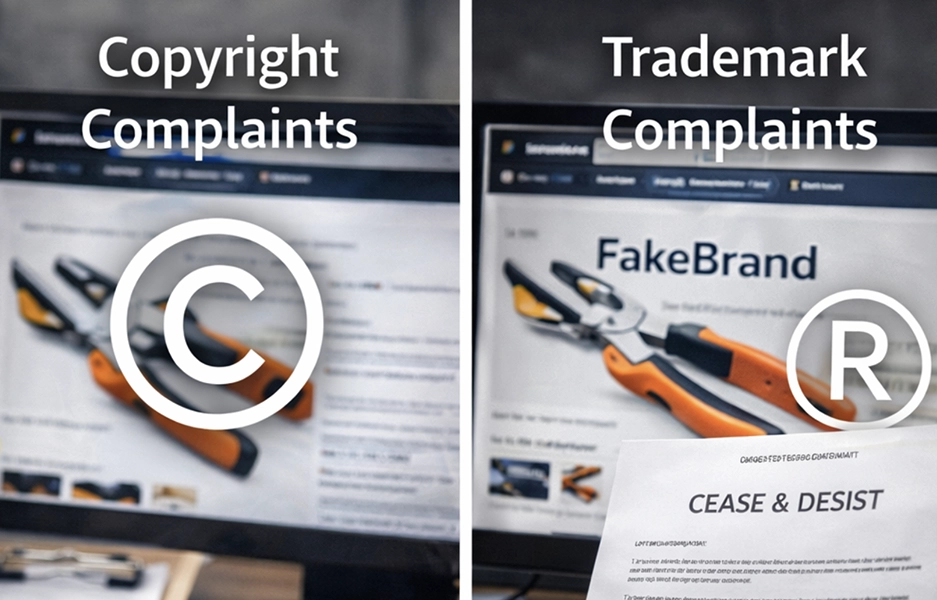
What Is a Trademark Complaint on Amazon?
A trademark complaint involves the unauthorized use of your registered brand identifier. This typically includes:- Brand name
- Logo
- Trademarked slogan
- Registered word mark
- Product mark
Common Trademark Violations on Amazon
- Counterfeit products using your brand name
- Sellers altering your listing title to insert keywords
- Unauthorized sellers creating new listings using your brand
- Seller storefronts pretending to be the “official brand”
- Material differences (for example, selling international versions without disclosure)
- A test buy
- Clear evidence of misuse
- Registered trademark documentation
What Is a Copyright Complaint on Amazon?
A copyright complaint protects original creative content — not brand names. This includes:- Product photos
- A+ Content
- Lifestyle images
- Infographics
- Instruction manuals
- Product description text
- Videos
Common Copyright Violations on Amazon
- Hijackers copying your product images
- Unauthorized sellers using your A+ Content in their own listing
- Competitors stealing your infographics
- Duplicate listings using your exact text and photography
The Core Difference
Here’s the simplest way to understand it:| Trademark | Copyright |
| Protects brand identity | Protects creative content |
| Covers names and logos | Covers images, text, videos |
| Often used for counterfeit claims | Often used for stolen content |
| Requires registered mark | Requires proof of original creation |
When Brands Use the Wrong Complaint
One of the biggest enforcement mistakes brands make is filing the wrong type of complaint. Example 1: An unauthorized seller is using your product images. If you file a trademark complaint, Amazon may reject it — because the issue isn’t misuse of your brand name. It’s misuse of your content. Correct approach: File a copyright complaint. Example 2: A seller is selling a product under your brand name without authorization. If the product is authentic, this is likely a grey market issue, not trademark infringement. Many brands first encounter this problem while trying to understand why their product is on Amazon. Filing a trademark complaint without proof of counterfeit can create legal risk. Correct approach:- Conduct a test buy
- Confirm authenticity
- Determine whether it is counterfeit or unauthorized resale
What About Counterfeit?
Counterfeit cases often involve both trademark and product authenticity. If a seller is using your trademark on a fake product:- Conduct a test buy
- Document differences
- File a trademark complaint through Brand Registry
- Legal threats from sellers
- Counter-notices
- Claims of bad faith enforcement
Graduated Enforcement Strategy
Not every violation needs to begin with a formal complaint. In many cases, brands benefit from a structured approach similar to broader marketplace enforcement programs such as removing unauthorized sellers without costly lawsuits. In many cases, brands benefit from a structured approach:- Friendly outreach asking for invoices
- First warning
- Escalated notice
- Final enforcement action
The Risk of Over-Enforcement
Brand Registry gives brands significant power. But misuse of that power can create real consequences. Amazon tracks:- False complaints
- Repeated incorrect claims
- Counter-notices
How to Decide Which Complaint to File
Ask yourself:- Is the seller misusing my brand name or logo? → Trademark complaint
- Is the seller copying my photos, A+ content, or text? → Copyright complaint
- Is the product fake? → Test buy → Trademark complaint
- Is the product authentic but unauthorized? → This is likely a distribution or grey market issue
Final Thoughts
Trademark and copyright complaints are not interchangeable tools. Each protects a different type of asset:- Trademark protects your identity.
- Copyright protects your content.
- Verify the violation
- Document the evidence
- Choose the correct legal basis
- Be prepared for a counter-response
Thank you for reading our post, “Trademark vs. Copyright Complaints on Amazon Brand Registry.” We hope you found it helpful.




 Brand Alignment