
Table of Contents
- The Two Enforcement Systems in Brand Registry
- 1. Intellectual Property (IP) Complaints / Takedowns
- 2. Policy Violation Complaints
- The Key Difference: Legal Claim vs Marketplace Policy
- IP Takedowns Carry Legal Risk
- Policy Complaints Are Operational, Not Legal
- IP Takedown Health vs Seller Central Account Health
- Choosing the Right Enforcement Strategy
Brands protecting their listings on Amazon often encounter two different enforcement tools inside Amazon Brand Registry. Understanding how these enforcement mechanisms work is a key part of broader Amazon brand protection strategies.
- Intellectual Property (IP) complaints / takedowns
- Policy Violation complaints
At first glance, these two options may appear similar — both allow brands to report sellers and request Amazon to take action. However, they operate in completely different systems, carry different risks, and should be used in different situations.
Understanding the difference between IP takedowns and policy violation reports is critical if you want to protect your listings without creating unnecessary legal exposure or weakening your enforcement capabilities.
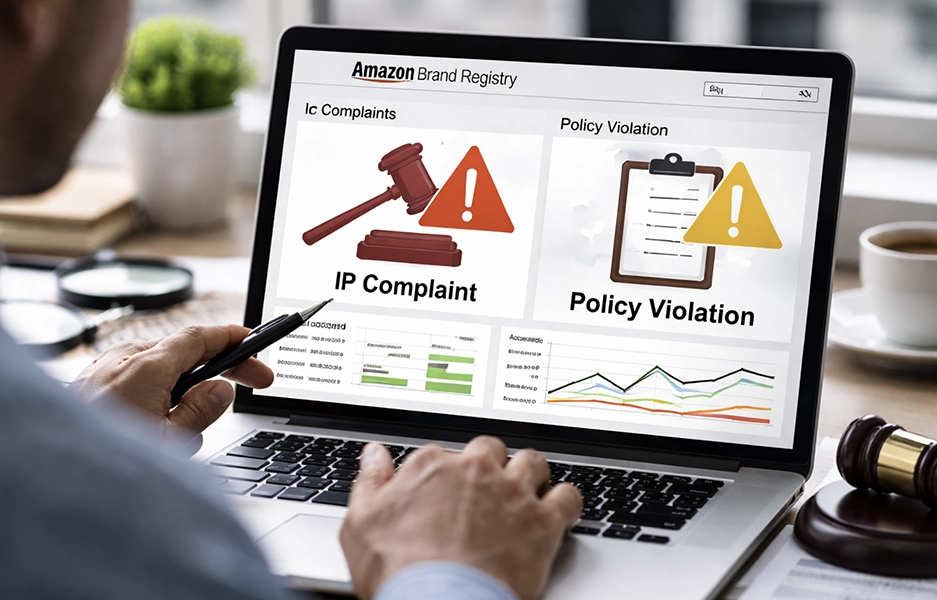
The Two Enforcement Systems in Brand Registry
Amazon gives brands multiple tools to report problematic sellers, but they fall into two main categories.
1. Intellectual Property (IP) Complaints / Takedowns
IP complaints — often referred to as IP takedowns — are submitted through the Brand Registry infringement reporting system. For brands unfamiliar with the system, it helps to understand how Amazon Brand Registry works and how infringement reporting is structured.
These takedowns are used when a seller is violating your legal intellectual property rights, such as:
- Trademark infringement
- Copyright infringement
- Patent infringement
- Counterfeit products
When you submit an IP takedown, you are making a legal claim that the seller is infringing on protected intellectual property owned by your brand.
Because of this, Amazon treats these takedowns very seriously.
Each takedown is tracked inside the Brand Registry infringement dashboard, which effectively acts as your IP enforcement health score.
The dashboard tracks:
- Accepted takedowns
- Rejected takedowns
- Takedowns under review
- Takedowns under additional review
This system shows how Amazon is evaluating your takedown submissions.
The screenshot below shows what this IP takedown health dashboard looks like inside Brand Registry.
Brands with consistently accurate takedowns tend to see higher acceptance rates, while brands submitting weak or incorrect claims may see more rejections.
2. Policy Violation Complaints
Policy violation complaints operate differently.
Instead of being filed through the infringement portal, they are typically submitted through:
Brand Registry → Contact Support
These complaints report sellers who are violating Amazon marketplace rules, such as:
- Used item sold as new
- Product not as described
- Incorrect product variations
- Regulatory violations
- Review manipulation
- Incorrect packaging or product condition
Policy violation reports are not legal claims.
Instead, they notify Amazon that a seller is breaking marketplace policies or listing rules.
The Key Difference: Legal Claim vs Marketplace Policy
| Complaint Type | What It Represents |
|---|---|
| IP Complaint / Takedown | A legal claim of intellectual property infringement |
| Policy Complaint | A report of marketplace rule violations |
When you file an IP takedown, you are essentially stating:
“This seller is infringing on my legally protected intellectual property.”
When you submit a policy violation complaint, you are saying:
“This seller is violating Amazon marketplace policies.”
That difference has major consequences.
IP Takedowns Carry Legal Risk
Because IP takedowns involve intellectual property law, they can carry legal consequences if filed incorrectly.
Some experienced Amazon sellers retain attorneys who specialize in marketplace disputes. If a seller believes an IP takedown was filed improperly, they may respond with:
- Retraction demands
- Counter complaints
- Legal threats
- Civil lawsuits for damages
Brands sometimes receive letters from Amazon seller attorneys requesting that the takedown be withdrawn.
This is why false or exaggerated IP takedowns are extremely dangerous.
If a seller can prove their product is authentic and legally obtained, the brand may be forced to retract the complaint and could face legal exposure.
This situation is especially common when brands confuse unauthorized sellers with counterfeit sellers.
Unauthorized sellers are not always committing intellectual property infringement. Many sellers obtain authentic inventory through secondary channels such as retail arbitrage, liquidation inventory, parallel imports, or grey market distribution. These types of distribution leaks are one of the hidden risks of selling on Amazon that brands often underestimate.
Many sellers obtain authentic products through:
- Retail arbitrage
- Liquidation inventory
- Parallel imports
- Grey market distribution
These sellers may damage pricing integrity or disrupt the Buy Box, but they are often still selling authentic inventory, meaning an IP takedown may not be appropriate.
Policy Complaints Are Operational, Not Legal
Policy violation complaints operate differently.
Instead of asserting a legal claim, they simply notify Amazon that a seller is violating marketplace rules.
Examples include:
- Selling used items as new
- Selling returned inventory
- Listing the wrong product under an ASIN
- Misrepresenting product condition
Because these complaints are not legal claims, they generally carry less legal risk for brands.
However, they still require evidence.
Submitting weak or unsupported complaints repeatedly can make that reporting channel less effective.
Amazon does not publicly disclose how policy complaints are internally scored, but many enforcement teams have seen situations where certain complaint types stop working if they are abused.
IP Takedown Health vs Seller Central Account Health
Many brands worry about their Seller Central account health score, but when it comes to enforcement, that is not the metric that matters.
What really matters is your IP takedown health inside Brand Registry.
Amazon evaluates brands based on how accurate their IP takedown submissions are.
If a brand submits:
- Strong evidence
- Legitimate infringement claims
- Well-documented takedowns
Amazon is more likely to continue trusting those submissions.
However, if a brand submits:
- Weak takedowns
- Incorrect infringement claims
- Unsupported complaints
Amazon may begin rejecting more submissions or placing them under additional review.
This is why maintaining a high-quality takedown record is critical for long-term enforcement success.
Why Test Buys Are Critical Before Filing Takedowns
Before filing many types of takedowns — especially counterfeit claims — brands should perform a test buy.
A test buy allows the brand to:
- Verify the seller actually ships the product
- Inspect the item received
- Compare it against authentic inventory
- Document differences
This step is especially important when filing counterfeit IP takedowns. Many brands also combine enforcement with authentication programs, which is why it is useful to understand the difference between Amazon Brand Registry and Amazon Transparency.
Test buys can reveal:
- Packaging differences
- Missing security seals
- Poor product materials
- Signs of tampering
Photographic evidence collected during a test buy can strengthen your takedown submission.
Test buys are also useful for confirming violations like used items sold as new, which may be better addressed through policy violation complaints instead of IP takedowns.
Choosing the Right Enforcement Strategy
Knowing when to use each complaint type is essential for effective brand protection.
Use IP Takedowns When
- A product is counterfeit
- A seller is misusing your trademark
- Your copyrighted images or text are being stolen
- There is clear intellectual property infringement
Use Policy Complaints When
- The product condition is misrepresented
- The wrong product is listed under an ASIN
- Used inventory is being sold as new
- Listing manipulation is occurring
Choosing the correct enforcement path improves the likelihood of successful removal while reducing legal risk. We can help you with that, learn about our counterfeit protection program
Final Thoughts
Amazon Brand Registry provides powerful enforcement tools, but IP takedowns and policy violation complaints are not interchangeable.
The key differences are:
- IP takedowns are legal claims
- Policy complaints are marketplace rule reports
- IP takedowns affect your enforcement health
- Policy complaints operate behind the scenes
Brands that understand this difference can enforce their listings far more effectively while avoiding unnecessary legal exposure.
The best approach is always the same:
- Gather evidence
- Perform test buys when necessary
- Use the correct complaint type
- Avoid filing takedowns without proof
When used strategically, these tools help brands maintain control over their listings, protect their reputation, and reduce marketplace abuse.




 Brand Alignment