

For many brands, one of the most mystifying and frustrating experiences is seeing your products—sometimes entire collections—listed on Amazon by sellers you never approved, never authorized, and don’t even recognize. How did these resellers get their hands on your inventory? Understanding how this happens is the first step to regaining control.
The Many Paths to the Amazon Marketplace
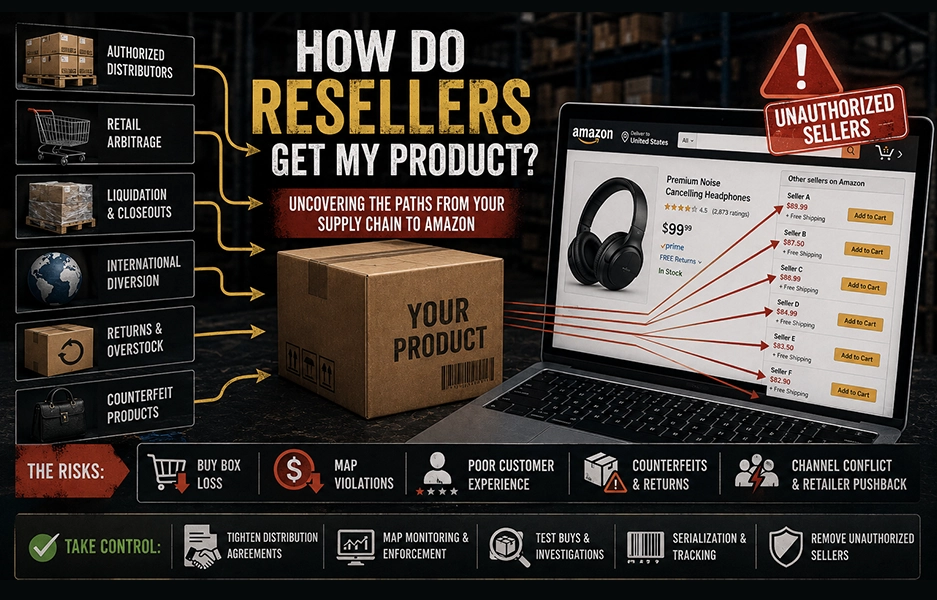
1. Authorized Distribution Leaks
You may have a trusted network of authorized distributors and retailers. However, even within “trusted” channels, products can leak into unauthorized hands:
- Distributors: Some may sell inventory to third-party resellers who operate on Amazon (sometimes knowingly, sometimes not).
- Retailers: A retailer may purchase bulk stock from you or your distributor, then decide to resell excess inventory on Amazon to move products quickly.
- International Distributors: Goods sold for other countries sometimes get diverted back to the U.S. and listed on Amazon’s U.S. marketplace—a classic “grey market” scenario.
This can create complex reseller networks similar to the shadow hierarchy of grey market sellers. If distributors are part of the issue, see how to stop distributors from selling on Amazon.
2. Retail Arbitrage
Retail arbitrageurs are individuals or small businesses that buy your products at a discount from brick-and-mortar stores or major online retailers. They:
- Watch for clearance sales, coupons, or bulk discounts.
- Purchase as much as allowed (sometimes using multiple accounts).
- Turn around and list those products as “new” on Amazon, often undercutting your suggested retail price.
This behavior is easier to understand when you look at Amazon’s shared listing model and how the Amazon Buy Box works.
3. Liquidation and Closeouts
- When your partners or your own business liquidates overstock, discontinued items, or returned merchandise, those goods often get picked up by wholesalers or liquidators.
- These companies specialize in selling bulk lots to small resellers, who then list them on Amazon.
- Items may not be in perfect condition—leading to poor customer experiences and negative reviews attributed to your brand.
4. Employee Theft, Returns, and “Backdoor” Inventory
- Sometimes, products “walk out the back door” through theft, miscounted returns, or employee misconduct.
- Returned or damaged stock that isn’t tracked or destroyed properly can end up resold online.
5. Counterfeit or “Lookalike” Products
- Some “resellers” aren’t selling your product at all, but rather a convincing counterfeit or knockoff. This is especially common with high-demand, high-margin items.
- These sellers might use your brand name, images, and even reviews, confusing customers and damaging your reputation.
In those cases, brands may need counterfeit protection in addition to reseller monitoring.
How to Investigate and Track Down Sources
- Test Buys: Purchase your own product from suspicious sellers. Check lot codes, serial numbers, or unique packaging. See Amazon test buys.
- Map Your Supply Chain: Look for leaks or suspiciously large orders from distributors or retailers.
- Monitor Returns and Liquidations: Ensure returned, damaged, or excess stock is accounted for and not quietly resold.
- Audit International Shipments: See if global distributors are feeding the U.S. market or other Amazon regions.
- Review Reviews: Poor experiences, damaged items, or counterfeit complaints often provide clues about bad actors.
How to Stop the Flow
1. Tighten Distribution Agreements
- Make clear, enforceable agreements with authorized distributors and retailers. Include “do not sell on Amazon” clauses and serial tracking where possible.
Brands may also need to rethink partner structure through selective distribution or a more value-driven Amazon seller strategy.
2. Serial Number Tracking & Product Serialization
- Use unique codes or serials to trace products back to their origin. This deters leaks and allows for actionable evidence if unauthorized sales occur.
For some brands, Amazon Transparency and Interoperability can add another layer of product-level traceability.
3. Proactive MAP Monitoring & Enforcement
- Detect violators quickly with real-time MAP monitoring tools, then take swift action with cease and desist letters, test buys, and Amazon complaints.
Learn more about MAP monitoring software, Amazon MAP monitoring, and Amazon MAP enforcement.
4. Manage Liquidation & Returns
- Carefully manage how and where your liquidations or overstock are sold. Work with trusted partners and set strict policies on returns and destruction.
5. Educate Your Team and Partners
- Train your teams to spot unusual orders, suspicious sales requests, or supply chain “red flags.”
- Regularly communicate with your distributors, reminding them of the consequences of channel leakage.
Final Thoughts
No single tactic will completely eliminate unauthorized resellers, but a layered approach—combining supply chain discipline, monitoring, and legal action—will dramatically reduce unauthorized activity.
If your listings are constantly hijacked by resellers, Brand Alignment’s specialists can help you diagnose your supply chain, clean up your Amazon listings, and put enforceable safeguards in place.
Related resources:
- How do resellers get my product?
- How to stop sellers from jumping on my listing
- Random sellers on my Amazon listing
- Remove unauthorized sellers on Amazon
- Amazon Buy Box Recovery Program
Ready to regain control? Connect with Brand Alignment here.
Take control of your marketplace presence with fast, effective brand protection strategies.
Every day, unauthorized sellers and MAP violations can erode your pricing, reputation, and revenue. Don’t wait for problems to escalate, start enforcing your policies and reclaim your market authority with our proven tools and expert support.

 Brand Alignment