

MAP compliance is the foundation of channel price integrity. Without it, a single discounting retailer can trigger a race to the bottom that erodes margins, damages brand perception, and destabilizes your entire distribution network.
MAP compliance occurs when a retailer or reseller advertises your product at or above the minimum advertised price (MAP) you have set as the brand owner. When a seller publicly displays a price below your MAP, that is a violation. MAP compliance is the foundation of channel price integrity: without it, a single discounting retailer can trigger a race to the bottom that erodes margins, damages brand perception, and destabilizes your entire distribution channel.
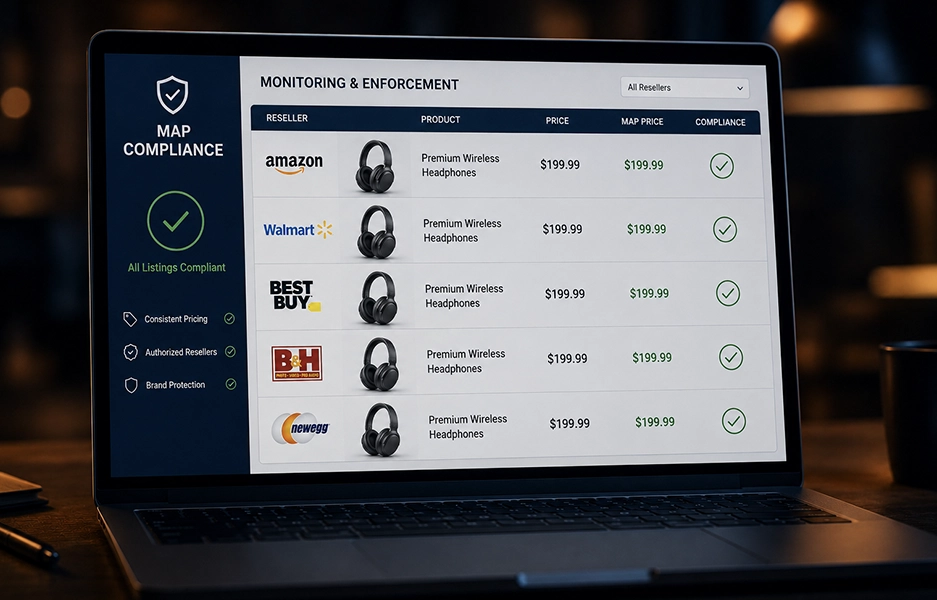
What is MAP compliance?
MAP stands for Minimum Advertised Price. It is the lowest price a manufacturer or brand owner permits a retailer to publicly display for a product. MAP compliance is when a seller honors that floor in every publicly visible channel: their website, Amazon listing, Google Shopping ad, email promotion, or any other advertisement.
A critical distinction: MAP governs the advertised price, not necessarily the actual transaction price. A seller may, in some cases, complete a sale below MAP through an in-cart discount or private negotiation, but they cannot publicly advertise a price below the threshold without violating the policy.
Real example: A shoe brand sets a MAP of $89. A retailer lists the shoe on their website at $79. That is a MAP violation, even if the retailer is an authorized reseller. The brand can take enforcement action regardless of whether the shoes being sold are authentic.
MAP compliance monitoring is the ongoing process of checking every public-facing channel where your products appear to confirm that no seller is advertising below your floor price.
MAP vs. MSRP vs. UPP: what is the difference?
These three terms are frequently used interchangeably. They are not the same, and confusing them can create legal exposure or enforce the wrong thing. For a detailed breakdown, see our guide to understanding MAP, MSRP, and UPP in retail pricing.
| Policy | Controls | Enforceable? | Legal risk if misused |
|---|---|---|---|
| MAP (Minimum Advertised Price) | Lowest price a seller can advertise publicly | Yes, if structured as a unilateral policy | Antitrust risk if negotiated, not unilateral |
| MSRP (Manufacturer’s Suggested Retail Price) | Suggested selling price; no binding floor or ceiling | No; guidance only, retailers may ignore it | Low; it is a recommendation, not a restriction |
| UPP (Unilateral Pricing Policy) | Both the advertised price and the actual sale price | Yes, if applied consistently | Higher risk if not structured correctly; tighter control |
The practical distinction that matters most: MSRP is what brands wish retailers would charge. MAP is the floor for what retailers can advertise. UPP goes further by covering the actual transaction price. For a direct comparison, see MSRP vs MAP: what’s the real difference for brands?
Real example — Apple AirPods: Apple AirPods carry an MSRP of $249. The MAP is typically set around $229. Retailers can advertise the product at any price at or above $229, but may not publicly display $228 or lower without violating the MAP policy.
Why MAP compliance matters for brands
Understanding why MAP policies are important is the first step to building a serious enforcement program. The business case is straightforward.
Preventing a race to the bottom
Because roughly 40% of consumers switch retailers for a better price, a single seller advertising below MAP can pull the entire channel into a discounting spiral. Each retailer sees a competitor undercutting them and responds in kind. The result is compressed margins for everyone, including authorized partners who invested in your brand.
Protecting brand perception
Price signals quality. When a product that normally retails at $150 appears for $79 at one channel, it undermines the perceived value across all channels, including brick-and-mortar retail where your margins are often healthiest. MAP compliance keeps pricing consistent enough that the product’s price position holds up across the market.
Protecting authorized retailer relationships
Retailers who invest in staff training, proper merchandising, and after-sale support cannot compete on price alone against a seller who has none of those costs. MAP creates a level playing field for your authorized distribution network. Losing those relationships is often more costly than the initial margin erosion from a violation.
Stabilizing your Amazon pricing
Amazon’s algorithm automatically matches the lowest price it finds for a product elsewhere on the internet. If any seller lists your product below MAP on any channel, Amazon may match it, and then every channel feels the pressure. This makes MAP enforcement an Amazon pricing issue as much as a general brand protection issue.
Is MAP compliance legal?
In the United States, MAP policies are generally legal under federal antitrust law when structured correctly. See our full breakdown of whether MAP pricing is legal for a complete jurisdiction-by-jurisdiction analysis.
The key legal requirement is that the policy must be unilateral: the brand sets the terms independently and informs resellers of the conditions under which it will continue doing business with them. It cannot be a negotiated agreement with retailers, because that could constitute vertical price fixing.
Critical legal rule: A MAP policy structured as a bilateral agreement or negotiated contract with resellers crosses into price-fixing territory under US antitrust law. The policy must be a unilateral statement by the brand, not a mutual agreement with the channel.
Outside the US, the legal landscape changes significantly:
- EU and UK: MAP is typically treated as vertical price fixing and is prohibited.
- Australia: MAP is prohibited under the Competition and Consumer Act.
- Canada: Generally legal with guidelines similar to the US approach.
- China: Vertical price restraints were named a top enforcement priority by regulators in 2024. Brands there typically use advisory price guides rather than formal MAP enforcement.
Brands operating across multiple markets should work with antitrust counsel to confirm that their MAP policy is compliant in each jurisdiction where it will be applied.
How to build and enforce a MAP policy
Start with a solid MAP policy template as your foundation, then tailor it to your specific channel structure and legal requirements.
- Draft the policy as a unilateral document. Write your MAP policy as a standalone statement from your brand, not a contract requiring retailer signatures. State clearly that sellers who advertise below MAP risk losing supply access. Have antitrust counsel review the language before distribution.
- Define clear consequences. Only 41% of MAP policies clearly define consequences. Brands with clear enforcement see 40–80% fewer violations. Specify a tiered response: first offense is a written notice, second is a supply pause, third is termination of the reseller relationship.
- Communicate the policy to all authorized sellers. Distribute the MAP policy to your entire authorized network before enforcement begins. Document the date of distribution. Apply it consistently across all sellers, including large-volume accounts, to avoid selective-enforcement antitrust risk.
- Set up MAP monitoring. Manual spot-checking does not scale. Deploy MAP compliance software or an external service to scan your listings continuously across ecommerce channels and marketplaces. AI-based crawlers can now scan hundreds of marketplaces per hour.
- Enforce consistently and document everything. When a violation is detected, send a written notice immediately and document the response timeline. Inconsistent enforcement — especially letting preferred large retailers slide while penalizing smaller ones — creates legal exposure and destroys channel trust. Learn more about how to enforce MAP pricing effectively.
- Review MAP pricing quarterly. Market conditions change. MAP prices that were appropriate 18 months ago may be too high or too low today. Audit MAP levels regularly and communicate changes to your retail network in advance.
Practical benchmark: MAP is typically set 10 to 20% below MSRP, giving retailers a small window to compete on price while still protecting the brand’s perceived value floor.
What tools are used for MAP compliance monitoring?
Manual monitoring through random audits was the standard approach for years. It does not scale. The price intelligence software market reached $1.41 billion in 2024, and tools now scan entire marketplaces continuously. MAP price monitoring across 200+ marketplaces is now table stakes for brands with serious distribution networks.
Main categories of MAP monitoring tools
- Automated crawlers (42Signals, Dealavo, GrowByData, PriceSpider): scan marketplaces and retail sites continuously, generate violation screenshots, and trigger templated enforcement notices.
- Brand protection platforms (Red Points, TrackStreet): combine MAP monitoring with broader functions like counterfeit detection and unauthorized seller identification.
- MAP compliance agencies: third-party services that monitor, document, and send enforcement correspondence on your behalf.
- Repricing monitoring: checking whether Amazon’s or a retailer’s algorithmic repricer is dropping below MAP in response to a competitor’s price.
What should you do when a retailer violates MAP?
Our complete guide on how to deal with MAP violations covers the full enforcement lifecycle. The core escalation structure is:
- First violation: send a written notice identifying the specific violation (ASIN or SKU, advertised price, MAP floor) with a specific deadline to correct the listing.
- Second violation: pause new purchase orders to the reseller until compliance is restored.
- Third violation: terminate the reseller relationship and remove them from your authorized seller list.
For unauthorized sellers who are not in your authorized network, enforcement is different. You cannot rely on supply access as leverage. In those cases, use cease-and-desist messaging for unauthorized sellers, work through Amazon MAP enforcement tools, or pursue legal action if the scale of the violation warrants it. For sellers who shouldn’t be on your listings at all, unauthorized seller removal is a separate process from MAP enforcement.
Consistency is legally required: Excusing large retailers while penalizing small ones for the same violation can be interpreted as discriminatory enforcement and creates antitrust exposure in the US. Your escalation ladder must apply equally to all sellers.
Pros and cons of enforcing MAP compliance
Pros for brand owners
- Prevents price erosion across all channels
- Protects margins for authorized retailers
- Preserves brand perception and product positioning
- Stabilizes Amazon pricing indirectly
- Strengthens distributor and retailer trust
- Creates a defensible legal framework for pricing disputes
- Reduces pressure on customer service from price-match requests
Cons and challenges
- Monitoring at scale requires investment ($500–$5,000/month for software)
- Must be structured carefully to avoid antitrust violations
- Illegal or restricted in EU, UK, and Australia
- Does not control actual transaction price, only advertised price
- Retailers can discount in-cart without technically violating MAP
- Inconsistent enforcement creates legal risk and channel conflict
- Some retailers refuse to work with brands that impose MAP
Key takeaways
- MAP compliance means a seller advertises your product at or above your minimum advertised price. Anything below that in a public channel is a violation.
- MAP controls advertised price only, not the transaction price. MSRP is a suggestion with no binding force. UPP covers both advertised and sale price.
- In the US, MAP policies are legal when structured as unilateral brand statements, not negotiated agreements.
- MAP is illegal or heavily restricted in the EU, UK, and Australia. International brands need jurisdiction-specific legal review.
- Only 41% of MAP policies clearly state enforcement consequences. Brands that define consequences see 40–80% fewer violations.
- Enforcement must be consistent across all retailers. Selective enforcement creates legal exposure.
- Automated MAP monitoring is now the standard, with the price intelligence software market at $1.41 billion in 2024.
- MAP enforcement on third-party marketplaces like Amazon requires separate tools since you cannot pull supply access from unauthorized sellers.
FAQ
What is MAP compliance in simple terms?
MAP compliance means a retailer is advertising your product at or above the minimum price you set. If they advertise below that price publicly, they are in violation of your MAP policy, regardless of whether the product they are selling is authentic or whether they are an authorized reseller.
Can a seller sell below MAP if they don’t advertise the low price?
In many cases, yes. MAP governs the publicly advertised price, not the transaction price. A seller may offer a discount at checkout that brings the final price below MAP without technically violating the policy. Some brands address this by using a UPP instead, which covers the actual sale price.
Is a MAP policy legal in the United States?
Yes, MAP policies are legal in the US under federal antitrust law when structured as unilateral brand policies. They become legally problematic when structured as bilateral agreements or when enforcement is applied inconsistently across the retail network.
What is the difference between MAP and MSRP?
MAP is the minimum price a retailer can publicly advertise a product for; it is enforceable. MSRP is the price a manufacturer suggests retailers charge; it carries no binding obligation, and retailers may freely ignore it without legal or contractual consequences.
How do you monitor MAP compliance across Amazon?
Automated MAP monitoring tools scan Amazon and other marketplaces continuously, capture screenshots of violations, and trigger enforcement notices. Because Amazon’s algorithm matches the lowest price found elsewhere, MAP enforcement also requires monitoring off-Amazon channels where your products appear.
What happens if you don’t enforce your MAP policy?
Unenforced MAP policies are treated as unenforceable by the channel. Retailers quickly learn which brands follow through and which do not. A policy that exists only on paper provides no pricing protection and may still carry legal risk if it is poorly structured.
Is MAP compliance required for Amazon Brand Registry?
No. Amazon Brand Registry does not require or enforce your MAP policy. Brand Registry helps with counterfeit and listing protection. MAP compliance is a separate brand policy that you enforce independently through monitoring tools, authorized reseller agreements, and your own enforcement actions.
Thank you for reading our post, ‘MAP Compliance: What It Is, Why It Matters, and How to Enforce It.’ We hope you found it helpful. At Brand Alignment, we help brands monitor and enforce MAP across hundreds of marketplaces — combining automated monitoring, violation documentation, and enforcement workflows so your pricing stays protected at scale. If you’d like to learn how we can support your MAP compliance program, we’d love to connect.
Take control of your marketplace presence with fast, effective brand protection strategies.
Every day, unauthorized sellers and MAP violations can erode your pricing, reputation, and revenue. Don’t wait for problems to escalate, start enforcing your policies and reclaim your market authority with our proven tools and expert support.


 Brand Alignment