

Table of Contents
- Two Different Enforcement Paths in Amazon Brand Registry
- Policy Violation Complaints
- Do Policy Complaints Affect Your Account Health Score?
- IP Complaints Carry Much Greater Risk
- Always Verify Before Filing a Counterfeit Claim
- Not Every Unauthorized Seller Is a Counterfeiter
- Best Practices for Filing Complaints on Amazon
Brands working to protect their Amazon listings often ask an important question:
“If we file too many complaints against sellers, will it hurt our account health?”
The answer depends on what type of complaint you’re filing. Amazon treats Intellectual Property (IP) complaints and Policy Violation complaints very differently — both in how they are submitted and how they affect your account.
Understanding that distinction is critical. Filing the wrong type of complaint, or filing them improperly, can create unnecessary risk for your brand and weaken your broader Amazon brand protection strategy.
Let’s break down how these two systems work. For a deeper breakdown of the two reporting systems, see our guide on IP complaints vs policy violation complaints in Amazon Brand Registry.
Two Different Enforcement Paths in Amazon Brand Registry
Inside Amazon Brand Registry, there are actually two separate enforcement mechanisms available to brands.
- Intellectual Property (IP) complaints
- Amazon Policy Violation complaints
These tools exist in different sections of the dashboard and function very differently.
Intellectual Property Complaints
IP complaints are submitted through the Brand Registry reporting tools, typically under:
- Trademark infringement
- Copyright infringement
- Patent infringement
- Counterfeit claims
These complaints are treated as legal claims because they involve intellectual property rights.
When a brand files an IP complaint, Amazon records that claim as a formal legal assertion that the seller violated the brand’s protected rights.
Because of this, IP complaints carry significant weight inside Amazon’s system.
Policy Violation Complaints
Policy complaints are different.
Instead of filing through the infringement portal, they are typically submitted through Brand Registry → Contact Support.
These complaints report violations such as:
- Used item sold as new
- Product not as described
- Incorrect product variation
- Regulatory compliance violations
- Listing manipulation
- Product review violations
These reports are essentially operational complaints, not legal claims.
They tell Amazon that a seller is violating marketplace policies, rather than infringing on intellectual property.
Because of this, they are handled very differently in Amazon’s internal systems.
Do Policy Complaints Affect Your Account Health Score?
This is where things become less clear.
Amazon has a visible Account Health Dashboard in Seller Central, but the metrics it shows primarily relate to:
- Order defect rate
- Policy violations on your own seller account
- Intellectual property complaints
Policy violation reports submitted through Brand Registry do not appear directly on this dashboard.
Instead, they operate more behind the scenes.
Most brands and enforcement teams believe there is some type of internal weighting system, but Amazon does not publicly disclose how it works.
What we do know from experience is this:
Certain types of policy complaints can stop working if they are abused.
For example:
- Filing large volumes of weak complaints
- Reporting sellers without clear evidence
- Repeatedly targeting the same seller with questionable claims
When this happens, Amazon may begin to:
- Ignore similar reports
- Request additional documentation
- Reduce the effectiveness of that complaint channel
In other words, there may not be a visible “score,” but abuse can absolutely reduce your credibility with Amazon.
IP Complaints Carry Much Greater Risk
While policy complaints may lose effectiveness if abused, IP complaints carry a different kind of risk entirely: legal exposure.
When you submit a trademark or copyright complaint, you are essentially stating:
“This seller is infringing on my legally protected intellectual property.”
That statement can have real legal consequences if it turns out to be incorrect.
Some experienced Amazon sellers retain attorneys who specialize in marketplace disputes. If they believe a complaint was filed falsely, they may respond with:
- Formal retraction demands
- Counter complaints
- Legal threats
- Civil lawsuits for damages
Brands have received letters from Amazon seller attorneys demanding that the complaint be withdrawn and warning against filing similar claims again.
This is why false IP complaints are extremely dangerous.
Filing inaccurate or overly broad complaints against legitimate sellers can quickly backfire. Some resellers are well-prepared with legal representation, and if a claim does not hold up, brands risk penalties, legal costs, and damaged credibility.
Always Verify Before Filing a Counterfeit Claim
One of the most important steps before filing an IP complaint — especially for counterfeit claims — is performing a test buy.
If you’re evaluating when enforcement is enough versus when authentication programs help, this comparison of Amazon Brand Registry vs Amazon Transparency breaks down the differences.
A test buy allows your brand to:
- Confirm the seller actually shipped the product
- Inspect the item for authenticity
- Document differences in packaging or materials
- Collect photographic evidence
Many brand protection teams follow a structured process like the one outlined here on how to report counterfeit products on Amazon:
- Purchase the item from the suspected seller.
- Compare it to authentic inventory.
- Document any material differences.
- Submit that evidence with the complaint.
Test buys are often necessary because some policy complaints require proof of the violation before Amazon will take action.
They can also reveal issues like:
- Used items sold as new
- Returned inventory being resold
- Incorrect versions of a product
These types of violations can sometimes be reported as policy violations instead of IP complaints, which reduces legal risk while still addressing the issue.
Not Every Unauthorized Seller Is a Counterfeiter
Another important point: unauthorized sellers are not automatically violating intellectual property law.
Many sellers obtain legitimate products through:
- Retail arbitrage
- Liquidation lots
- Parallel imports
- Grey market distribution
These sellers may still cause major problems for a brand — including MAP violations, Buy Box disruption, or selling returned inventory — but that does not necessarily mean they are committing IP infringement.
Grey market sales, for example, involve authentic products sold through unauthorized channels. While they can damage pricing integrity and brand perception, they often operate in a legal gray area rather than outright illegality.
Because of this, brands should be cautious about automatically filing trademark or counterfeit complaints. In many cases, the correct path is a structured approach to remove unauthorized sellers on Amazon without making weak IP claims.
Best Practices for Filing Complaints on Amazon
If you want to protect your listings while minimizing risk, a few best practices can make a major difference.
1. Use the Correct Complaint Type
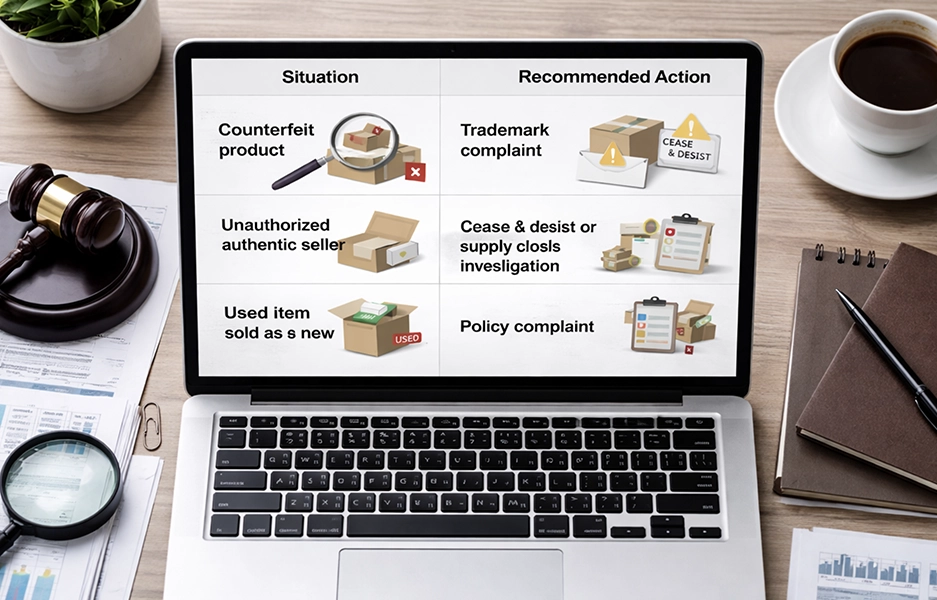
Choose the enforcement path that matches the violation:
| Situation | Recommended Action |
|---|---|
| Counterfeit product | Trademark complaint (after test buy) |
| Unauthorized authentic seller | Cease & desist or supply chain investigation |
| Used item sold as new | Policy complaint |
| Wrong variation or listing manipulation | Policy complaint |
2. Gather Evidence First
Always collect evidence before filing complaints:
- Test buy documentation
- Photos
- Screenshots
- Order IDs
- Packaging comparisons
Evidence strengthens your case and protects your brand from false claims.
3. Avoid Overusing Complaint Channels
If every seller gets reported immediately, Amazon may eventually treat your complaints with less urgency.
A smarter approach is graduated enforcement, where brands escalate actions over time.
4. Consider Legal Advice for IP Enforcement
Because intellectual property complaints carry legal implications, it’s often wise to consult with an IP attorney when building an enforcement strategy.
This helps ensure your complaints are accurate and defensible.
Final Thoughts
Filing Amazon complaints will not automatically damage your account health — but the type of complaint matters greatly.
- IP complaints carry legal weight and appear in account health metrics.
- Policy complaints operate more behind the scenes and are less legally risky.
However, both systems can lose effectiveness if they are abused.
The safest and most effective strategy is:
- Verify violations through test buys and evidence
- Use the correct reporting channel
- Avoid filing complaints without proof
- Focus on strategic enforcement instead of volume
When handled carefully, Amazon’s reporting tools can be powerful allies in protecting your brand’s listings, pricing integrity, and reputation.




 Brand Alignment