

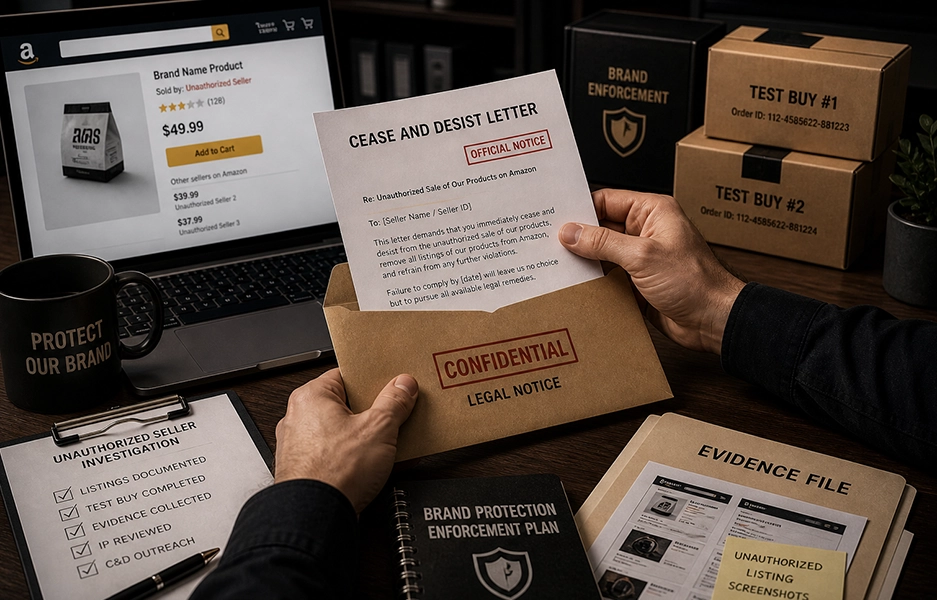
If you discover unauthorized sellers offering your products on Amazon, your first instinct may be to send a cease and desist letter. While this is a common and sometimes effective tactic, it’s important to understand how these letters work, what they can (and cannot) accomplish, and how to maximize your chances of success.
Table of Contents
- What Is a Cease and Desist Letter?
- When Should You Send a Cease and Desist Letter?
- How Should a Cease and Desist Letter Be Sent?How Should a Cease and Desist Letter Be Sent?
- What Should a Cease and Desist Letter Include?
- Friendlier Types of Outreach
- Graduated Enforcement Strategies
- Best Practices for Sending a Cease and Desist Letter
- What to Expect After Sending
- What If the Seller Ignores Your Cease and Desist?
- Final Thought
What Is a Cease and Desist Letter?
A cease and desist letter is a formal written notice demanding that a person or business stop engaging in specific conduct—in this case, selling your products on Amazon without authorization. It’s not a lawsuit, but it is a clear warning that you are prepared to take further action if the behavior does not stop. For more context, see what a cease and desist letter is.When Should You Send a Cease and Desist Letter?
- When you identify a seller offering your product on Amazon who is not authorized to do so.
- If they are violating your intellectual property rights (e.g., trademarks, copyrighted images, or selling counterfeits).
- If they are breaching a contract or MAP policy as an authorized partner.
How Should a Cease and Desist Letter Be Sent?
- Electronically: Use Amazon’s messaging system or the seller’s email address.
- Physically: Send by standard mail, certified mail, or priority mail for tracking and documentation.
What Should a Cease and Desist Letter Include?
- Clear Identification: State your brand, the product(s) in question, and the seller’s Amazon storefront or seller ID.
- Nature of the Violation: Explain the unauthorized sale or any specific policy/contract/IP infringement.
- Demand for Action: Clearly request that the seller stop selling your products and remove listings immediately.
- Deadline: Give a specific date for compliance.
- Potential Consequences: Mention possible next steps if they do not comply (such as reporting to Amazon, legal action, or contract termination).
- Contact Information: Provide a way for the seller to respond or resolve the matter.
Friendlier Types of Outreach
Not all outreach needs to be adversarial. Sometimes, a friendly message asking the seller who they are, where they obtained your product, or requesting invoices to prove authenticity can resolve the issue without escalation.- This can help you trace leaks, gather information, or resolve misunderstandings without threatening legal action.
Graduated Enforcement Strategies
Many brands use a graduated enforcement approach:- First Contact: Friendly inquiry or first warning
- Second Warning: Formal cease and desist with clearer demands and potential consequences
- Final Warning: Very strict letter outlining immediate action if not resolved
Best Practices for Sending a Cease and Desist Letter
- Be Professional: Use clear, polite, and factual language—avoid threats you cannot enforce.
- Document Everything: Keep records of all communications and evidence of unauthorized sales.
- Send Through Multiple Channels: Marketplace portals, email, and physical mail.
- Avoid Misrepresentation: Only claim what you can prove—false claims can expose you to legal risk.
What to Expect After Sending
- Some Sellers Comply: Many unauthorized sellers—especially small ones—will remove their listings to avoid conflict.
- Others May Ignore You: Not all sellers respond, especially those operating anonymously or outside the U.S.
- It May Trigger Conversation: Sometimes a dialogue opens, giving you a chance to negotiate or understand how they obtained your product.
What If the Seller Ignores Your Cease and Desist?
- Report to Amazon: If you have a valid IP claim (counterfeit, trademark, or copyright infringement), use Amazon Brand Registry or the infringement reporting tools.
- Very important: Do not file a trademark complaint with Amazon unless you have clear proof. Filing false or unsupported trademark complaints is a real legal risk and may result in legal action against you.
- Audit Your Distribution: Review your supply chain to find out how unauthorized sellers are acquiring your products.
- Legal Action: In rare cases, if you have a strong contractual or IP case, consult an attorney to consider next steps.
Disclaimer
This article is for informational purposes only and is not legal advice. Brand Alignment is not a law firm. For legal guidance about your specific situation, consult a qualified attorney.Final Thought
Sending a cease and desist letter is often the first step to stopping unauthorized Amazon sellers, but it’s just one part of a larger brand protection strategy. Combine strong contracts, active monitoring, and clear enforcement to protect your pricing, reputation, and channel health. Need help drafting cease and desist letters, identifying leaks, or building a sustainable enforcement strategy? Connect with Brand Alignment’s team. We help brands take control of their Amazon presence—without overreliance on legal threats.
Thank you for reading our post, “Sending Cease and Desist Letters to Unauthorized Amazon Sellers” We hope you found it helpful.
Start Protecting Your Brand Today
Take control of your marketplace presence with fast, effective brand protection strategies.
Every day, unauthorized sellers and MAP violations can erode your pricing, reputation, and revenue. Don’t wait for problems to escalate, start enforcing your policies and reclaim your market authority with our proven tools and expert support.


 Brand Alignment