

Every brand eventually faces the same strategic question: Should we scale through wholesale partnerships — or build a direct-to-consumer (DTC) channel? The answer isn’t simple. Both models offer powerful advantages, and both carry meaningful risks. The right approach depends on your margins, operational capacity, brand positioning, and long-term growth strategy.
Let’s break down the pros and cons of wholesale and direct-to-consumer so you can evaluate which model aligns best with your goals.
What Is Wholesale?
Wholesale means selling your products in bulk to retailers or distributors who then resell to the end customer. This can include:
- Brick-and-mortar retailers
- Online marketplaces
- Large chains (Target, Best Buy, etc.)
- Regional distributors
You generate revenue from large purchase orders, but you give up direct control over the final sale. In many cases, this raises questions around whether wholesalers can sell on Amazon and how that impacts your pricing and distribution strategy.
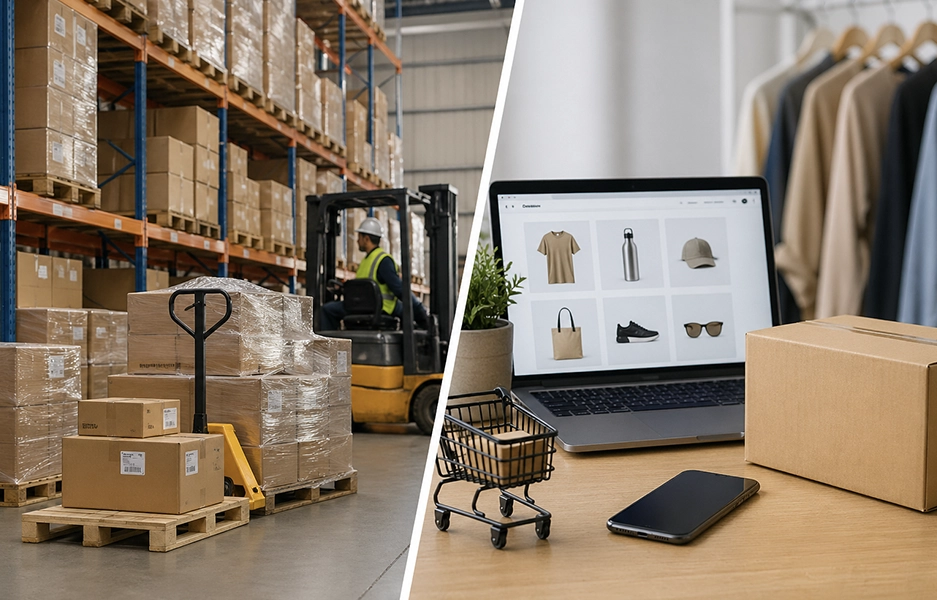
What Is Direct-to-Consumer (DTC)?
Direct-to-consumer means selling directly to the end customer through your own channels, such as:
- Your website (Shopify, WooCommerce, etc.)
- Amazon Seller Central
- Social commerce platforms
- Email marketing funnels
You own the customer relationship and keep the full retail margin — but you also take on full operational responsibility.
Wholesale: The Pros
1. Faster Revenue at Scale
Wholesale allows you to move large volumes quickly.
One purchase order from a major retailer can equal thousands of individual DTC transactions. This model works especially well for brands that:
- Manufacture at scale
- Have strong production capacity
- Need predictable volume
Revenue forecasting tends to be more stable with wholesale relationships.
2. Lower Customer Acquisition Costs
In wholesale, retailers handle the marketing.
You don’t pay for:
- Paid ads
- Conversion optimization
- Website infrastructure
- Customer service operations
Your primary focus becomes production and fulfillment.
For brands struggling with rising ad costs in DTC, wholesale can feel financially safer.
3. Broader Physical Reach
Retail presence builds legitimacy.
Being on shelves in national stores can:
- Increase brand visibility
- Build trust
- Support long-term brand equity
Wholesale also opens geographic markets faster than building DTC brand awareness from scratch.
4. Operational Simplicity (On the Front End)
You ship bulk orders to fewer buyers instead of managing thousands of individual shipments.
This reduces:
- Packaging complexity
- Return handling volume
- Daily order management
For operational teams, this can be a major advantage.
Wholesale: The Cons
1. Lower Margins
Wholesale typically operates at 40–60% off MSRP.
That means:
- Retailers keep a large share of margin
- You lose pricing control
- Profitability depends on volume
If pricing integrity weakens, margin erosion accelerates quickly.
2. Loss of Pricing Control
Retailers may:
- Discount aggressively
- Run unauthorized promotions
- Price match competitors
This can trigger price cascading — where one retailer drops price and others follow, creating a race to the bottom.
If you don’t enforce a strong MAP (Minimum Advertised Price) policy, wholesale pricing instability can impact all channels, including DTC. Learn more about MAP, MSRP, and UPP in retail pricing and how they influence channel control.
3. Grey Market & Diversion Risk
Wholesale distribution increases the risk of:
- Unauthorized sellers
- Product diversion
- Parallel imports
- Liquidation inventory resurfacing online
If inventory leaks into unauthorized hands, it can end up on marketplaces competing against your own DTC listings. Many brands only realize this after seeing unauthorized sellers on their Amazon listings.
Understanding where grey market sellers get their products is key to preventing long-term damage.
Once product is out of your control, removing unauthorized sellers becomes significantly more complex, often requiring supply chain investigation to trace the source.
4. Limited Customer Data
Retailers own the customer relationship.
You don’t get:
- Email addresses
- Purchase history
- Behavioral insights
- Retention opportunities
This limits your ability to build lifetime customer value.
Direct-to-Consumer: The Pros
1. Higher Margins
DTC allows you to capture full retail price.
Even after factoring:
- Payment processing fees
- Shipping
- Marketing spend
Margins are typically higher than wholesale — assuming acquisition costs are managed properly.
2. Full Pricing Control
You control:
- MSRP
- Promotions
- Discount timing
- Bundling strategies
This protects brand value and reduces dependency on retailer decisions.
With strong pricing discipline, DTC can anchor your broader pricing strategy, especially when combined with MAP enforcement systems.
3. Ownership of Customer Data
This is arguably the biggest advantage of DTC.
You gain:
- Email subscribers
- Customer insights
- Retention opportunities
- Upsell and cross-sell capabilities
Customer lifetime value becomes a measurable, controllable asset.
4. Brand Experience Control
From website design to packaging, you control the full customer journey.
This allows:
- Premium positioning
- Better storytelling
- Stronger brand differentiation
For brands focused on long-term equity, this matters.
Direct-to-Consumer: The Cons
1. Customer Acquisition Costs Are Rising
Paid media costs continue to increase.
You must invest in:
- Ads
- Creative
- Influencer marketing
- SEO
- Email marketing
Without efficient acquisition strategy, margins can shrink quickly.
2. Operational Complexity
You’re responsible for:
- Fulfillment logistics
- Returns management
- Customer service
- Fraud prevention
- Technology stack management
DTC requires more moving parts than wholesale.
3. Slower Initial Scale
Building traffic takes time.
Unlike wholesale purchase orders, DTC growth is incremental. It requires sustained marketing investment and optimization.
4. Channel Conflict
If you operate both wholesale and DTC, pricing inconsistencies can create friction.
Examples include:
- Retailers upset about direct discounts
- DTC sales undercutting retail partners
- Marketplace price suppression due to lower external pricing
Without clear channel strategy, DTC can disrupt wholesale relationships.
Hybrid Model: The Modern Approach
Most successful brands today use a hybrid model:
- Wholesale for volume and reach
- DTC for margin and customer ownership
However, hybrid strategies require strong channel discipline.
Key considerations include:
- Clear MAP policies
- Controlled distributor onboarding
- Monitoring for diversion
- Structured promotional calendars
- Defined pricing hierarchy
Without these safeguards, wholesale instability can undermine DTC profitability.
Which Model Is Right for You?
Choose Wholesale If:
- You prioritize predictable bulk revenue
- Your manufacturing capacity is high
- You want broad retail presence
- You can manage distribution risk
Choose DTC If:
- You want higher margins
- You value customer ownership
- You can invest in marketing
- You want pricing control
Choose Hybrid If:
- You want balanced growth
- You can enforce pricing discipline
- You have operational maturity
Final Verdict
Wholesale and direct-to-consumer aren’t competing strategies — they’re structural decisions about control.
Wholesale trades margin for scale.
DTC trades simplicity for control.
The real question isn’t which model is “better.”
It’s whether you have the infrastructure to protect pricing, control distribution, and maintain brand integrity — regardless of channel.
Because once pricing instability or unauthorized selling enters the equation, both models become vulnerable. In many cases, brands also need to evaluate whether grey market activity is legal and how it impacts their strategy.
Brands that succeed long-term don’t just pick a channel — they build control systems around it.
Take control of your marketplace presence with fast, effective brand protection strategies.
Every day, unauthorized sellers and MAP violations can erode your pricing, reputation, and revenue. Don’t wait for problems to escalate, start enforcing your policies and reclaim your market authority with our proven tools and expert support.


 Brand Alignment