

As Best Buy expands its marketplace model, more brands are starting to encounter a new dynamic: a hybrid environment where first-party (1P) retail meets a growing base of third-party (3P) sellers.
Unlike Target Plus, Best Buy Marketplace appears to have less stringent vetting, and early signs show that pricing inconsistencies — and even knockoffs — are already entering the ecosystem.
For brands, this creates both an opportunity and a risk.
The opportunity: access to a trusted retail platform.
The risk: loss of pricing control if MAP enforcement isn’t proactive.
Table of Contents
- Understanding Best Buy Marketplace Dynamics
- Why MAP Enforcement Is Critical on Best Buy
- Step 1: Monitor All 1P and 3P Pricing
- Step 2: Identify High-Risk Violations
- Step 3: Use Direct Seller Outreach First
- Step 4: Watch for Product Quality & Listing Integrity Issues
- Step 5: Investigate Persistent Violators
- Step 6: Align Pricing Across All Marketplaces
- Key Takeaways
Understanding Best Buy Marketplace Dynamics
Best Buy has historically operated as a 1P retailer, but its marketplace expansion introduces new complexity. Key characteristics:- Mix of Best Buy (1P) + 3P sellers on the same listings
- Less restrictive onboarding compared to Target Plus
- Seller contact information (including emails) is typically available
- Early signs of product inconsistency and knockoffs reported by brands
- Target Plus (controlled, curated)
- Amazon (open, highly competitive)
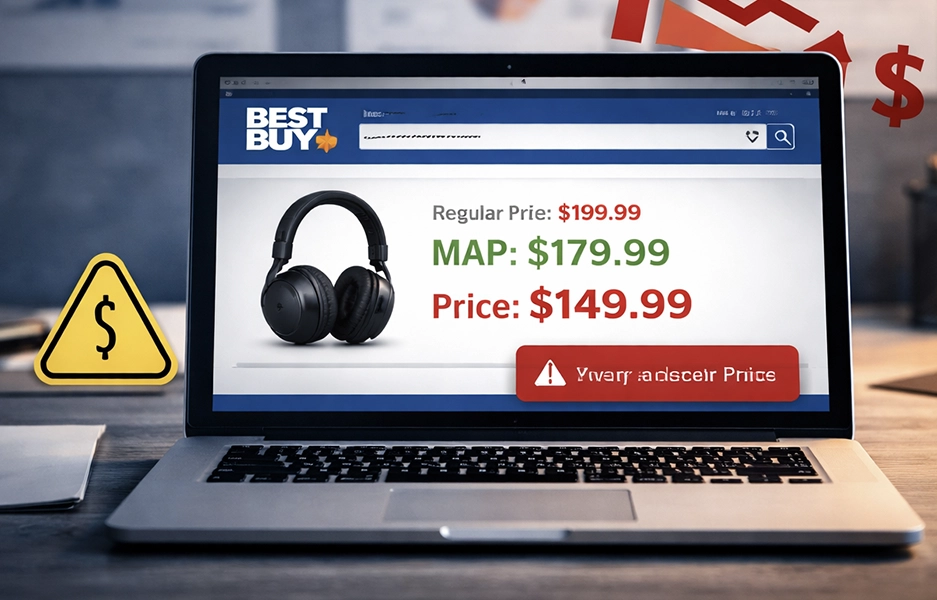
Why MAP Enforcement Is Critical on Best Buy
MAP violations on Best Buy don’t stay contained. Just like other major retailers:- Best Buy participates in competitive price matching
- External platforms may react to Best Buy pricing
- A 3P seller drops below MAP on Best Buy
- Best Buy or other retailers match the price
- Pricing integrity breaks across channels
Step 1: Monitor All 1P and 3P Pricing
The first challenge on Best Buy Marketplace is visibility. You’re not just monitoring sellers — you’re monitoring:- Best Buy retail pricing (1P)
- Third-party seller pricing (3P)
- Listing ownership and rotation
- Inventory signals when available
- Who is selling your product?
- At what price?
- Is Best Buy matching a 3P seller?
- Is pricing consistent across marketplaces?
- Real-time alerts
- Screenshot evidence
- Seller identification
- Cross-channel pricing comparisons
Step 2: Identify High-Risk Violations
Because Best Buy Marketplace is still evolving, not all violations carry equal risk. Prioritize:- High-visibility SKUs (top sellers)
- Products where Best Buy is actively competing on price
- Listings where multiple 3P sellers are present
- Any SKU where pricing differs from Amazon or Target
Step 3: Use Direct Seller Outreach First
One advantage of Best Buy Marketplace: Seller emails are typically accessible. This allows for direct enforcement without needing platform escalation. Start with structured communication:- Identify the violation clearly (SKU, price, MAP)
- Include evidence (timestamp, screenshot)
- Request correction within a defined timeframe
- Initial notice (informational)
- Follow-up (firm expectation)
- Final notice (policy enforcement language)
- Some sellers will comply quickly
- Others may ignore or delay
Step 4: Watch for Product Quality & Listing Integrity Issues
A key difference with Best Buy Marketplace: Knockoffs and inconsistent product quality have already been reported. This introduces a second layer of risk beyond pricing:- Incorrect or mismatched products
- Older or liquidated inventory
- Customer complaints tied back to your brand
- Poor reviews
- Brand reputation damage
- Increased return rates
Step 5: Investigate Persistent Violators
If a seller continues violating MAP:- Review their broader marketplace behavior
- Check if they’re selling across multiple platforms
- Analyze pricing patterns (are they consistently undercutting?)
- More formal communication
- Internal review of your distribution channels
- Identifying how the seller is sourcing inventory
- Over-distribution
- Retail arbitrage
- Lack of channel control
Step 6: Align Pricing Across All Marketplaces
Best Buy cannot be treated in isolation. Because of price matching dynamics:- Amazon may react to Best Buy
- Walmart may react to Amazon
- The entire ecosystem becomes interconnected
- Maintain consistent pricing across retailers
- Monitor external price discrepancies
- Coordinate with authorized sellers
Key Takeaways
Best Buy Marketplace introduces a new layer of complexity for brands. Compared to Target Plus:- More accessible sellers
- Less strict vetting
- Higher risk of pricing and product issues
- Real-time monitoring of 1P + 3P pricing
- Fast, structured seller communication
- Cross-channel pricing awareness
- Ongoing investigation of repeat violators
Thank you for reading our post, “How to Monitor and Enforce MAP Pricing on the Best Buy Marketplace
” We hope you found it helpful.


 Brand Alignment