

Most brands can detect MAP violations quickly, but struggle to act before damage spreads. Automated MAP enforcement closes this gap by turning detection into fast, structured action. Instead of relying on manual coordination, brands use workflows to review violations, validate evidence, apply consistent templates, and enforce MAP policies in minutes. The result is faster execution, fewer recurring violations, and a MAP program that actually holds.
Table of Contents
Why Most MAP Programs Fail After Detection
Most brands believe they struggle with MAP enforcement because sellers keep violating pricing rules. In reality, most MAP programs fail for a much simpler reason: what happens after detection.
Today, detecting MAP violations is no longer the hard part. Brands can identify underpriced listings across Amazon, Walmart, and the open internet quickly and reliably. Dashboards surface violations in near real time. Reports show which sellers are out of compliance and where.
And yet, prices continue to erode.
The MAP problem is not monitoring.
It is execution.
Detection without fast, structured action does not prevent price erosion. It documents it.
Detection Is Solved. Enforcement Is Not.
MAP monitoring technology has matured. Most serious brands already know when and where MAP violations occur.
What they often lack is a clear, repeatable way to act on that information.
Once a violation is detected, enforcement frequently depends on manual coordination. Teams review screenshots, select templates, loop in stakeholders, wait for approvals, and send individual emails. Each step introduces delay. Each delay allows the violation to remain live.
By the time action is taken, additional sellers may have matched the lower price. Buy Box dynamics may have shifted. Authorized partners may already be questioning whether MAP is truly enforced.
Detection alone does not protect MAP. Enforcement does.
Why Manual MAP Enforcement Becomes More Expensive and Complex Over Time
Manual MAP enforcement has worked for many brands, and it still does.
Human judgment, direct communication, and case by case review remain essential, especially for sensitive violations, strategic sellers, or escalations that require discretion.
The issue is not effectiveness.
The issue is cost and complexity over time.
As brands grow, MAP enforcement requires more coordination. More products, more sellers, more marketplaces, and more regions increase the number of enforcement actions that must be handled consistently.
Each violation still requires the same steps: review, validation, messaging, escalation, and follow up. What changes is the operational burden required to execute those steps reliably.
Over time, this creates hidden costs:
- More internal hours spent coordinating enforcement actions
- Greater reliance on senior staff for approvals
- Increasing complexity managing templates by marketplace and country
- Higher risk of inconsistent communication
Manual enforcement is not wrong. It simply becomes more expensive and operationally complex as MAP programs mature.
The strongest MAP teams do not remove human involvement. They reduce friction around it.
The Hidden Cost of Slow MAP Action
Slow MAP enforcement carries consequences beyond missed violations.
Price erosion compounds quickly. A single unresolved violation often triggers additional sellers to match the lower price. What begins as one issue becomes market wide degradation.
Seller trust erodes. Authorized partners expect fair enforcement. When violators remain active, compliant sellers feel disadvantaged.
Internal teams absorb the cost. Time spent coordinating emails, approvals, and follow ups replaces time spent improving policy, analyzing risk, or preventing future violations.
Most importantly, MAP credibility weakens. Sellers learn how fast, or how slow, a brand reacts. Inconsistent enforcement trains noncompliance.
Speed is not aggression.
Speed is containment.
What Effective MAP Enforcement Actually Requires
Effective MAP enforcement is not about sending more messages. It is about creating a system that consistently turns detection into action.
At a minimum, brands need:
- A unified workflow from violation review to notification
- Standardized templates aligned to MAP policy
- Clear escalation logic tied to severity and history
- Evidence attached by default
- Visibility into pending, sent, and resolved actions
Without structure, enforcement depends on individual effort. With structure, enforcement becomes repeatable, auditable, and defensible.
This is where many MAP programs struggle. They treat enforcement as a task instead of an operational process.
Turning Detection Into Action With a Structured Workflow
Automated MAP enforcement closes the gap between insight and execution.
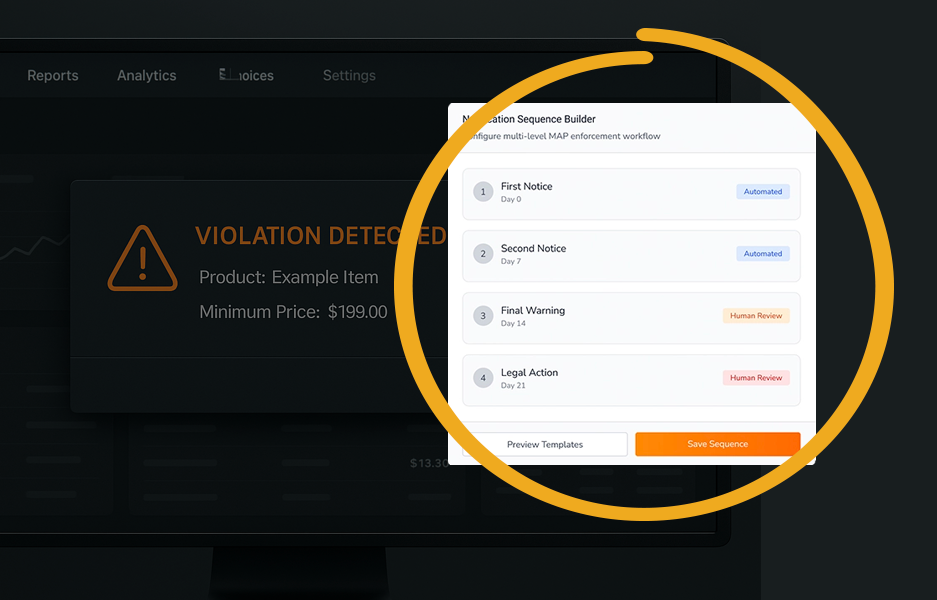
Instead of coordinating enforcement manually, brands operate within a structured workflow. Violations are reviewed in context. Evidence is validated instantly. Approved templates are applied consistently. Escalations follow predefined logic.
Routine cases move quickly. Sensitive cases still allow for review and approval. The difference is that enforcement does not stall.
MAP Notifications fits naturally into this model as an execution layer. It does not replace monitoring or managed enforcement. It operationalizes MAP policy by making enforcement faster, more consistent, and easier to manage.
When enforcement is automated and structured:
- Price erosion is addressed earlier
- Seller communication becomes more professional
- Repeat violations decline
- Internal teams regain control
- MAP policies operate as intended
Final Thought
Most MAP programs do not fail because brands lack visibility. They fail because action happens too late, or not at all.
Automated MAP enforcement is not about removing people from the process. It is about removing unnecessary friction from enforcement.
Detection shows you the problem.
Execution solves it.
To see how structured workflows turn MAP insights into action, explore how MAP Notifications enables fast, consistent MAP enforcement without added complexity.
Detection alone does not stop MAP violations. Execution does.
If you want to see how a structured workflow turns MAP insights into action, explore how MAP Notifications enables automated MAP enforcement with speed, consistency, and full control.




 Brand Alignment