

But neither tool replaces the need for a structured Amazon Brand Protection strategy.
Let’s break down what each program does, where they overlap, and how to decide what your brand actually needs.Table of Contents
What Is Amazon Brand Registry?
Amazon Brand Registry is Amazon’s foundational brand protection program.
It gives registered trademark owners access to tools that help them:
- Control listing content
- Report intellectual property violations
- Remove counterfeit listings
- Access enhanced brand analytics
- Create A+ Content and Brand Stores
- File copyright and trademark complaints
Brand Registry is the entry point for serious brand protection on Amazon.
Without it, your ability to remove infringing listings is extremely limited.
Lear more about how does Amazon Brand Registry works
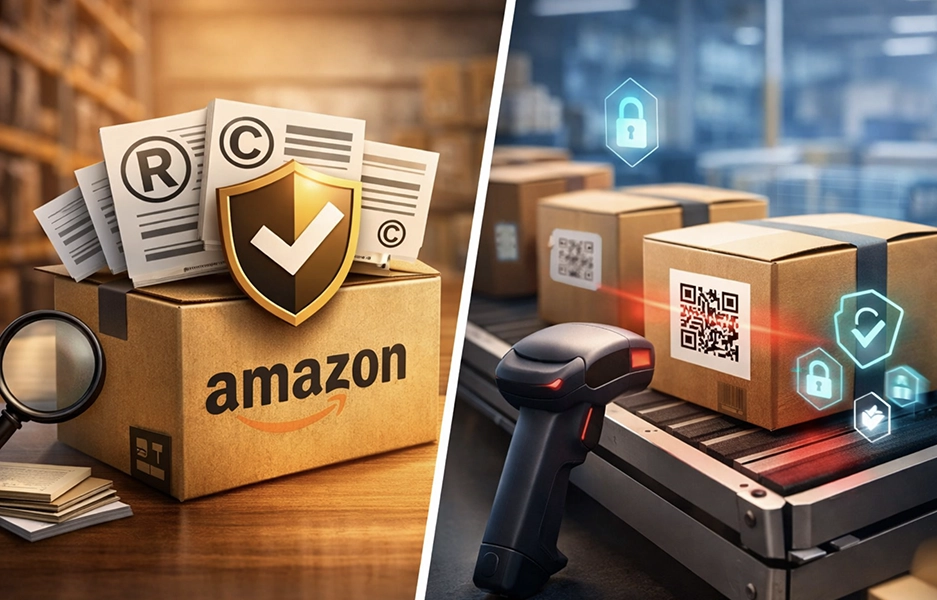
What Brand Registry Actually Protects
Brand Registry primarily protects your intellectual property.
That includes:
- Trademarks (brand name, logo)
- Copyright (images, A+ content, videos)
- Counterfeit activity
- Listing hijackers altering content
It gives you reporting authority through Amazon’s internal systems.
However — and this is critical — Brand Registry does not automatically prevent unauthorized sellers from listing your product. Discover our top-tier solution to remove unauthorized sellers on Amazon.
If someone buys authentic inventory and resells it, Brand Registry alone will not stop them.
This is where confusion begins.
What Is Amazon Transparency?
Amazon Transparency is a product serialization program.
It requires brands to:
- Enroll specific SKUs.
- Apply unique, scannable Transparency codes to every unit manufactured.
- Allow Amazon to scan and verify codes before shipment.
Each unit gets a unique identifier.
If a seller attempts to send inventory to FBA without valid Transparency codes, Amazon may block the shipment.
Transparency is designed specifically to combat counterfeit products, not grey market diversion.
You might be interest in reading what is the Amazon Transparency Interoperability API — and Why It Matters for Brand Protection
What Transparency Actually Protects
Transparency helps prevent:
- Counterfeit units from entering Amazon fulfillment centers.
- Fake inventory from being co-mingled
- Unauthorized production runs
It verifies authenticity at the unit level.
However:
Transparency does not stop someone from reselling genuine, serialized inventory if they legally acquired it.
If a reseller purchases real product with valid Transparency codes, they may still be able to sell it.
Transparency is about authenticity verification — not distribution control.
The Core Difference
Here’s the simplest breakdown:
Brand Registry
- Protects intellectual property
- Used to report violations
- No per-unit labeling required
- Applies account-wide
- Reactive and proactive
Transparency
- Protects physical product authenticity
- Used to prevent counterfeit units
- Requires serialized codes on every unit
- Applies SKU-by-SKU
- Primarily preventative
| Brand Registry | Transparency |
|---|---|
| Protects intellectual property | Protects physical product authenticity |
| Used to report violations | Used to prevent counterfeit units |
| No per-unit labeling required | Requires serialized codes on every unit |
| Applies account-wide | Applies SKU-by-SKU |
| Reactive and proactive | Primarily preventative |
Note: On smaller screens this comparison is displayed as two cards for readability.
Brand Registry protects your brand identity.
Transparency protects your physical product.
They address different risks.
Where Brands Get Confused
Many brands enroll in Brand Registry and assume:
“Now unauthorized sellers can’t sell my product.”
That’s incorrect.
If a seller acquires genuine product, Amazon generally allows resale under the First Sale Doctrine — even if they are not authorized by you.
Brand Registry allows you to:
- Report counterfeit through Amazon’s internal systems
- Report copyright theft
- Report trademark misuse
It does not grant distribution exclusivity.
Transparency, meanwhile, helps ensure products are genuine — but it doesn’t eliminate grey market sellers who source legitimate inventory.
So if your main issue is:
- Diversion
- MAP violations
- Unauthorized sellers with authentic inventory
Neither Brand Registry nor Transparency alone will solve it. Seek help from an Amazon brand protection agency.
When Brand Registry Is Essential
Every serious brand on Amazon should be in Brand Registry.
It is foundational.
You need it if you want to:
- Remove counterfeit listings
- File copyright complaints.
However, misuse of intellectual property reporting can also create exposure if not handled correctly.
- Control listing content
- Protect A+ content
- Escalate intellectual property issues
Without Brand Registry, enforcement becomes slow and limited.
Brand Registry also unlocks Brand Analytics and content control, which are critical for competitive positioning.
When Transparency Makes Sense
Transparency makes sense if:
- You have a high counterfeit risk category (supplements, beauty, electronics)
- Counterfeit sellers repeatedly attempt to infiltrate your listings
- You manufacture at scale and can operationalize serialization
- You want unit-level authenticity verification
However, enrollment alone does not guarantee operational efficiency, code integrity, or real-time oversight across ASINs and marketplaces.
Brands managing Transparency at scale often require API-based serial infrastructure, continuous ASIN monitoring, and structured seller tracing to fully protect their investment.
Transparency is most powerful for brands with strong manufacturing controls and structured packaging workflows.
However, it requires:
- Labeling changes
- Operational coordination
- Per-unit cost considerations
- Internal tracking discipline
It is not a casual program.
What Transparency Does Not Solve
Transparency does not:
- Remove authorized resellers
- Stop grey market diversion
- Enforce MAP policies
- Eliminate Buy Box competition
- Restrict parallel imports
If a distributor leaks genuine inventory with valid Transparency codes, those units remain valid.
Transparency verifies authenticity — not authorization.
That distinction is critical.
The Buy Box Reality
From a Buy Box perspective:
- Brand Registry gives you reporting power.
- Transparency reduces counterfeit risk.
- Neither guarantees Buy Box ownership.
If unauthorized sellers undercut pricing, they can still win the Buy Box — even if enrolled in both programs — as long as the inventory is genuine.
That’s why brands dealing primarily with diversion need:
- Distribution discipline
- Seller monitoring
- Inventory tracing
- Structured enforcement strategy
Technology alone doesn’t replace supply chain control.
Can You Use Both?
Yes — and many brands do.
The programs are complementary.
Brand Registry provides:
- Legal enforcement tools
- Listing control
Transparency provides:
- Physical product authentication
Used together, they strengthen brand protection — but they still don’t replace strategic enforcement against unauthorized sellers.
The Bigger Strategic Question
Before choosing between Brand Registry and Transparency, brands should ask:
- Is my main threat counterfeit — or diversion?
- Do I need IP enforcement — or inventory authentication?
- Can my operations support serialization?
- Is my real issue Buy Box instability driven by pricing?
If counterfeit is your biggest threat → Transparency is worth evaluating.
If listing control and IP protection are priorities → Brand Registry is mandatory.
If your issue is unauthorized sellers selling real product → The solution lies beyond both programs. Learn more about our unauthorized seller removal program on Amazon.
Final Thoughts
Brand Registry and Transparency are not competing tools.
They are built for different purposes.
Brand Registry protects your intellectual property.
Transparency protects your physical product from being faked.
But neither replaces strong distribution control, seller monitoring, and marketplace enforcement strategy.
If you’re losing the Buy Box due to counterfeit activity, Transparency can help.
If you’re dealing with listing hijackers or stolen content, Brand Registry is essential.
If you’re dealing with unauthorized sellers selling authentic inventory — you’re facing a supply chain issue, not a platform feature issue.
Understanding the difference ensures you invest in the right protection — and avoid relying on tools that weren’t designed to solve your core problem.
You might also want to know the difference between FBA and FBM.
Take control of your marketplace presence with fast, effective brand protection strategies.
Every day, unauthorized sellers and MAP violations can erode your pricing, reputation, and revenue. Don’t wait for problems to escalate, start enforcing your policies and reclaim your market authority with our proven tools and expert support.


 Brand Alignment