

FBA vs FBM fundamental definition
FBA (Fulfilled by Amazon): Amazon stores, packs, and ships your products for you, handling customer service and returns. This boosts delivery speed, eligibility for Prime, and Buy Box visibility
FBM (Fulfilled by Merchant): You manage storage, shipping, and customer service yourself. Offers full control over fulfillment but requires reliability to stay competitive on Amazon
If you sell on Amazon, you’ve likely seen the terms FBA and FBM attached to seller offers on your listings.
At first glance, they simply describe fulfillment methods.
But in reality, the difference between Fulfillment by Amazon (FBA) and Fulfillment by Merchant (FBM) can dramatically impact:
- Buy Box ownership
- Pricing pressure
- Customer reviews
- Unauthorized seller activity
- Enforcement effectiveness
For brands trying to protect their marketplace presence, understanding how FBA and FBM operate is critical — especially within a broader Amazon Brand Protection strategy.
Let’s break it down.
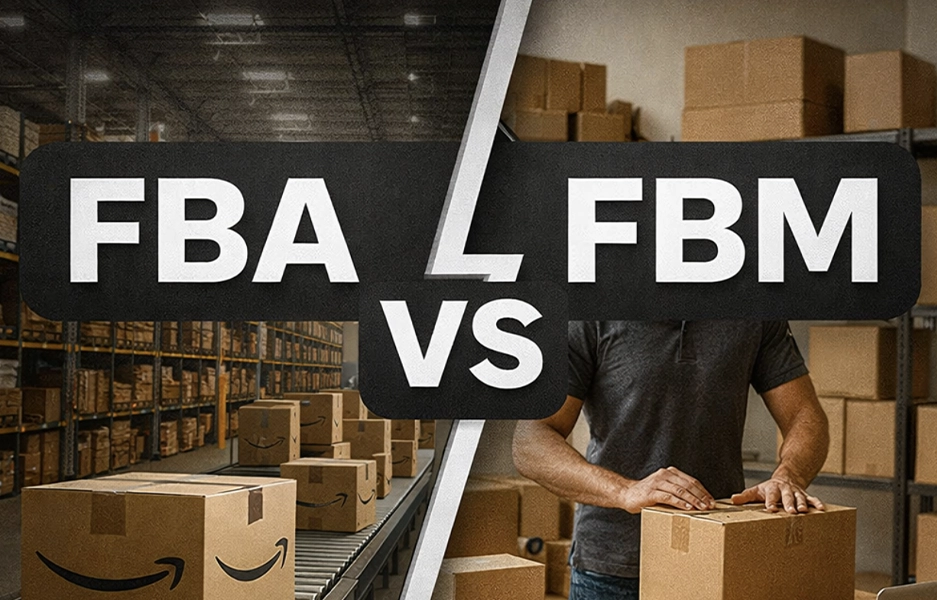
What Is FBA (Fulfillment by Amazon)?
FBA means the seller sends inventory into Amazon’s warehouses. Amazon handles:
- Storage
- Shipping
- Customer service
- Returns
The seller owns the inventory — but Amazon fulfills the order.
Products fulfilled through FBA typically qualify for:
- Prime shipping
- Faster delivery
- Higher Buy Box eligibility
From Amazon’s algorithm perspective, FBA often receives preferential treatment because it improves the customer experience.
What Is FBM (Fulfillment by Merchant)?
FBM means the seller stores and ships the product themselves.
They are responsible for:
- Inventory storage
- Shipping speed
- Packaging
- Customer service
- Returns
FBM sellers may still compete for the Buy Box — but their performance metrics must be strong.
Unless they qualify for Seller Fulfilled Prime (SFP), they typically lack Prime eligibility.
The Core Operational Difference
| FBA | FBM |
|---|---|
| Amazon stores inventory | Seller stores inventory |
| Amazon ships product | Seller ships product |
| Prime eligible | Usually not Prime |
| Amazon handles returns | Seller handles returns |
| Higher Buy Box weighting | Must compete on metrics |
FBA prioritizes convenience and speed.
FBM prioritizes control and flexibility.
Why FBA Often Wins the Buy Box
Amazon’s Buy Box algorithm considers:
- Landed price (product + shipping)
- Seller performance metrics
- Fulfillment speed
- Inventory availability
FBA sellers typically have:
- Faster shipping
- Prime badge
- Strong fulfillment reliability
This gives them a structural advantage.
In many competitive listings, the lowest FBA offer will rotate Buy Box ownership among similarly priced FBA sellers. Learn how buy box rotation works.
FBM sellers must price aggressively or maintain near-perfect metrics to compete.
Why This Matters for Brand Control
For brands, FBA vs FBM isn’t just about logistics.
It directly affects:
- Unauthorized seller visibility
- Pricing stability
- Customer experience
- Inventory traceability
Let’s examine each.
FBA and Unauthorized Sellers
Unauthorized sellers often prefer FBA because:
- Prime eligibility increases conversion
- Amazon handles returns
- Buy Box probability improves
- They can scale volume quickly
If an unauthorized seller sends diverted inventory to FBA, they can quickly win the Buy Box simply by undercutting price by a small margin.
Even worse, multiple FBA sellers at the same price will split Buy Box traffic.
That means if five FBA sellers price at $49.99, they may each receive 20% of the traffic.
From a brand perspective, this can dilute visibility quickly and destabilize your listing.
FBM and Investigative Advantage
While FBA sellers are harder to trace, FBM sellers sometimes provide more investigative clues.
Because they ship directly:
- Return labels may reveal origin zip codes
- Shipping addresses may reveal warehouse locations
- Packaging inconsistencies can be examined
For brands conducting test buys to trace diversion or grey market activity, FBM sellers often provide more actionable data.
This makes FBM sellers easier to investigate — but not necessarily less harmful.
FBA and Price Wars
FBA sellers frequently use automated repricing software.
These tools:
- Match the lowest FBA price
- Adjust pricing by pennies
- Compete continuously for Buy Box share
This can lead to:
- Rapid price drops
- Pricing instability
- Cascading price erosion
FBM sellers often use repricers as well — but FBA repricing has more direct Buy Box impact.
For brands focused on unauthorized seller enforcement, FBA sellers can create fast-moving disruption that requires constant monitoring and swift action.
When FBM Has an Advantage
Despite FBA’s dominance, FBM can outperform in certain scenarios:
- Large or Oversized Products
FBA storage fees may be cost-prohibitive.
- High-Margin Niche Products
Strong brand loyalty may offset slower shipping.
- Direct-to-Consumer Control
Some brands prefer to maintain packaging control and manage customer interactions directly.
- Seller Fulfilled Prime (SFP)
FBM sellers who qualify for SFP regain Prime badge eligibility.
In those cases, FBM can compete more evenly.
How FBA vs FBM Affects Unauthorized Seller Enforcement
For brands focused on unauthorized seller enforcement, fulfillment method changes enforcement dynamics.
FBA Sellers:
- Higher Buy Box impact
- Faster conversion
- Often larger inventory volume
- More difficult to trace supply origin
FBM Sellers:
- Easier to investigate
- May have smaller inventory
- Often one-off or arbitrage sellers
Strategically, brands must:
- Monitor Buy Box ownership by fulfillment method
- Prioritize high-volume FBA violators
- Use test buys for FBM tracing
- Identify upstream supply leaks
Focusing solely on price without understanding fulfillment structure misses part of the problem.
Should Brands Use FBA Themselves?
Many brands selling directly on Amazon use FBA because:
- It increases Buy Box eligibility
- Improves conversion rate
- Enhances Prime visibility
However, brands must:
- Monitor for unauthorized FBA sellers
- Track seller inventory levels
- Maintain strong distribution control
FBA improves performance — but only when channel discipline exists.
Final Thoughts
FBA vs FBM isn’t just a logistics decision.
It is part of a much larger ecosystem of operational, pricing, and control risks that brands must manage proactively.
It shapes:
- Who wins the Buy Box
- How fast price wars escalate
- How easy sellers are to trace
- How unauthorized sellers scale
- How your brand is perceived
FBA offers visibility and speed.
FBM offers control and traceability.
For brands dealing with unauthorized sellers and Buy Box instability, understanding which fulfillment method is driving the disruption is essential.
Because on Amazon, fulfillment isn’t just about shipping.
It’s about marketplace leverage — and control.
Take control of your marketplace presence with fast, effective brand protection strategies.
Every day, unauthorized sellers and MAP violations can erode your pricing, reputation, and revenue. Don’t wait for problems to escalate, start enforcing your policies and reclaim your market authority with our proven tools and expert support.


 Brand Alignment