

A brand opens its latest MAP report and finds a familiar problem: multiple third-party sellers on Amazon are advertising the same product below MAP.
The obvious conclusion is that those sellers started discounting.
But that isn’t always where the problem began.
Amazon Retail may have lowered its 1P price first. Third-party sellers then respond to the new competitive environment, additional sellers follow, and a single pricing movement develops into widespread price erosion.
In other cases, even Amazon may not be the true first mover. A lower external-market price can contribute to Amazon pricing changes, which can then influence sellers on the marketplace.
For brands, this means identifying MAP violations isn’t enough. You also need to understand how the pricing cascade started.
Table of Contents
- Amazon 1P vs. 3P: What's the Difference?
- How a Pricing Cascade Can Begin
- Why Amazon 1P Pricing Can Move
- Why 3P Sellers Respond to Amazon Pricing
- Why a MAP Snapshot Can Miss the Root Cause
- Don't Automatically Blame Your Authorized Sellers
- The True First Mover May Be Outside Amazon
- What Brands Should Monitor
- A Better Way to Respond to Pricing Cascades
- Find the Cause, Not Just the Violations
Amazon 1P vs. 3P: What’s the Difference?
Understanding the problem starts with distinguishing Amazon 1P from third-party marketplace sellers.
With Amazon 1P, Amazon purchases inventory wholesale and sells that inventory directly to consumers. On the product detail page, the offer is sold by Amazon.
With Amazon 3P, an independent seller offers the product through Amazon’s marketplace. Depending on the seller and the brand’s distribution strategy, that seller may be authorized or unauthorized.
This distinction matters because Amazon Retail doesn’t operate like a typical authorized 3P retailer.
When Amazon’s price changes, the effects can spread across the marketplace. Other sellers are competing for the same customers and, potentially, Buy Box visibility.
Before responding to a group of apparent MAP violations, brands therefore need to understand which offer moved first.

How a Pricing Cascade Can Begin
Consider a simplified example.
Your product has a MAP of $100.
Amazon Retail has been selling it for $100, alongside several third-party sellers.
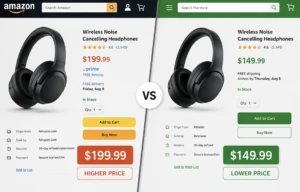
Amazon’s price then moves to $90.
A 3P seller reacts by moving to $89.99. Another seller responds. Soon, multiple sellers are advertising the product below $100.
When the brand checks its marketplace, it sees several MAP violations.
But those violations don’t tell the complete story.
The important question is:
Who moved first?
If Amazon’s price fell before the third-party offers, those 3P sellers may have been reacting to an existing pricing event rather than independently initiating a price war.
This is the first-mover problem.
Without historical pricing data, a brand can easily see the end result without seeing the sequence that produced it.
Why Amazon 1P Pricing Can Move
When Amazon Retail lowers a price, brands shouldn’t automatically assume that Amazon independently decided to discount the product.
Pricing elsewhere on the internet can also be part of the picture.
Amazon may respond to competitive pricing it identifies on reputable external marketplaces or retail sites. That can create a more complicated pricing chain.
For example:
External retailer lowers price → Amazon pricing responds → 3P sellers react → additional sellers follow
What initially looks like an Amazon MAP problem may actually have originated somewhere else entirely.
This is why brands selling through Amazon need to think beyond Amazon when investigating pricing problems.
If you’re only monitoring the Amazon marketplace, you may be missing the event that started the cascade.
Why 3P Sellers Respond to Amazon Pricing
Third-party sellers compete in a highly dynamic environment.
Price isn’t the only factor affecting Amazon Buy Box performance, but it can be an important one. Seller performance, inventory, fulfillment, eligibility, and other factors also contribute.
When Amazon Retail is selling the same product at a lower price, however, a 3P seller may face significant competitive pressure.
Some sellers may respond by lowering their advertised price. Automated repricing and other competitive pricing behavior can accelerate that movement.
Then other sellers see the new lower offers and react.
The result can be a cycle in which one price change produces several downstream changes.
For a brand managing MAP, the challenge is distinguishing the trigger from the reaction.
Why a MAP Snapshot Can Miss the Root Cause
Suppose you check Amazon at 2 p.m. and find five sellers below MAP.
That tells you something important: five offers are currently below your expected advertised price.
But it doesn’t tell you what happened at 10 a.m.
Or yesterday.
Or on another retail website.
That’s why historical monitoring can be significantly more useful than relying solely on a current snapshot.
When investigating a pricing cascade, brands should ask:
- When did the product first move below MAP?
- Which offer moved first?
- Was Amazon Retail already below the expected price?
- Did a 3P seller move before Amazon?
- Was the product available for less on another ecommerce site?
- Was a promotion or coupon involved?
- How quickly did other sellers respond?
Timestamped evidence and historical pricing information can help reconstruct the sequence.
Instead of simply identifying violations, the brand begins developing pricing intelligence.
Don’t Automatically Blame Your Authorized Sellers
Understanding the pricing sequence is also important for maintaining healthy relationships with authorized retailers.
Imagine an authorized 3P seller has followed your MAP policy consistently.
Amazon Retail then moves below MAP. Marketplace pricing begins falling, and the authorized seller eventually responds.
That doesn’t necessarily change how the brand applies its established MAP policy. But it does provide important context about what’s happening.
If the brand continually sends violation notices to authorized sellers without investigating why the same products keep experiencing price erosion, those sellers may become frustrated.
From their perspective, they may feel they’re being asked to solve a pricing problem they didn’t create.
The better approach is twofold:
Apply your MAP process consistently while investigating the source of recurring pricing pressure.
The objective isn’t to excuse violations. It’s to understand why they keep happening.
The True First Mover May Be Outside Amazon
Brands should also avoid assuming that Amazon is always the beginning of the chain.
External pricing can matter.
A retailer outside Amazon may advertise the product at a lower price. Amazon’s pricing environment may respond. Third-party sellers on Amazon then react to the new price.
The result is a chain reaction that eventually appears in the brand’s Amazon MAP monitoring.
Brands experiencing recurring pricing problems should therefore look across relevant marketplaces and ecommerce sites for patterns.
- Is the same retailer frequently lowering its price first?
- Are promotions or coupons creating apparent price discrepancies?
- Is unauthorized inventory appearing below MAP?
- Does Amazon’s pricing movement regularly follow a lower external price?
The answers can change how the brand approaches the problem.
What Brands Should Monitor
Effective MAP monitoring around Amazon should provide more than a list of sellers currently below a threshold.
Brands should build visibility into signals such as:
- Amazon Retail pricing
- 3P seller pricing
- Authorized and unauthorized seller activity
- MAP violation history
- Buy Box ownership
- Timestamped screenshots
- Relevant external-market pricing
- Coupons and promotions
- Seller inventory where available
- Recurring first-mover patterns
Looking at these signals together provides a much clearer picture than treating MAP, Buy Box performance, unauthorized sellers, and external pricing as completely separate issues.
For example, an apparent MAP problem could ultimately be connected to an unauthorized seller, an external retailer, or another distribution issue.
A Better Way to Respond to Pricing Cascades
When multiple sellers suddenly appear below MAP, brands can use a simple framework:
Detect → Reconstruct → Identify → Enforce → Correct
| Step | Process |
|---|---|
| Detect | Identify the pricing movement and affected products. |
| Reconstruct | Use historical data to determine when the cascade began and how prices changed. |
| Identify | Determine the likely first mover or external pricing trigger. |
| Enforce | Follow the brand’s established MAP process where applicable. |
| Correct | Investigate and address the underlying marketplace, pricing, or distribution issue contributing to repeated erosion. |
For brands with a direct Amazon relationship, Amazon Retail pricing may also require attention through the appropriate internal vendor or marketplace strategy.
The key is not to stop at the violation report.
Find the Cause, Not Just the Violations
When five third-party sellers are below MAP, it’s tempting to see five separate problems.
Sometimes there is really one underlying problem with five visible consequences.
Amazon 1P pricing can create competitive pressure that contributes to downstream 3P pricing changes. External-market pricing can potentially influence the situation further. Unauthorized sellers can introduce another source of pricing instability.
That’s why effective MAP management requires more than identifying who’s below MAP today.
Brands need to understand who moved first, what triggered the movement, and how the pricing cascade developed.
That visibility helps brands respond more intelligently, maintain stronger relationships with authorized sellers, and focus their efforts on the underlying cause of recurring price erosion.
Seeing recurring MAP violations around your Amazon listings?
Our team can help you understand the pricing activity surrounding your products, identify first-mover patterns, and build greater visibility into the marketplace conditions contributing to price erosion. Contact us.
Take control of your marketplace presence with fast, effective brand protection strategies.
Every day, unauthorized sellers and MAP violations can erode your pricing, reputation, and revenue. Don’t wait for problems to escalate, start enforcing your policies and reclaim your market authority with our proven tools and expert support.


 Brand Alignment