

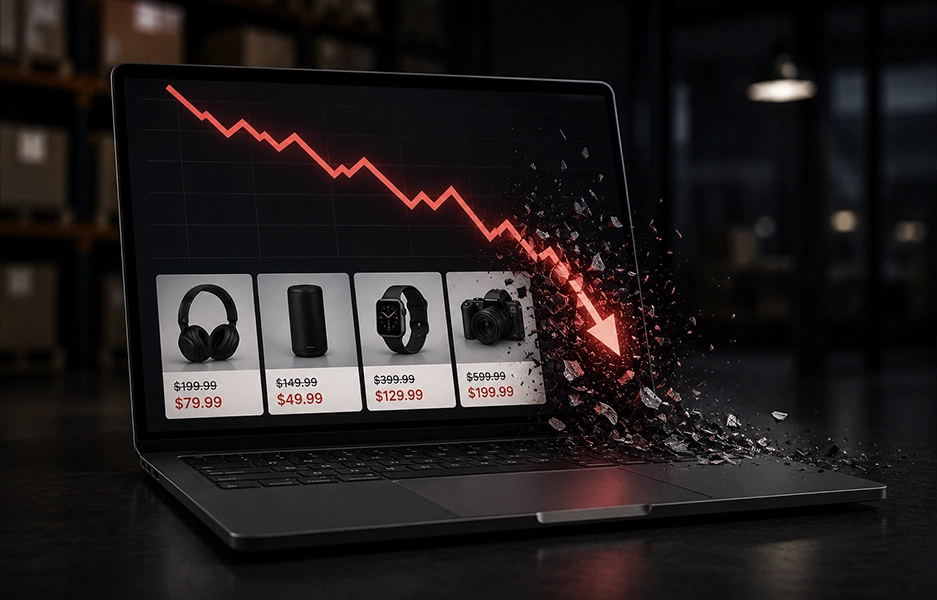
Online prices don’t collapse by accident. There are 10 predictable forces — from unauthorized sellers and repricing algorithms to grey market imports and AI comparison tools — that drive price erosion on every major marketplace. Understanding these forces is the first step to stopping them.
Table of Contents
- The Internet Rewards the Lowest Price
- Unauthorized Sellers Undercut Pricing Because They Can
- Authorized Sellers Follow Suit Out of Survival
- Automated Repricing Software Accelerates the Crash
- External Price Matching Triggers Buy Box Suppression
- Distributors Undercut Brands to Move Volume
- Liquidation Channels Flood the Marketplace
- Grey Market Imports Undercut U.S. Pricing
- Consumers Now Compare Prices Instantly — Powered by AI
- Brands Often Lack Visibility Into Their Own Marketplace
- How to Stop Online Price Collapse
In today’s retail landscape, not all inventory is created equal. Inventory grading — the classification of products as A-Stock, B-Stock, or C-Stock based on condition, packaging, and resale eligibility — has become a critical factor in pricing strategy, customer trust, and channel control. For brands managing MAP compliance and marketplace integrity, understanding these stock categories and controlling how they flow through your distribution network can mean the difference between market leadership and sustained margin erosion.
1. The Internet Rewards the Lowest Price
Online marketplaces like Amazon, Walmart, Target.com, and eBay are built around the idea that lower prices win. On Amazon specifically, the Buy Box determines who gets the sale, who controls visibility, and who receives conversions — and it overwhelmingly favors the lowest landed price (price + shipping), assuming seller performance meets minimum thresholds.
This creates a race to be a penny lower, a few cents faster, and slightly more competitive. Once one seller drops price, everyone else must follow — or lose nearly all sales. This is the foundation of online price collapse. For brands already struggling with Buy Box suppression, this dynamic is especially damaging.
2. Unauthorized Sellers Undercut Pricing Because They Can
Many sellers online are not authorized by the brand. They often obtain inventory through distribution leaks, liquidation auctions, retail arbitrage, international grey market imports, and overstock purchases. Because they have no MAP obligations, they can list products at any price that clears their inventory quickly.
Their goal is simple: undercut everyone, sell through fast, and move on to the next item. The risks of unauthorized sellers are severe — even a single unauthorized seller with a handful of units can trigger price erosion that affects the entire marketplace.
3. Authorized Sellers Follow Suit Out of Survival
Once unauthorized sellers break pricing, authorized sellers must decide: follow MAP and lose all sales, or drop price to stay competitive. This is where the price collapse cascade begins. Even sellers with strong relationships and good intentions eventually break MAP when the marketplace is flooded with below-MAP pricing. They feel pressure from overstock concerns, revenue goals, cost of capital, and competitive repricing — and this pulls every seller into a downward spiral.
4. Automated Repricing Software Accelerates the Crash
Most serious Amazon and Walmart sellers use repricing algorithms that scan competitor prices, automatically adjust pricing, and update listings in real-time. When one seller drops their price, repricers drag every competing offer down as well. Grey market sellers actively exploit automated repricing to trigger cascading price drops across the marketplace — causing penny wars, algorithmic loops, instant MAP violations, and wide-scale price crashes. A single discount can spread across dozens of sellers instantly.
5. External Price Matching Triggers Buy Box Suppression
Prices collapse even when Amazon sellers didn’t initiate the drop. If Amazon detects your product cheaper on Walmart.com, Costco, Home Depot, Target, or any major online channel, Amazon may automatically match the lower price, lower the Buy Box threshold, or suppress the Buy Box entirely. A price drop anywhere becomes a price drop everywhere — making cross-channel price integrity absolutely critical for brands.
6. Distributors Undercut Brands to Move Volume
Distributors typically operate on thin margins and prioritize clearing inventory, hitting quotas, and improving cash flow. Because of this, they frequently offload product to jobbers, brokers, liquidators, and Amazon resellers. Understanding how distributor leakage happens is essential — these buyers do not honor MAP, and once this diverted product hits the marketplace, the pricing structure collapses rapidly.
7. Liquidation Channels Flood the Marketplace
Any inventory that enters liquidation — even unintentionally — results in steep online price drops. This includes customer returns, overstock, closeouts, product updates, packaging changes, and retail bankruptcies. Liquidators buy pallets for pennies and resell them through Amazon or through small sellers who list everything below MAP. Once those units appear online, maintaining your intended price becomes extremely difficult.
8. Grey Market Imports Undercut U.S. Pricing
Parallel importers purchase your product in countries where wholesale cost is lower, currency advantages exist, or international discounts are deeper. They ship product into the U.S. and list it online at prices domestic sellers can’t match. These sellers often operate anonymously behind multiple LLCs and are highly experienced at avoiding detection. Parallel imports are one of the most persistent forms of grey market activity that drives price erosion.
9. Consumers Now Compare Prices Instantly — Powered by AI
Price transparency has always fueled race-to-the-bottom behavior, but today it’s supercharged by AI-driven price comparison tools. Consumers now use AI shopping assistants, browser extensions that scrape pricing across channels, Google Shopping’s AI-surfaced comparisons, price history algorithms, and mobile apps that instantly show alternative sellers. AI tools automatically surface the lowest available price — sometimes even notifying users the moment a seller drops price by a few cents.
This creates two powerful downward forces: consumers flock to the lowest price immediately, draining higher-priced sellers of demand, and sellers know they are being compared by AI, which drives them to undercut more aggressively and more frequently. In short, AI accelerates price erosion by amplifying consumer awareness and seller competition faster than traditional tools ever could.
10. Brands Often Lack Visibility Into Their Own Marketplace
Many brands don’t realize how many sellers are listing their products, which sellers are authorized, where diverted inventory is coming from, how algorithms shape the pricing environment, or how quickly MAP violations propagate. By the time a brand notices pricing issues — often through a seller investigation — dozens of sellers may already be below MAP, with repricers locked in a downward spiral.
So How Do You Stop Online Price Collapse?
Price erosion isn’t random — and the right strategy can stop it.
- Monitor all marketplaces continuously. Visibility is the foundation of pricing stability.
- Identify unauthorized sellers. Use investigation, test buys, and data tools to uncover where they source inventory.
- Remove violators. Graduated enforcement reduces seller count by 90%+ when properly executed.
- Strengthen distributor and retailer agreements. Add strict online sales restrictions, penalties, and audit requirements.
- Control liquidation pathways. Work with partners to return excess inventory rather than dumping it into secondary markets.
- Maintain MAP enforcement consistently. Sporadic enforcement = sporadic compliance.
- Fix supply-chain leakage at the source. Sustainable price stability requires eliminating the root cause.
Prices collapse online because marketplaces reward the lowest price, unauthorized sellers flood the channel, repricers escalate competition, liquidation and diversion undermine stability, AI comparison tools amplify consumer behavior, and brands lack visibility into who is selling and why. But once you understand these forces, you can create a pricing environment that protects your margins, strengthens your brand, and restores control across every channel — including through a structured Buy Box recovery program.
Online price collapse is one of the most damaging threats to brand equity — and it rarely resolves on its own. If you’re seeing your MAP policy undermined, your Buy Box lost to unauthorized sellers, or your pricing eroding across channels, it’s time to take a structured approach to marketplace control.
At Brand Alignment, we help brands monitor pricing across 200+ marketplaces, identify and remove unauthorized sellers, investigate grey market supply chains, and restore pricing stability. Whether the problem originates from a distributor, a liquidation event, or an international grey market, we trace it, document it, and stop it.
Ready to stop online price collapse and protect your brand? Contact us today to schedule a consultation and find out how we can help you take back control of your marketplace pricing.
Take control of your marketplace presence with fast, effective brand protection strategies.
Every day, unauthorized sellers and MAP violations can erode your pricing, reputation, and revenue. Don’t wait for problems to escalate, start enforcing your policies and reclaim your market authority with our proven tools and expert support.



 Brand Alignment