


Amazon Buy Box analytics help brands understand who controls the Buy Box, why suppression happens, and how external price matching across retailers can silently impact visibility and revenue.
Table of Contents
- Amazon Buy Box Analytics: What Brands Are Missing When Visibility Drops
- What Is Buy Box Analytics and Why It Matters
- Why Buy Box Suppression Happens (And Why It’s Often Misdiagnosed)
- The Hidden Role of External Price Matching
- What Buy Box Analytics Reveals Over Time
- Price Matching Detection as a Diagnostic Layer
- From Visibility Loss to Structured Action
- How Brand Alignment Approaches Buy Box Analytics
- Example: Visibility Recovery Over Time
- Why This Matters for Brands and Manufacturers
Amazon Buy Box Analytics: What Brands Are Missing When Visibility Drops
Most brands think they understand their Buy Box performance.
They check who owns it.
They review pricing.
They monitor inventory.
And yet, Buy Box suppression keeps happening.
The reason is simple: Buy Box behavior is not static. It changes throughout the day, across sellers, ASINs, and markets, influenced by signals that are rarely visible in a single place.
That is where Amazon Buy Box analytics become critical.
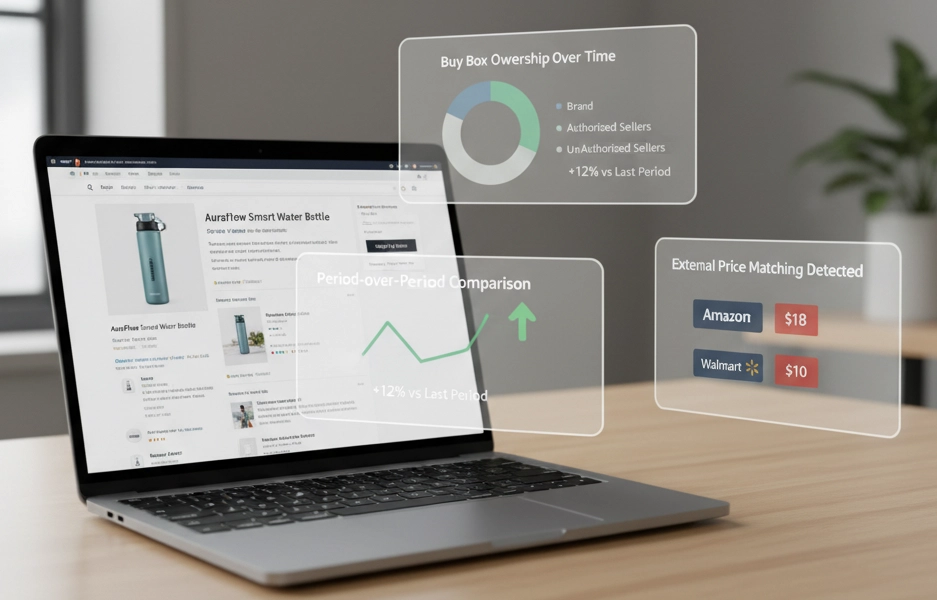
What Is Buy Box Analytics and Why It Matters
Buy Box analytics is not about knowing who owns the Buy Box at a specific moment.
It is about understanding how Buy Box control behaves over time.
For brands and manufacturers, this distinction matters. A static snapshot might show everything looking fine, while underneath, ownership is shifting repeatedly, visibility is dropping during specific windows, and suppression is quietly setting in.
Buy Box analytics gives brands a time-based view of:
- Ownership fluctuations across the day
- Availability vs suppression patterns
- Which sellers gain control and when
- Which ASINs create recurring instability
Without this context, teams are left reacting to symptoms instead of understanding causes.
Why Buy Box Suppression Happens (And Why It’s Often Misdiagnosed)
Buy Box suppression rarely has a single cause.
In practice, it is usually triggered by a combination of internal and external signals that interact over time. Brands often focus on what they can see inside Amazon, while missing what happens outside of it.
Common contributing factors include:
- Pricing inconsistencies across channels
- Inventory gaps or fulfillment misalignment
- Unauthorized sellers winning during specific windows
- Eligibility or listing health issues
- External price matching across other retailers
The last one is often the most overlooked.
For brands selling through Amazon Vendor Central, Buy Box eligibility is influenced by a mix of internal signals Amazon evaluates across pricing, availability, and channel consistency. While Amazon provides some visibility into performance inside Vendor Central, many of the signals that ultimately drive suppression originate outside the platform and remain opaque without external diagnostics.
We recommend reading our complete guide to winning the Amazon Buy Box.
The Hidden Role of External Price Matching
External price matching is one of the least visible, yet most impactful, contributors to Buy Box suppression.
When Amazon detects that a product is being sold at a lower price outside its marketplace, Buy Box eligibility can be quietly suppressed. In many cases, brands are not aware this is happening because they are not actively monitoring external retailers.
What makes this especially challenging is that:
- The price discrepancy may appear briefly
- It may come from a retailer the brand does not actively manage
- It may affect only specific ASINs
- It may coincide with certain times of day or inventory conditions
As a result, brands often see visibility decline without a clear explanation.
This is where traditional Buy Box monitoring falls short.
What Buy Box Analytics Reveals Over Time
A proper Buy Box analytics layer allows brands to move beyond assumptions and start seeing patterns.
Over time, brands can observe:
- Which ASINs experience repeated suppression
- When ownership fluctuates most aggressively
- Which sellers benefit during those windows
- How often Buy Box availability drops entirely
- How suppression aligns with pricing signals
Most importantly, it allows teams to connect Buy Box behavior to external price matching events that would otherwise remain invisible.
Price Matching Detection as a Diagnostic Layer
Identifying that an external price exists is not enough.
What brands actually need to know is:
- Which retailer is matching or undercutting price
- When that pricing appears
- Which ASINs are affected
- How Buy Box ownership responds over time
This diagnostic clarity changes how teams operate.
Instead of guessing, brands can prioritize action based on impact, not noise.
From Visibility Loss to Structured Action
Without diagnostics, Buy Box issues are experienced in reverse.
First, revenue declines.
Then visibility drops.
Only later do teams try to understand why.
With Buy Box analytics and price matching detection in place, that flow reverses.
Brands can start with understanding, not reaction.
When brands move from reactive monitoring to structured opportunity diagnostics, they can quantify how much revenue is locked behind suppression, identify who is driving displacement, and pinpoint where pricing signals are misaligned.
That is the difference between visibility reporting and opportunity recovery — turning suppressed visibility into measurable, recoverable revenue.
They can see where suppression originates, which ASINs matter most, and which external signals must be addressed first.
How Brand Alignment Approaches Buy Box Analytics
At Brand Alignment, Buy Box analytics is built as part of our Buy Box Opportunities tool, not as a standalone report.
The goal is not to generate charts for the sake of reporting.
The goal is to give brands a system that:
- Tracks Buy Box ownership as a trend, not a snapshot
- Identifies high-instability ASINs
- Surfaces sellers and markets driving suppression
- Detects external price matching across retailers
- Prioritizes action based on material impact
This allows teams across pricing, ecommerce, and brand protection to work from the same source of truth.
Example: Visibility Recovery Over Time

Following the red line, marking the beginning of Brand Alignment’s involvement, Buy Box possession began to steadily rise and remained consistently high.
This kind of outcome is rarely achieved by fixing one variable. It comes from understanding how Buy Box behavior evolves over time and addressing the signals that drive suppression at the source.
Why This Matters for Brands and Manufacturers
For brands operating at scale, Buy Box suppression is not just a marketplace issue.
It is a visibility issue.
A pricing issue.
A channel consistency issue.
Without Buy Box analytics and external price matching detection, teams are forced to rely on incomplete information.
With them, Buy Box control becomes measurable, explainable, and manageable.
Win Back Your Buy Box
Buy Box Analytics is included as part of Buy Box Opportunities for brands with MAP and Internet-Wide monitoring enabled and an active Amazon API connection.
To understand how Buy Box analytics and price matching detection work together inside Buy Box Opportunities, explore the full solution here:


 Brand Alignment