

Liquidation pallets are everywhere on social media — but where do they actually come from? Understanding the full supply chain behind every pallet is essential for both resellers and brands managing marketplace integrity.
Table of Contents
- Thin Margins — Volume Matters Most
- Distributors Are Not Responsible for MAP Enforcement
- Internal Sales Incentives Encourage Overselling
- Distributors Quietly Offload Excess Inventory
- A Culture of "Not My Problem"
- Grey Market Buyers Are Expert Manipulators
- International Distributors and Parallel Imports
- Distributors Rarely Monitor Where Customers Sell
- Distributors Don't Fear Enforcement
- How to Stop Distributors From Undercutting Your Brand
In today’s retail landscape, not all inventory is created equal. Inventory grading — the classification of products as A-Stock, B-Stock, or C-Stock based on condition, packaging, and resale eligibility — has become a critical factor in pricing strategy, customer trust, and channel control. For brands managing MAP compliance and marketplace integrity, understanding these stock categories and controlling how they flow through your distribution network can mean the difference between market leadership and sustained margin erosion.
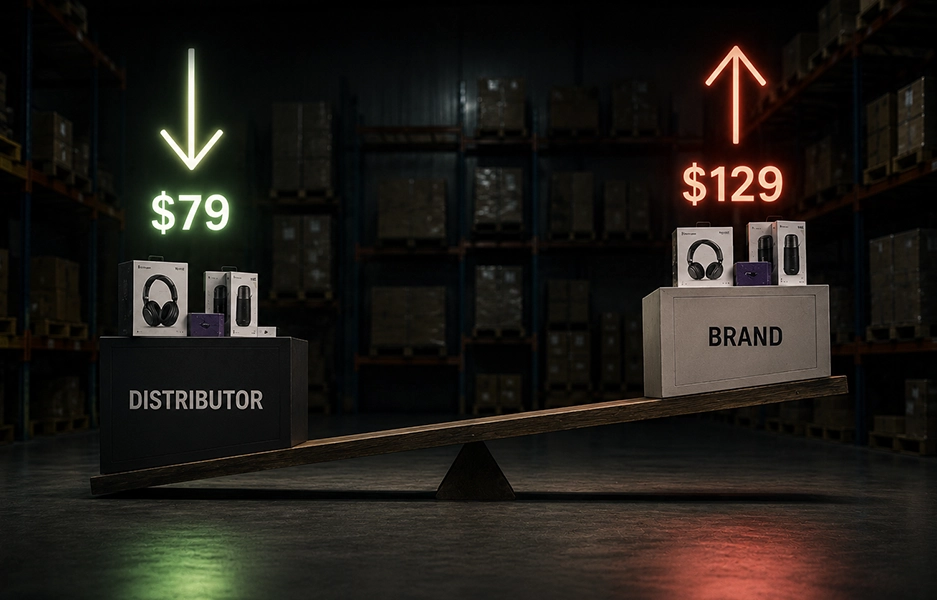
1. Distributors Operate on Thin Margins — So Volume Matters Most
Distributors typically operate with slim profit margins, often only 3–10%. This means a single large sale can make their quarter, while a small increase in order volume can significantly affect revenue. Discounting becomes a primary competitive tool. Because of this, distributors prioritize moving product — not protecting your pricing strategy.
If a distributor has the chance to sell bulk inventory to liquidators, grey market resellers, cash-based buyers, jobbers who flip product online, or brokers who move inventory overseas, they may choose volume over brand integrity. From their perspective, moving inventory quickly outweighs long-term brand concerns — especially when their agreements don’t include meaningful enforcement penalties. This is a core driver of distributor leakage that brands often underestimate.
2. Distributors Are Not Responsible for MAP Enforcement
Many brands assume distributors will enforce MAP pricing or avoid buyers who violate MAP. But MAP is not a distributor’s policy to enforce — it’s yours. Unless your agreements explicitly outline MAP compliance requirements, online channel restrictions, penalties for selling to unauthorized buyers, audit rights, and consequences for diversion, a distributor has no contractual obligation to protect your pricing.
Even well-intentioned distributors often unknowingly sell to buyers who create unauthorized Amazon listings, break MAP to win the Buy Box, resell inventory on niche marketplaces, or liquidate to secondary brokers. Because MAP does not legally bind distributors, many see adherence as optional unless clearly enforced through MAP enforcement software and policy.
3. Internal Sales Incentives Encourage Overselling
Sales teams inside distribution companies are often rewarded based on monthly quotas, quarterly revenue targets, order size, and customer acquisition — not compliance. Incentives rarely reward responsible channel management, only sales volume. This creates predictable behavior: reps push large orders even when demand doesn’t justify them, new accounts get approved too easily, and buyers with questionable business models pass through unnoticed.
In many cases, distributors unintentionally enable grey market sellers simply because their internal metrics reward volume, not brand integrity.
4. Distributors Quietly Offload Excess Inventory
Distributors routinely accumulate inventory they need to move: overstock from aggressive purchasing, products approaching expiration dates, items with updated packaging, versions being discontinued, products retailers returned, and slow-moving SKUs. When this happens, the easiest solution is to offload inventory through jobbers, brokers, discount sellers, and liquidation partners.
These buyers almost always resell online and typically ignore MAP. Once the product enters the secondary market, price erosion begins within days — especially on Amazon. This is one of the most common pathways to unauthorized sellers getting inventory and flooding the marketplace.
5. A Culture of “Not My Problem”
Many distributors see unauthorized and grey market resellers as an unavoidable reality. Their mindset often includes: “If someone is willing to buy, why shouldn’t we sell to them?” or “MAP enforcement is the brand’s job.” Unless your contracts, oversight, and enforcement make it their problem, distributors will continue selling to risky accounts. The risks of unauthorized sellers ultimately fall back on the brand, not the distributor.
6. Grey Market Buyers Are Expert Manipulators
Grey market resellers are not amateurs. They’re sophisticated operators who know exactly how to approach distributors. They may pose as brick-and-mortar stores, gift shops, exporters, boutiques, mall kiosks, or specialty retailers. They use fake storefronts, temporary lease agreements, clean invoices, and generic reseller websites. Their goal is simple: convince your distributor they are a legitimate retail buyer.
Once approved, they purchase at wholesale or distributor pricing and funnel your inventory directly to Amazon or Walmart. Distributors may have no idea they’ve been manipulated unless the brand actively monitors downstream behavior through grey market supply chain investigation and seller investigation services.
7. International Distributors Often Cause Parallel Import Problems
If you have global distribution, foreign partners may buy more than their region needs, sell excess product into the U.S., offload to international brokers, or ship back inventory through freight forwarders. Parallel importation undercuts your U.S. market because international pricing is often lower, discounts abroad can be deeper, and currency fluctuations create profit opportunities. Your U.S. distributors and retailers cannot compete with these prices — and your Amazon listing collapses quickly as foreign inventory hits the market.
8. Distributors Rarely Monitor Where Their Customers Sell
Most distributors don’t check Amazon, don’t vet online presence, don’t evaluate reseller behavior, don’t track marketplace activity, and don’t enforce selective distribution. Even when they want to help, they lack the tools and time. This creates a perfect environment for unauthorized Amazon sellers to flourish — and for your Buy Box to erode.
9. Distributors Don’t Fear Enforcement (Unless It Exists)
Most brands do not enforce consequences when distributors violate MAP, online sales restrictions, territory pricing, channel limitations, or bulk-buying safeguards. Without meaningful consequences, distributors continue selling to problematic buyers because there is no downside — they make money, they don’t get caught, and they assume it’s tolerated. Only when brands implement real enforcement — and follow through — do behaviors change.
How Do You Stop Distributors From Undercutting Your Brand?
Once you understand the root causes, you can take targeted action:
- Strengthen your distribution agreements. Include explicit online sales bans, penalties for diversion, prohibition on selling to marketplaces, serial number tracing, purchase limits, and audit rights.
- Monitor the marketplace. Know who is selling your product, at what price, and at what volume. MAP enforcement software can automate detection and enforce compliance at scale.
- Identify diversion sources. Through test buys and seller investigation, determine exactly where unauthorized sellers got inventory.
- Enforce consequences. A polite warning isn’t enough. Cease and desist notices and account terminations must show distributors that violations have real costs — loss of discounts, reduced territory, or termination.
- Educate your distributors. Explain how MAP violations and grey market leaks threaten retail partnerships, Amazon pricing, brand equity, and long-term revenue.
- Work with a brand protection partner. Brands that take action consistently achieve 95%+ unauthorized seller removal, restored Buy Box control, and stabilized pricing.
Distributors undercut brands because their margins are thin, their incentives favor volume, MAP isn’t their responsibility, liquidation is easy, grey market buyers are persistent, and enforcement is rare. But once you understand the root causes, you can fix the problem permanently.
Distributor undercutting is one of the most damaging and frustrating channel problems a brand can face — and it rarely fixes itself. If you’re seeing your pricing erode, your MAP policy ignored, or unauthorized inventory showing up on marketplaces, it’s time to take a structured approach to distributor accountability.
At Brand Alignment, we help brands investigate the source of grey market product, enforce MAP policies, remove unauthorized sellers, and rebuild control over their pricing and distribution channels. Whether the problem starts with a distributor, a wholesaler, or an international partner, we have the tools and experience to trace it, document it, and stop it.
Ready to protect your brand from distributor undercutting? Contact us today to schedule a consultation and find out how we can help you take back control of your marketplace.
Take control of your marketplace presence with fast, effective brand protection strategies.
Every day, unauthorized sellers and MAP violations can erode your pricing, reputation, and revenue. Don’t wait for problems to escalate, start enforcing your policies and reclaim your market authority with our proven tools and expert support.



 Brand Alignment