

Finding an unauthorized seller on Amazon can be frustrating, but the fact that a seller isn’t authorized by your brand doesn’t automatically mean there is a valid basis for an Amazon complaint.
The seller may be offering genuine merchandise obtained through liquidation, grey-market distribution, another retailer, or another secondary source.
But the situation changes when a test buy reveals a genuine product problem.
If your brand purchases a product from an unauthorized seller and the product arrives expired, you now have direct evidence of a product-condition issue.
That evidence can provide a legitimate path for marketplace enforcement.
The process is straightforward:
Identify the seller → Conduct a test buy → Confirm the product is expired → Document the evidence → File a complaint through Amazon Brand Registry’s Policy Violation section
And brands shouldn’t stop there. The test-buy product may also provide valuable clues about where the unauthorized inventory originated.
Table of Contents
- Unauthorized Doesn't Automatically Mean Removable
- Why Expired Inventory Creates a Different Enforcement Opportunity
- Test Buy First, Then File the Complaint
- File the Complaint Under Policy Violations in Brand Registry
- Why the Test Buy Is So Important
- The Product Can Also Tell You Where the Inventory Came From
- Don't Misuse Counterfeit or Trademark Complaints
- Expired Products Can Reveal a Bigger Distribution Problem
- A Better Expired-Inventory Enforcement Process
- Use Evidence to Drive Amazon Enforcement
Unauthorized Doesn’t Automatically Mean Removable
One of the most important principles in unauthorized seller enforcement is understanding the difference between unauthorized and counterfeit.
An unauthorized seller can still be selling genuine products.
Products can reach unauthorized sellers through distributors, retailers, liquidation, grey-market channels, excess inventory, or other forms of diversion.
That means brands shouldn’t automatically submit trademark or counterfeit complaints simply because they don’t recognize a seller.
Instead, enforcement should be based on evidence.
If you suspect a seller is carrying old, expired, damaged, or otherwise problematic inventory, the next step may be to purchase the product and determine what customers are actually receiving.
The evidence uncovered during that investigation should determine the type of complaint you file.
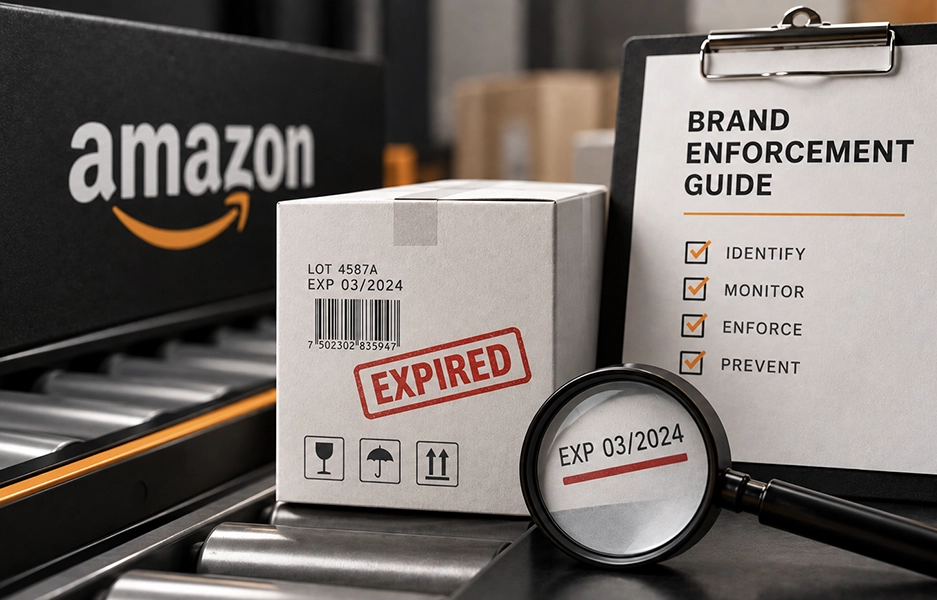
Why Expired Inventory Creates a Different Enforcement Opportunity
Expiration changes the nature of the issue.
Initially, your concern may simply be:
“We didn’t authorize this seller.”
After a test buy, you may be able to say something much more specific:
“We purchased this product from this seller, and the product we received was expired.”
That’s an important difference.
You now have an actual product in your possession that can be examined, photographed, and documented.
The expiration date can be recorded. Packaging can be inspected. Lot or serial numbers may be captured. The order can be connected to a specific seller and ASIN.
Instead of making assumptions about the seller, you’re documenting what an actual Amazon customer could receive.
That creates a much stronger foundation for marketplace enforcement.
Test Buy First, Then File the Complaint
When you suspect an unauthorized seller is carrying expired inventory, don’t begin with the complaint.
Begin with the test buy.
Purchase the product from the specific seller you are investigating and preserve the information associated with the transaction.
Your documentation should include information such as:
- Seller name
- ASIN and product listing
- Amazon order information
- Purchase date
- Delivery date
- Photographs of the received product
- Expiration or best-by date
- Product packaging and labels
- Lot, batch, or serial numbers where available
- Any additional evidence relevant to the product’s condition
Make sure the photographs clearly show the expiration information and identify the product involved.
Then verify what you’ve received.
If the test buy confirms that the seller shipped expired inventory, document the evidence and file the appropriate complaint through Amazon Brand Registry under the Policy Violation section.
This sequence matters because the complaint is based on the condition of the product actually received—not simply on the seller’s unauthorized status.
File the Complaint Under Policy Violations in Brand Registry
Brands should also distinguish an expired-product complaint from intellectual property enforcement.
If your test buy shows that the product is genuine but expired, the issue you’re documenting is the expired product.
The appropriate approach is to file the complaint through Amazon Brand Registry’s Policy Violation section and provide the supporting information associated with the test buy.
The basic workflow is:
Test buy → Confirm expiration → Gather evidence → Brand Registry → Policy Violation → Submit the applicable complaint
Keep the complaint focused on what your evidence actually demonstrates.
If the product is genuine but expired, don’t describe it as counterfeit.
Likewise, don’t turn an expiration issue into a trademark complaint unless you have separate evidence supporting an actual trademark violation.
The guiding principle should always be:
Match the complaint to the evidence.
That creates a more disciplined and defensible approach to Amazon enforcement.
Why the Test Buy Is So Important
Without a test buy, a brand may suspect that a seller has expired inventory but have little evidence of what customers are actually receiving.
A seller may have unusually low prices. The inventory may appear old. The seller may be completely unknown to the brand.
Those details can justify further investigation, but they don’t necessarily establish that the product being shipped is expired.
A test buy provides direct evidence.
It allows your team to connect a particular product to a particular transaction and seller.
Instead of saying, “We think this seller is shipping expired products,” you can document the actual product received, its expiration information, the order, and the seller involved.
For brand protection teams, that’s an important distinction:
Verify first. Report second.
The Product Can Also Tell You Where the Inventory Came From
The test buy has another purpose beyond supporting the Amazon complaint.
It can become an investigative tool.
Examine the received product for identifiers such as:
- Lot numbers
- Batch numbers
- Serial numbers
- Manufacturing information
- Packaging variations
- Distribution markings
Then compare those identifiers with your internal supply-chain records where possible.
You may be able to determine which distributor, retailer, shipment, territory, or account originally received the inventory.
For example, the lot information may connect the product to inventory sold to a particular distributor months or years earlier.
Now the investigation has moved beyond:
“Who is this Amazon seller?”
The more valuable question becomes:
“How did this seller get our inventory?”
That is where unauthorized seller enforcement begins to become supply-chain control.
Don’t Misuse Counterfeit or Trademark Complaints
When brands are frustrated by unauthorized sellers, it can be tempting to look for the fastest possible method of getting the seller removed.
That can create unnecessary risk.
If the product is genuine but expired, don’t call it counterfeit.
If the evidence doesn’t demonstrate trademark infringement, don’t characterize the situation as a trademark violation simply because the seller isn’t authorized.
Instead, report the issue your investigation actually uncovered.
For an expired product confirmed through a test buy, that means documenting the expiration issue and filing the appropriate complaint through the Policy Violation section of Amazon Brand Registry.
Intellectual property complaints should be reserved for situations where the evidence supports the applicable intellectual property claim.
Brands should work with qualified legal counsel when dealing with questions involving their legal rights or potential legal claims. Brand Alignment provides strategic marketplace and brand-protection guidance, not legal representation.
Expired Products Can Reveal a Bigger Distribution Problem
Getting Amazon to act on a documented expired-product complaint can address the immediate marketplace problem.
But there’s another question brands shouldn’t overlook:
Why does an unauthorized seller have expired inventory in the first place?
Old inventory can sometimes point toward a larger distribution issue.
Possible sources may include liquidation, excess distributor inventory, poor inventory rotation, unauthorized resale, grey-market distribution, or products moving outside their intended territory or sales channel.
And if one seller has access to that inventory, other sellers may have access to it as well.
That’s why simply removing individual sellers can become a game of whack-a-mole.
One account disappears.
Another account appears.
The seller name changes, but the inventory source remains.
A stronger long-term strategy combines marketplace enforcement with investigation into the supply chain.
A Better Expired-Inventory Enforcement Process
Brands dealing with suspected expired inventory can use a simple framework:
Detect → Test Buy → Confirm → Document → File → Trace → Prevent
| Step | Process |
|---|---|
| Detect | Identify the unauthorized or suspicious seller carrying your product. |
| Test Buy | Purchase the product from that specific seller. |
| Confirm | Inspect the received product and verify whether it is actually expired. |
| Document | Preserve the product, photographs, expiration date, order information, seller details, packaging, and relevant identifiers. |
| File | If the product is confirmed expired, submit the appropriate complaint through Amazon Brand Registry’s Policy Violation section with the available supporting evidence. |
| Trace | Use lot numbers, serial numbers, packaging, and internal records to investigate where the inventory may have originated. |
| Prevent | Address the underlying distribution or supply-chain issue where possible so additional sellers don’t obtain the same inventory. |
This approach does more than pursue a seller account.
It helps the brand understand the marketplace problem and potentially prevent it from happening again.
Use Evidence to Drive Amazon Enforcement
Unauthorized sellers are rarely a one-dimensional problem.
A seller may be unauthorized while still carrying genuine merchandise. That alone shouldn’t be confused with counterfeiting or another policy violation.
But when a test buy confirms that the seller shipped expired inventory, the brand has something much more useful: evidence of a specific product issue.
Document it carefully.
Then file the appropriate complaint through Amazon Brand Registry under the Policy Violation section.
Afterward, don’t throw away the test-buy product and consider the investigation finished.
Look at the expiration date. Examine the lot or serial number. Review the packaging. Compare the product with your distribution records.
The evidence that supports today’s Amazon complaint may also help reveal the supply-chain leak creating tomorrow’s unauthorized seller problem.
Finding unauthorized sellers carrying expired or questionable inventory?
Our team can help investigate sellers, conduct test buys, document marketplace issues, and trace potential supply-chain leakage. Contact us.
Take control of your marketplace presence with fast, effective brand protection strategies.
Every day, unauthorized sellers and MAP violations can erode your pricing, reputation, and revenue. Don’t wait for problems to escalate, start enforcing your policies and reclaim your market authority with our proven tools and expert support.


 Brand Alignment