

Unauthorized sellers are one of the most significant threats to Buy Box stability — learn how they disrupt pricing, trigger algorithmic suppression, and what brands can do to take back control.
Table of Contents
- What is the Buy Box and why does it matter?
- Who are unauthorized sellers?
- How unauthorized sellers affect the Buy Box
- Pricing disruption and Buy Box suppression
- Algorithmic impact on Buy Box eligibility
- Real-world marketplace example
- Strategic impact for brands
- How brands mitigate Buy Box disruption
- Key Takeaways
- FAQ
- Conclusion
Unauthorized sellers directly reduce Buy Box ownership by disrupting pricing stability, damaging seller eligibility signals, and triggering algorithmic suppression. On marketplaces like Amazon, where the Buy Box drives the majority of conversions, unauthorized sellers create competitive pressure that forces price erosion, inconsistent seller rotation, and frequent Buy Box loss. In simple terms: unauthorized sellers destabilize the conditions Amazon requires to assign the Buy Box.
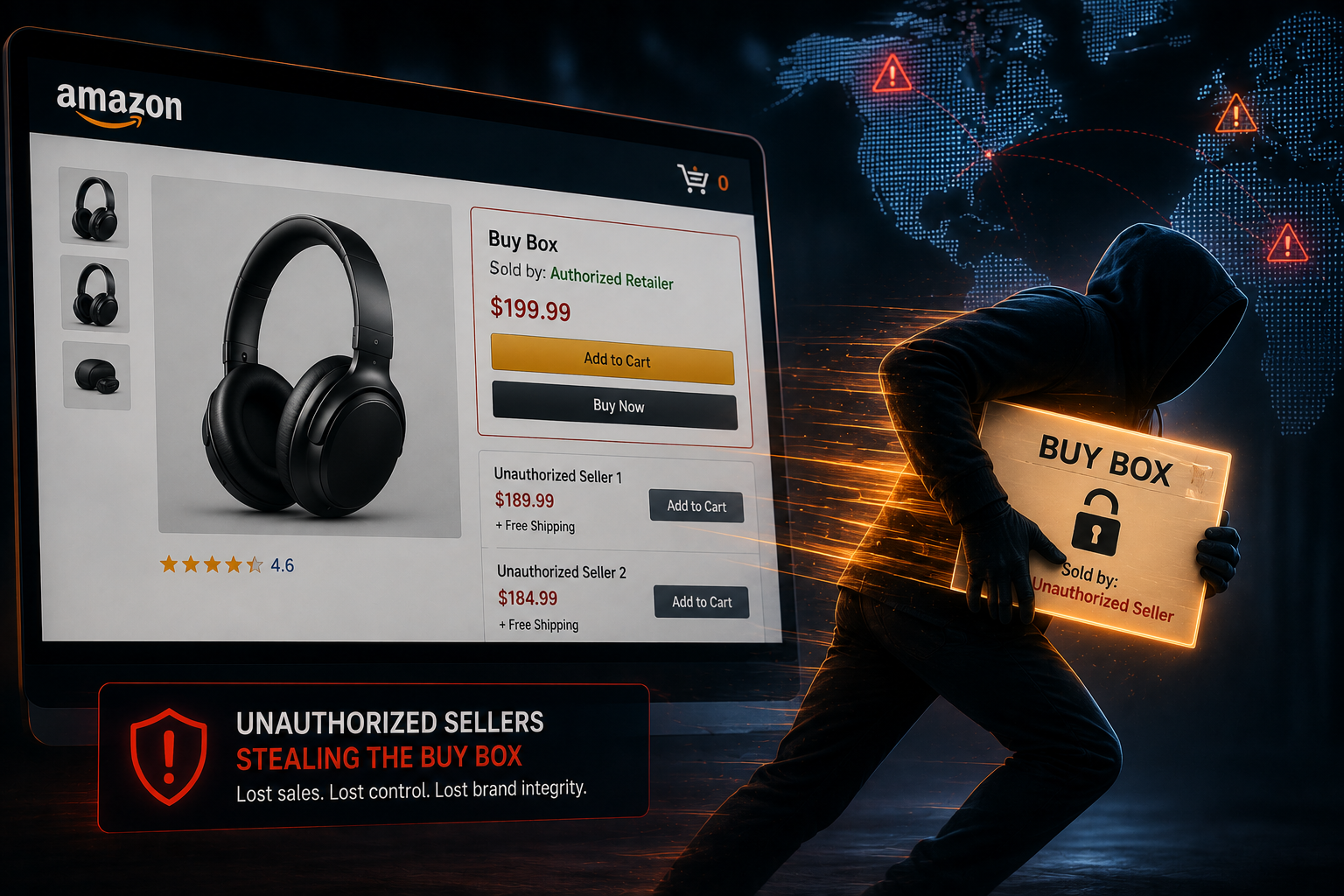
What is the Buy Box and why does it matter?
The Buy Box is the primary purchase button on product pages in marketplaces like Amazon. It determines which seller gets the sale when multiple sellers offer the same product. Understanding how the Amazon Buy Box works is essential context for any brand managing third-party seller activity on their listings.
Key fact: Over 80–90% of Amazon sales go through the Buy Box, making it the most valuable conversion position in ecommerce.
Key characteristics
- Only one seller typically “wins” at a time
- Rotation depends on pricing, fulfillment, and seller metrics
- Not all sellers are eligible simultaneously
- Highly sensitive to pricing changes and seller behavior
Who are unauthorized sellers?
Unauthorized sellers are third-party merchants who sell branded products without approval from the brand’s official distribution network. They source inventory through non-approved channels such as grey markets, liquidation, arbitrage, or parallel imports.
Common types
- Grey market resellers
- Liquidation buyers
- Arbitrage sellers
- Parallel importers
- Marketplace opportunists
For a full breakdown of who they are and how they operate, see 9 types of unauthorized sellers on Amazon. These sellers often operate outside MAP (Minimum Advertised Price) agreements and distribution controls — which is what makes them so damaging to Buy Box stability.
If you’re wondering why random sellers keep appearing on your Amazon listing, unauthorized distribution is almost always the root cause.
How unauthorized sellers affect the Buy Box
Unauthorized sellers negatively impact the Buy Box by introducing lower prices, unstable supply signals, and competing offers that disrupt Amazon’s algorithmic selection process.
1. Price undercutting triggers Buy Box redistribution
When unauthorized sellers list below MAP or standard pricing, Amazon prioritizes lower-priced offers. The Buy Box rotates away from authorized sellers, and price becomes the dominant ranking factor. Grey market sellers using automated repricing tools can accelerate this process in minutes, dragging the entire listing’s pricing floor down before the brand even detects the violation.
2. Increased Buy Box competition reduces win rate
More sellers on the listing means more competition. The effects include fragmented Buy Box ownership, frequent rotation between sellers, and reduced consistent visibility for brand-authorized partners. Even authorized sellers get caught in the rotation when unauthorized sellers are present.
3. MAP violations distort Buy Box eligibility
When unauthorized sellers violate MAP, price benchmarks collapse. Authorized sellers appear “overpriced” relative to the new floor, and Buy Box eligibility thresholds shift artificially against them. This is directly tied to Amazon MAP enforcement failures — without active enforcement, the price floor has no structural support.
4. Seller metric dilution
Unauthorized sellers often have lower performance standards, higher defect or return rates, and limited fulfillment capabilities. Even when not winning the Buy Box, their presence impacts listing health signals, reduces trust in offer stability, and weakens the overall buyability score that Amazon uses to evaluate listing quality.
Pricing disruption and Buy Box suppression
Pricing instability caused by unauthorized sellers is one of the leading reasons for Buy Box suppression in competitive marketplaces. The suppression chain typically unfolds as follows:
- Unauthorized seller enters listing below MAP
- Price floor drops across the entire listing
- Amazon detects pricing inconsistency relative to other channels
- Buy Box is suppressed or rotated aggressively between sellers
- Conversion rate declines across all sellers, including authorized ones
When the Buy Box is suppressed, the “Add to Cart” button disappears and only “See All Buying Options” remains — a significant conversion killer. See why Amazon suppresses the Buy Box for the full picture of what triggers and how to recover from it.
Simple comparison
| Scenario | Buy Box Outcome |
|---|---|
| Controlled authorized channel | Stable Buy Box ownership |
| Unauthorized sellers present | Frequent rotation / suppression |
| MAP violations active | Buy Box instability |
| Grey market competition | Lowest-price dominance |
Algorithmic impact on Buy Box eligibility
Amazon’s Buy Box algorithm evaluates dozens of signals continuously — price, fulfillment method, shipping speed, seller rating, and inventory reliability. Unauthorized sellers degrade several of these signals simultaneously:
- Price signal: Unauthorized sellers create a false price floor that makes the algorithm treat authorized pricing as uncompetitive
- Offer consistency: Erratic pricing from unauthorized sellers makes the listing appear unstable, reducing algorithmic confidence
- External price parity: Amazon monitors prices across the web. When unauthorized sellers create off-Amazon price inconsistencies, it triggers Buy Box suppression on Amazon even if authorized sellers are compliant
- Listing trustworthiness: A listing with many competing sellers — especially low-quality ones — receives lower algorithmic trust scores
Brands recovering from these algorithmic effects typically need both enforcement and a structured Amazon Buy Box recovery program to restore eligibility signals after unauthorized sellers are removed.
Real-world marketplace example
A brand sells a product with a MAP of $120. Authorized sellers maintain a $120–$125 range. An unauthorized seller lists at $105. Other sellers immediately match $105 using repricing tools. Amazon shifts the Buy Box to the lowest-price offer. Brand-authorized sellers lose visibility entirely.
Outcome:
- Margin erosion of 10–20% across the listing
- Buy Box ownership drops from 85% to 40% within hours
- Increased customer confusion about the “real” price
- Authorized distributors begin questioning the value of the relationship
This scenario repeats across thousands of branded listings daily on Amazon. The difference between brands that recover and those that don’t is usually how quickly they detect and act on the unauthorized seller’s presence. For brands experiencing this, winning back the Buy Box requires addressing both the pricing and the seller simultaneously.
Strategic impact for brands
Unauthorized sellers impact not only Buy Box performance but also long-term brand equity, pricing power, and channel trust.
Key business consequences
- Loss of pricing control across channels
- Reduced profitability per unit sold
- Channel conflict with authorized distributors who invested in the brand
- Increased customer perception of discounting, weakening premium positioning
- Higher return rates due to inconsistent product sourcing by unauthorized sellers
Strategic insight: Buy Box loss is often a symptom of deeper supply chain leakage, not just pricing competition. Grey market supply chain investigation identifies where unauthorized inventory is entering the market — which is the only way to eliminate the problem at its source rather than chasing it downstream.
How brands mitigate Buy Box disruption
1. MAP enforcement programs
Deploy MAP enforcement software to monitor pricing across marketplaces, catch violations in real time, and enforce consistently before price floors collapse. The key is speed — catching a violation within hours prevents the cascade; catching it after a week means the damage is already done.
2. Unauthorized seller removal
Identify grey market sources, trace distribution leaks, and remove repeat violators. Removing unauthorized sellers on Amazon requires a documented process — not a one-time report — to prevent the same sellers from returning under different accounts.
3. Supply chain tightening
Restrict distribution partners, control regional pricing agreements, and reduce arbitrage opportunities in the supply chain. Most unauthorized Amazon inventory originates from distribution leaks, not counterfeiting — closing those leaks is the most durable fix.
4. Buy Box recovery strategies
Once unauthorized sellers are removed, brands need to actively realign pricing across channels, stabilize the authorized seller network, and improve fulfillment performance to rebuild the algorithmic signals Amazon uses for Buy Box assignment.
Key Takeaways
- Unauthorized sellers are a major driver of Buy Box instability on Amazon and other marketplaces.
- They reduce pricing control and trigger algorithmic repricing behavior that damages all sellers on the listing.
- MAP violations caused by unauthorized sellers accelerate Buy Box loss and can trigger full suppression.
- Even indirect presence — sellers not currently winning the Buy Box — affects listing health and visibility signals.
- Buy Box control depends on supply chain discipline and enforcement infrastructure, not just pricing adjustments.
- Brands must combine enforcement, monitoring, and distribution control to stabilize Buy Box performance durably.
FAQ
How do unauthorized sellers affect the Amazon Buy Box?
They introduce lower prices and inconsistent offers, reducing Buy Box stability and ownership for authorized sellers. Their presence also degrades the algorithmic signals Amazon uses to evaluate listing trustworthiness.
Why do unauthorized sellers sometimes win the Buy Box?
Because they often undercut pricing and temporarily meet Amazon’s lowest-price algorithmic conditions. Amazon’s algorithm prioritizes offer quality signals including price — unauthorized sellers who undercut MAP are artificially competitive.
Can unauthorized sellers cause Buy Box suppression?
Yes. Excessive price variation across sellers — especially when it creates inconsistencies between Amazon and off-Amazon pricing — can lead Amazon to suppress the Buy Box entirely, removing the “Add to Cart” button from the listing.
What is the biggest risk of unauthorized sellers?
Long-term erosion of pricing power and brand equity due to uncontrolled discounting. Short-term Buy Box loss is visible immediately; the brand perception damage from prolonged price inconsistency compounds over time.
How do brands stop Buy Box loss from unauthorized sellers?
Through MAP enforcement, supply chain control, and systematic removal of unauthorized sellers. These three elements work together — enforcement without supply chain control means the same sellers return; supply chain control without enforcement means violations go unchecked in real time.
Conclusion
Unauthorized sellers are one of the most significant threats to Buy Box stability in modern ecommerce. They disrupt pricing structures, trigger algorithmic repricing, and weaken the conditions required for consistent Buy Box ownership.
For brand owners and ecommerce leaders, the key insight is clear: Buy Box performance is not just a marketplace issue — it is a supply chain and distribution control issue. Brands that actively monitor pricing, enforce MAP policies, and eliminate unauthorized distribution channels consistently achieve higher Buy Box share, stronger margins, and more stable marketplace performance over time.
Thank you for reading our post, ‘How Do Unauthorized Sellers Affect the Buy Box?’ At Brand Alignment, we help brands detect unauthorized sellers, enforce MAP pricing in real time, and recover Buy Box ownership through a combination of monitoring, enforcement, and supply chain investigation. If unauthorized sellers are costing you visibility and margin on Amazon, we’d love to show you how we can help.
Take control of your marketplace presence with fast, effective brand protection strategies.
Every day, unauthorized sellers and MAP violations can erode your pricing, reputation, and revenue. Don’t wait for problems to escalate, start enforcing your policies and reclaim your market authority with our proven tools and expert support.


 Luis Amor