

For years, Amazon has dominated the marketplace conversation. But Walmart Marketplace has steadily grown into a serious eCommerce contender — attracting established brands, mid-sized sellers, and manufacturers looking to diversify beyond Amazon.
With lower competition in many categories and access to Walmart’s massive retail footprint, the opportunity is real.
But like any marketplace, Walmart comes with trade-offs.
If you’re evaluating whether to expand to Walmart Marketplace — or reassessing your performance there — here’s a clear breakdown of the pros and cons.
What Is Walmart Marketplace?
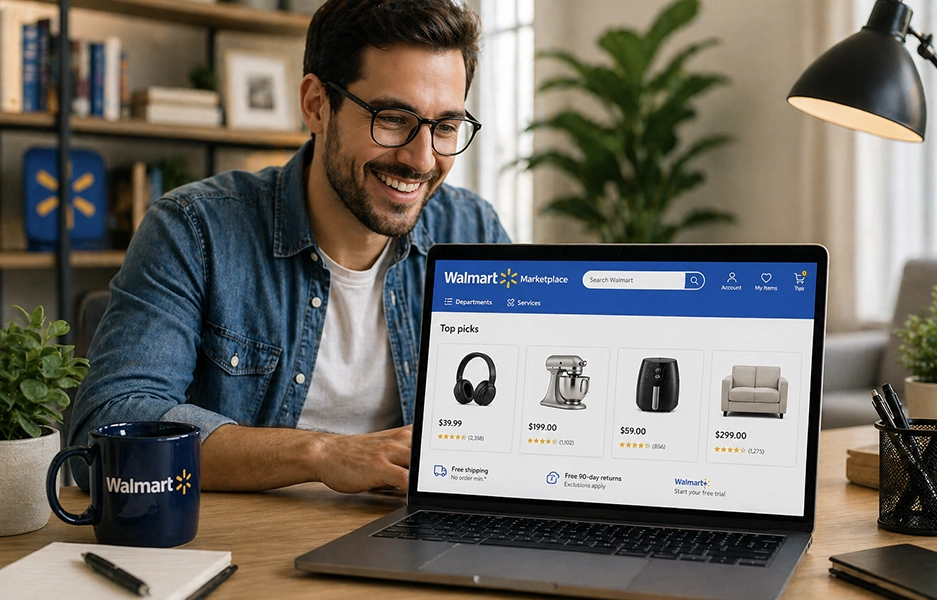
Walmart Marketplace is a third-party selling platform that allows approved sellers to list products alongside Walmart’s own retail inventory.
Unlike Amazon, Walmart’s marketplace is:
- Curated (application-based approval)
- More controlled in seller onboarding
- Still growing in overall seller saturation
Walmart also integrates marketplace listings with its broader retail ecosystem — including Walmart.com and in-store pickup options. You can explore the platform directly through the Walmart Marketplace.
The Pros of Selling on Walmart Marketplace
1. Less Saturation Than Amazon
One of Walmart’s biggest advantages is lower competition.
While Amazon has millions of sellers, Walmart’s marketplace is:
- More selective
- Less crowded in many categories
- Less saturated with unauthorized sellers (in some segments)
This can mean:
- Higher visibility
- Easier ranking
- Less Buy Box volatility
For brands overwhelmed by Amazon competition, Walmart can feel like a cleaner playing field compared to selling on Amazon.
2. Strong Brand Recognition & Consumer Trust
Walmart is one of the most recognized retail brands in the world.
Selling on Walmart gives you:
- Built-in consumer trust
- Association with a major national retailer
- Increased credibility for emerging brands
For some customers, Walmart carries stronger trust signals than newer marketplaces.
3. Lower Referral Fees (In Many Categories)
Compared to Amazon, Walmart’s referral fees are often similar or slightly lower depending on category.
Additionally:
- There is no monthly seller fee (in most cases)
- You’re not required to use Walmart Fulfillment Services (WFS)
This can improve margin structure — particularly for brands already handling their own fulfillment.
4. Growing Omnichannel Integration
Walmart connects online listings with:
- In-store pickup
- Local delivery
- Walmart Fulfillment Services (WFS)
- Walmart+ membership benefits
As Walmart continues investing in omnichannel infrastructure, sellers benefit from expanded reach without building separate systems.
5. Opportunity for Early-Mover Advantage
Walmart Marketplace is still growing.
Brands entering now may benefit from:
- Lower competition
- Easier keyword ranking
- Faster category authority
- Stronger long-term positioning
On Amazon, many categories are mature and saturated. Walmart still offers room for expansion.
The Cons of Selling on Walmart Marketplace
While opportunity exists, Walmart presents unique challenges.
1. Strict Pricing Parity Enforcement
Walmart is highly sensitive to pricing consistency.
If your product is listed at a lower price on:
- Amazon
- Your own DTC website
- Another retailer
Walmart may:
- Suppress your listing
- Remove the Buy Box (Featured Offer)
- Depublish the product
Walmart aggressively enforces price competitiveness. This is why many brands rely on Walmart MAP monitoring and Walmart MAP enforcement.
2. External Price Suppression Risk
Like Amazon, Walmart monitors external pricing.
If it detects a lower price elsewhere, it may:
- Hide your offer
- Remove Buy Box visibility
- Prioritize a lower-priced seller
If unauthorized sellers are undercutting you on other marketplaces, Walmart may penalize your listing — even if you’re compliant on Walmart itself.
Cross-channel pricing consistency becomes critical. See why monitoring and enforcing Walmart MAP pricing matters.
3. Less Mature Seller Tools
Compared to Amazon, Walmart’s seller ecosystem is still developing.
Limitations include:
- Fewer advertising tools
- Less advanced reporting analytics
- More limited third-party integrations
- Slower support response times
Brands accustomed to Amazon’s robust infrastructure may find Walmart less refined operationally.
4. Unauthorized Sellers Still Exist
Although Walmart has stricter onboarding, unauthorized sellers can still appear.
Common sources include:
- Distributor diversion
- Grey market sellers
- Liquidation inventory
- Parallel importers
If your distribution network isn’t tightly controlled, unauthorized sellers may list your product — undercutting price and competing for the Featured Offer.
Monitoring is still required. Many brands address this through removing unauthorized sellers on Walmart and structured enforcement.
5. Slower Organic Traffic Compared to Amazon
While Walmart has strong retail presence, its online traffic still trails Amazon in most categories.
This means:
- Lower total search volume
- Slower sales velocity
- Longer ramp-up time
For brands seeking rapid online scale, Walmart may feel slower — at least initially.
6. Operational Demands Remain
If you do not use Walmart Fulfillment Services (WFS), you are responsible for:
- Shipping times
- On-time delivery metrics
- Return management
- Customer service
Walmart maintains strict performance standards.
Failure to meet metrics can result in:
- Listing suppression
- Account warnings
- Reduced visibility
Buy Box (Featured Offer) Considerations
On Walmart, the Buy Box is called the “Featured Offer.”
Winning the Featured Offer depends on:
- Price competitiveness
- Shipping speed
- Seller performance metrics
- Inventory availability
Just like Amazon, the majority of sales go to the Featured Offer owner.
If pricing instability exists across channels, Featured Offer control becomes unpredictable.
Brands must understand that:
Walmart does not guarantee Featured Offer ownership — even if you are the brand owner.
When Selling on Walmart Makes Sense
Walmart Marketplace works well for brands that:
- Want channel diversification beyond Amazon
- Maintain strong cross-channel pricing discipline
- Have controlled distribution networks
- Want early positioning in a growing marketplace
- Can meet performance and shipping standards
It is particularly valuable as a secondary marketplace to reduce reliance on Amazon, especially when combined with strategies to protect brand equity on Amazon.
When Walmart Can Become Risky
Walmart becomes challenging when:
- Unauthorized sellers are active on other platforms
- Pricing is inconsistent across retailers
- Distribution leaks are unresolved
- Inventory forecasting is weak
- Operational performance metrics are not maintained
Because Walmart enforces pricing parity aggressively, instability elsewhere can directly impact Walmart visibility. This is why many brands invest in automated MAP monitoring for Walmart and Walmart product monitoring strategies.
Final Verdict
Selling on Walmart Marketplace offers real opportunity — especially for brands seeking diversification and long-term growth outside Amazon’s ecosystem.
Pros:
- Lower competition
- Strong retail credibility
- Growing omnichannel reach
- Early positioning advantages
Cons:
- Strict pricing enforcement
- Cross-channel price sensitivity
- Operational performance requirements
- Ongoing monitoring needs
The real question isn’t whether Walmart is worth it.
It’s whether your pricing and distribution infrastructure are strong enough to support it.
Because on Walmart, just like Amazon, visibility follows control.
Brands that monitor pricing, manage distribution carefully, and maintain cross-channel discipline are the ones who win Featured Offer stability — and sustainable growth.
Take control of your marketplace presence with fast, effective brand protection strategies.
Every day, unauthorized sellers and MAP violations can erode your pricing, reputation, and revenue. Don’t wait for problems to escalate, start enforcing your policies and reclaim your market authority with our proven tools and expert support.


 Brand Alignment